AI-powered weld defect detection is moving beyond controlled pilot programs into scalable, multi-facility deployment across metal fabrication and discrete manufacturing. The shift is driven by measurable quality gains, maturing data infrastructure, and growing governance frameworks that address model versioning, traceability, and cybersecurity requirements.
Background
Bibliometric trends from 2004 to 2025 show rapid growth of AI in weld defect inspection, reflecting sustained research investment and accelerating industrial adoption. The welding industry has historically been slow to adopt new technology, but that has changed over the past two years, with robotics and sensor adoption accelerating sharply in the post-COVID manufacturing environment.
The impetus is well-documented: manual weld inspection by certified inspectors (CWI, CSWIP) catches approximately 70% of defects, according to platform documentation from iFactory. Manual inspection is time-consuming, subjective, and prone to human error - studies show that even skilled inspectors achieve only about 80% accuracy under optimal conditions. Rising demand for high-throughput production has made manual inspection a quality-control bottleneck.
Current AI deployments span resistance spot welding, arc welding, laser beam welding, and thick-section structural weld verification, with automotive and heavy equipment manufacturing leading adoption. Large organizations that can afford the necessary investment are pioneering AI-based defect detection, primarily in high-volume, low-mix sectors such as automotive manufacturing.[1]
Deployment Details and Measurable Outcomes
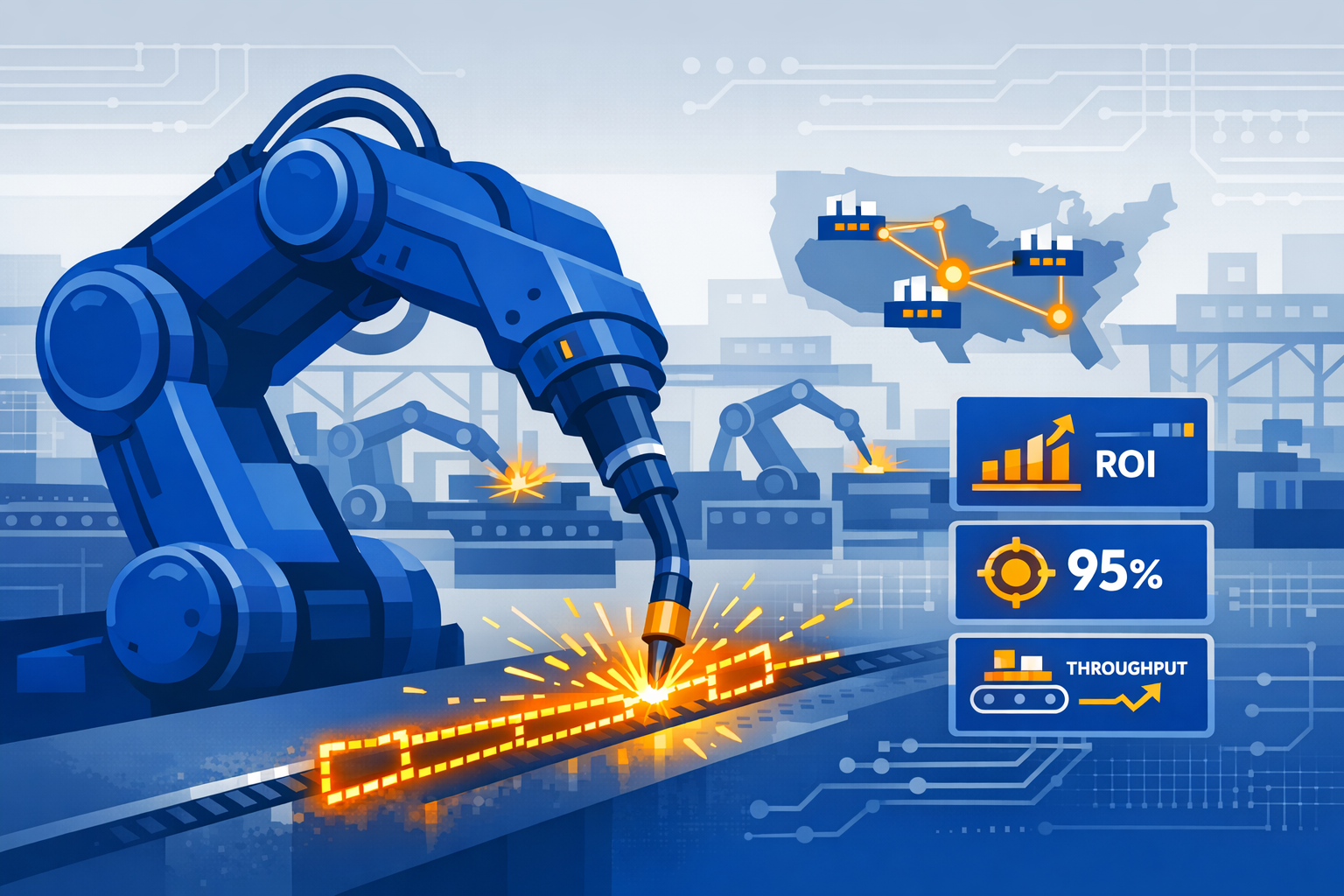
Performance data from deployed systems shows significant quality gains over baseline inspection methods. In automotive body manufacturing, AI vision systems inspecting every spot weld have achieved a 94% reduction in downstream weld failures and a 15% reduction in overall body manufacturing time, with ROI realized in four months. In heavy equipment applications combining AI vision with thermal imaging during multi-pass welding, manufacturers report 60% faster inspection cycles and reduced need for destructive testing.
Mapvision's WSI 2025 automated seam inspection system, using a universal semantic segmentation model, can inspect 150 weld seams in 40 seconds with defect accuracy rates between 97% and 100% for supported defect types. The WSI 2025 was developed to address demand for detailed defect data and meet elevated quality standards set by automotive OEMs.
Convolutional neural networks remain widely used in AI weld inspection, achieving over 95% classification accuracy and mean intersection-over-union of roughly 85-91% in segmentation, though performance is often dataset-dependent.
Scaling beyond single-cell pilots requires resolving data readiness challenges first. Current monitoring methods rely predominantly on the subjective judgment and experiential knowledge of human operators, introducing inconsistencies in quality evaluation and hindering standardized assessment protocols. Many existing techniques use a single data modality - insufficient given the inherent complexity of welding processes. Multimodal frameworks that fuse visual, thermal, and acoustic sensor streams address this gap. Research demonstrates that combining ResNet-based image feature extraction with LSTM temporal pattern analysis from sensor data improves defect prediction accuracy while enabling dynamic parameter adjustment.
On the governance side, many existing machine learning models lack generalizability across new process configurations. While pooling data across manufacturers could help, data-sharing raises critical privacy concerns that have blocked collaborative learning in industry. Federated transfer learning frameworks providing domain generalization in distributed learning while preserving data privacy are emerging as the preferred architecture for multi-site deployments. Models trained across multiple plants without sharing sensitive data improve accuracy globally - a critical requirement for fabricators operating under contractual IP restrictions or cross-border data sovereignty regulations.
Immediate feedback loops that allow manufacturing teams to identify root causes and implement real-time process adjustments rely on edge or on-premises installations that ensure minimal latency while maintaining data security. Integration via standard industrial protocols - including OPC-UA, MQTT, and Modbus - enables connection to existing PLC and MES infrastructure without full cell redesign.
Outlook
Lightweight, real-time models suited for industrial deployment are under active development, though research gaps in dataset comparability and evaluation standards remain a recognized barrier to cross-facility model portability. Workforce requirements are evolving in parallel: quality technicians and process engineers are increasingly expected to interpret AI-generated inspection data, manage model update cycles, and maintain labeled defect datasets that sustain model performance across high-mix, low-volume production schedules. Deep learning integration in welding quality control represents a step toward fully automated manufacturing, with implementation offering economic benefits including reduced inspection costs, minimized rework and scrap rates, and improved production efficiency.