Ninety-one percent of North American fenestration manufacturers now use some form of production-floor automation - up from 84% just three years ago, according to Window + Door's 2025 Top Manufacturers survey[2]. Yet for most, that automation remains siloed: an automated washer here, a servo-driven loader there. End-to-end, fully automated fabrication of individual architectural components has been a different conversation entirely - until now.
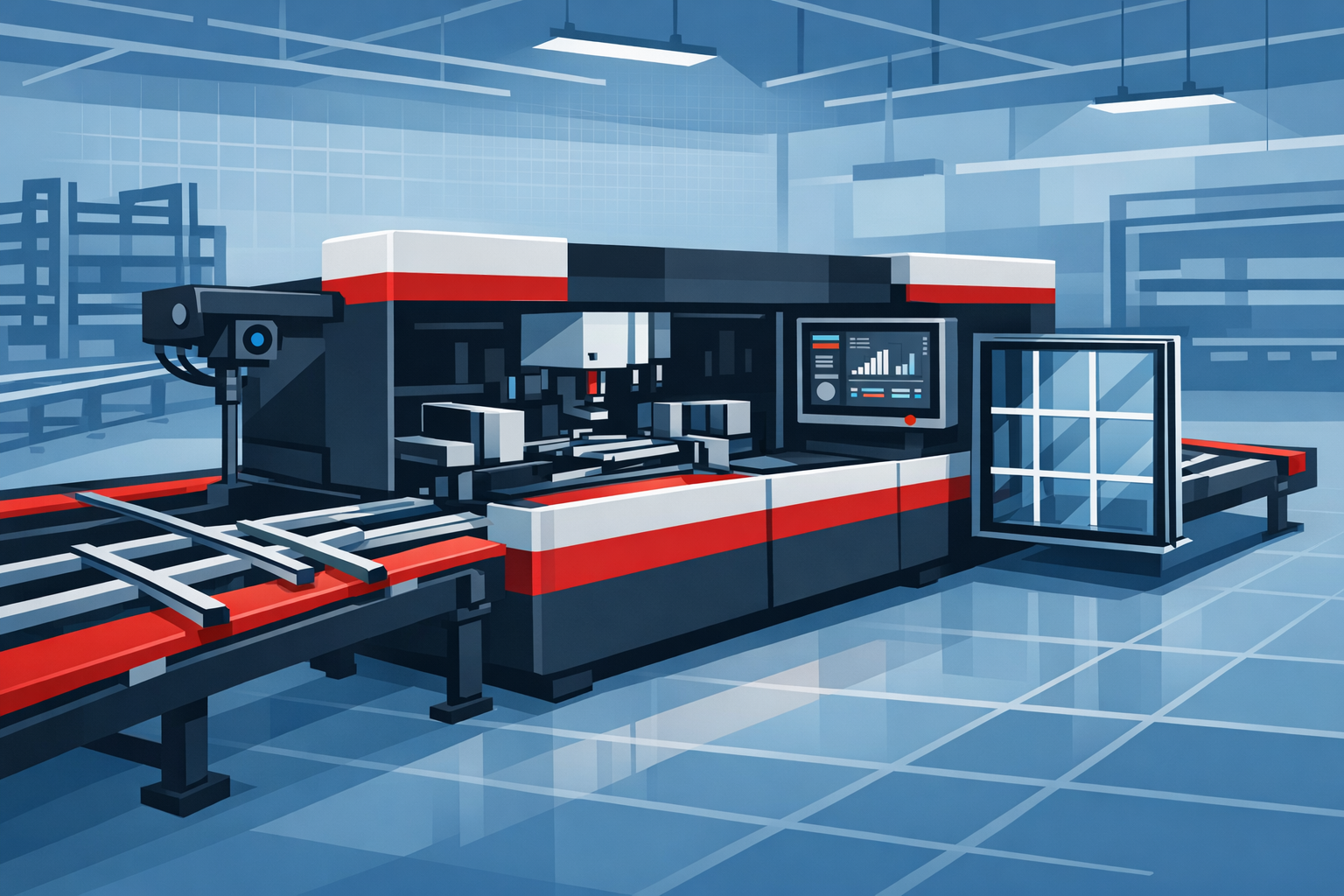
PDS IG's recently launched Muntin Machining Center represents a meaningful escalation in factory automation scope for insulating glass (IG) fabricators. The system processes both contour and flat bars, including two-tone materials, while eliminating the financial burden of traditional punches and dies.[1] More significant than any single feature, however, is what the deployment reveals about the trajectory of niche, high-precision fabrication automation: purpose-built systems are maturing from pilot-scale experiments into scalable production standards.
What the PDS IG System Actually Does
Muntin bars - the internal grids that divide insulating glass units into individual lites - appear deceptively simple. In practice, they pose a precision fabrication challenge: tight dimensional tolerances, frequent profile changes, two-tone finish requirements, and the need for exact coordination with glass cut sizes and spacer dimensions.
PDS IG's Muntin Machining Center is a three-axis CNC that cuts and punches muntin bars without requiring expensive die changes - dies that wear out on conventional machines. That die elimination alone addresses one of muntin production's most persistent friction points: the cost and downtime of tooling changeover when operators switch between bar profiles or finishes.
The system's production architecture integrates several interdependent layers:
- Vision-guided stock handling: Raw bar stock is sorted by profile and finish automatically, with orientation confirmed before machining begins. This handles two-tone material without operator intervention - a capability that previously required manual re-orientation.
- 3-axis CNC precision cutting: Bars are cut and punched to tight dimensional tolerances, eliminating the variance introduced by worn dies on conventional punch-based systems.
- Inline quality telemetry: Real-time measurement during production enables closed-loop feedback, catching dimensional drift before it propagates into scrap.
- MES data integration: Production data streams continuously to a Manufacturing Execution System, providing per-part traceability and feeding downstream assembly operations with accurate job data.
- Software-defined changeover: Profile switching is handled through software rather than physical tooling, dramatically compressing changeover time between runs.
The reported outcome: cycle-time reductions of up to 40% on typical muntin runs, alongside a marked decrease in scrap driven by the combination of vision alignment and real-time measurement feedback.
Why Niche Segments Are First Movers for End-to-End Automation
The conventional assumption in manufacturing automation is that high-volume, low-mix production justifies the capital. The muntin case challenges that framing.
Niche fabrication segments - where the process is well-defined, repeatable, and geometrically constrained - present an ideal automation target even at lower volumes. The muntin bar is a finite family of profiles. The cuts, punches, and orientations follow deterministic rules. There is no ambiguity for a vision system to resolve; every variation is catalogued and programmable.
This aligns with broader industry dynamics. MES has shifted from a niche, compliance-driven tool to a core operational priority across manufacturing sectors, with rising cost pressures, supply chain volatility, and regulatory demands driving adoption as manufacturers seek real-time visibility to reduce downtime, improve quality, and optimize throughput.
The global MES market was valued at USD 16.57 billion in 2025 and is projected to grow to USD 18.61 billion in 2026, reaching USD 56.65 billion by 2034 at a CAGR of 14.9%. according to Fortune Business Insights[3]. Case studies frequently show MES can reduce production cycle times by 10-30%, lower work-in-progress inventory by 15-25%, and improve overall equipment effectiveness (OEE) by several percentage points. In tightly defined niche processes like muntin fabrication, those ranges tend to compress toward the upper bound - because variability is lower and every parameter is measurable.
Traditional vs. Automated Muntin Fabrication: A Direct Comparison
| Capability | Traditional Fabrication | PDS IG Automated System |
|---|---|---|
| Tooling | Punch-and-die sets (wear-prone, costly to swap) | Die-free 3-axis CNC / laser trimming |
| Profile Changeover | Manual re-tooling - extended downtime | Software-defined - minimal changeover |
| Quality Inspection | End-of-line manual sampling | Inline closed-loop telemetry |
| Two-Tone Handling | Manual operator orientation | Vision-guided automatic orientation |
| Production Data | Batch-level paper records | Real-time MES traceability per part |
| Cycle Time Impact | Baseline | Up to 40% reduction reported |
| Workforce Role | Punch operator / machine tender | Systems technician / data analyst |
Supply-Chain Resilience: Automation as a Stabilizer
The architectural hardware supply chain operates under persistent pressure. Disruptions - port closures, raw material delivery delays, and logistical bottlenecks - cascade through fenestration businesses, leading to missed deadlines, project delays, and potential financial penalties.
For downstream glazing facilities and assembly plants, receiving muntin bars that are out-of-spec - even marginally - creates rework, fit issues, and scheduling delays. An automated line with inline telemetry and MES traceability standardizes output in a way manual fabrication cannot replicate consistently.
The PDS IG deployment demonstrates a tangible supply-chain benefit: when every bar is dimensionally verified before leaving the line and every production event is logged to an MES, the supplier-to-assembler data handoff becomes reliable. Downstream partners can receive part-level quality records rather than batch certificates, supporting the granular traceability that commercial glazing projects and architectural specifications increasingly demand.
Industry observers note a valid caution: niche automation delivers supply-chain benefits only when upstream material handling and downstream assembly are aligned. A high-throughput muntin line fed by inconsistent raw stock, or discharging into a manual assembly area with lower capacity, creates new bottlenecks rather than eliminating them. Integration planning across the full value stream is not optional.
The Workforce Transition Dimension
PDS IG's emphasis on workforce retraining reflects an emerging industry norm. The automation does not eliminate roles - it redefines them. Operators who previously monitored punch cycles now need skills in:
- CNC and vision system programming - configuring job recipes for new profiles
- MES monitoring and data interpretation - reading production telemetry and flagging anomalies
- Preventive maintenance - managing servo drives, vision cameras, and laser optics on a scheduled basis
- Systems integration - coordinating the automated line with upstream glass cutting and downstream spacer application
Deloitte's 2025 research shows that 92% of manufacturers now consider smart manufacturing the primary driver for competitiveness over the next three years, with 78% allocating more than 20% of their overall improvement budget toward smart manufacturing initiatives. The workforce dimension is where many of those initiatives stall. Companies that invest in tooling without investing equally in technician development find automated lines underperform because the human layer managing them cannot extract full value.
The fenestration sector faces this acutely. Supply chain problems may be easing and lead times normalizing, but skilled labor shortages remain an ongoing challenge for building professionals. Automated lines that require fewer workers but higher-skilled technicians do not solve a labor shortage by themselves - they shift its character. Upskilling pipelines must be built in parallel with capital deployment.
The Broader Implication for Fabrication Manufacturers
The PDS IG muntin system is a case study in a broader pattern: automation pilots in specialized fabrication are maturing into scalable production systems. The conditions that made this deployment viable - a well-characterized process, a finite set of variables, strong demand for consistency, and clear supply-chain traceability requirements - exist in numerous other niche fabrication segments.
For plant managers and process engineers evaluating automation capital expenditures, the muntin deployment provides a focused ROI framework:
- Identify processes with deterministic variation - where every parameter can be measured and every deviation has a known cause
- Align robotic handling with precision measurement - vision and telemetry are not optional layers; they make throughput gains sustainable
- Integrate MES from the start - part-level traceability is increasingly a commercial requirement, not a back-office convenience
- Design changeover into the architecture - software-defined profile switching makes niche automation economically viable across a range of SKUs
- Build the workforce transition in parallel - the limiting factor in high-precision automated lines is often technician readiness, not machine capability
Previous coverage on this site examined how vision-guided robotics drive ROI in high-mix metal fabrication. The PDS IG case extends that analysis into a different register: not high-mix generalist cells, but deep, process-specific automation in a defined architectural hardware segment. Both approaches converge on the same conclusion - data-driven, measurement-integrated automation is becoming the production baseline, not a differentiator.
The industry is responding to recent challenges with innovation and investment, advancing new products and capabilities. For IG fabricators, fully automated muntin production is no longer a future scenario. It is a commercially available system on the floor today.