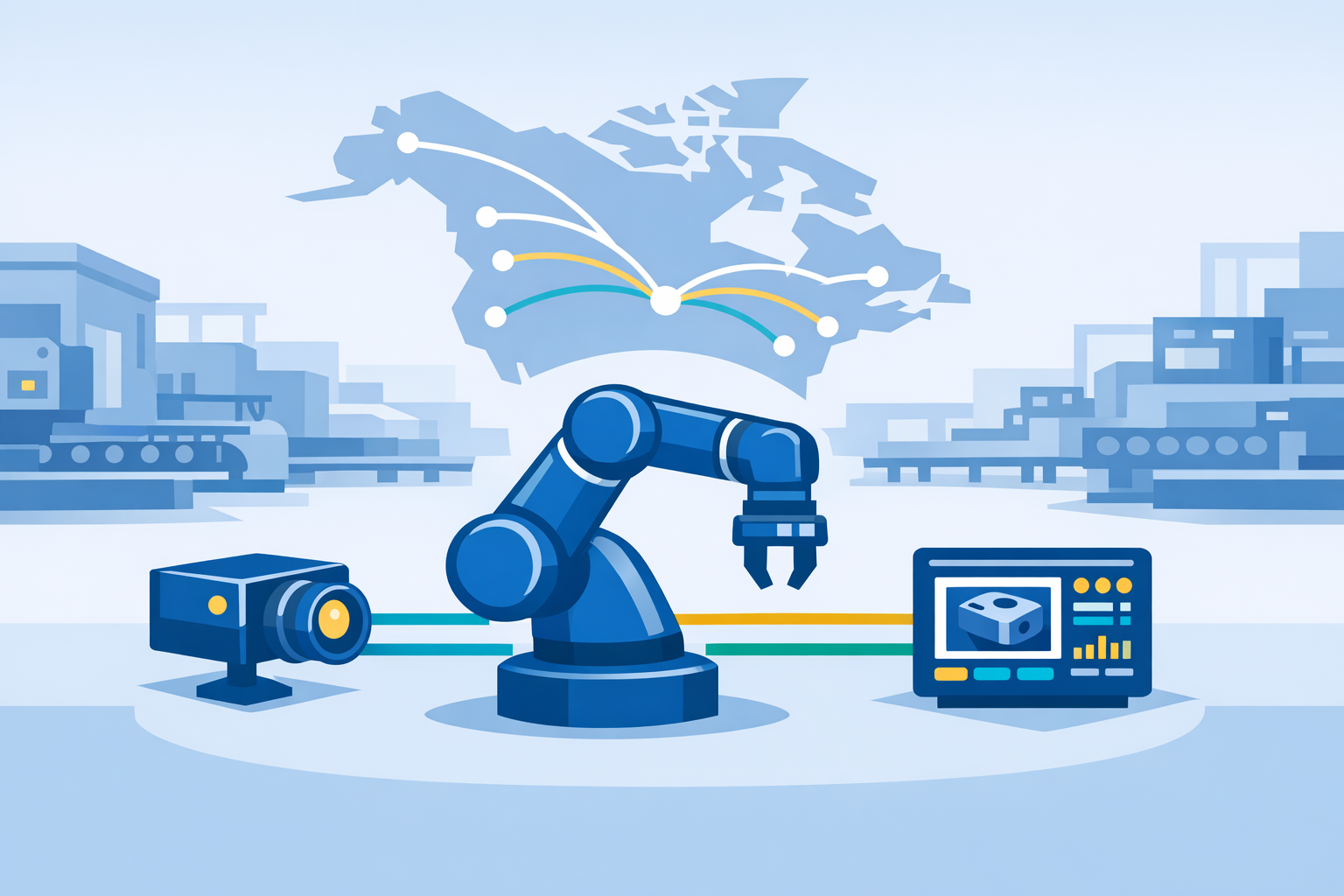
More than 60% of mid-to-large manufacturers in North America were running at least one AI-driven system on the production floor by mid-2025 - up from roughly 35% at the start of 2024. Yet for high-mix metal fabricators, the leap from a successful proof-of-concept to continuous, multi-line production has historically stalled at the same bottleneck: incompatible hardware, proprietary data formats, and no agreed-upon rulebook for cross-vendor integration. That bottleneck is dissolving. Industry groups and cross-vendor consortia now deliver standardized vision-automation blueprints that give AI-based inspection and robotic guidance a repeatable path from pilot cell to full-scale shop floor.
Why Interoperability Standards Changed the Calculus
Early machine vision deployments in fabrication shops were largely siloed. A weld inspection camera from one vendor, a laser profiler from another, and a robot controller from a third rarely shared a common data language. Engineers spent months writing custom middleware, only to discover that swapping a single component reset much of that work.
The shift began when hardware interface standards - particularly GigE Vision and USB3 Vision[1], both maintained by the Automated Imaging Association (AIA) - reached broad adoption. GigE Vision allows simple interfacing between compliant devices and a network card using standard Ethernet cable, providing excellent interoperability and vendor independence. Layered on top, the GenICam standard supplies a unified programming interface[2] that lets software written for one compliant camera migrate across vendors without rebuilding the acquisition layer.
The result: code written against GigE Vision and GenICam standard interfaces can migrate across camera vendors, decoupling hardware decisions from software investment - a fundamental prerequisite for high-mix shops that swap tooling and part families frequently.
At the communications layer, OPC UA and MQTT[3] have matured into complementary standards that carry vision data from the shop floor to enterprise systems. OPC UA provides hierarchical, semantically rich data models suited to machine-to-machine communication among PLCs, SCADA, and MES platforms. MQTT, via the Eclipse Foundation's Sparkplug B specification, handles lightweight, high-frequency telemetry between edge nodes and cloud or ERP destinations. OPC UA and MQTT can be implemented together: OPC UA communicates horizontally with PLCs and edge gateways, while MQTT handles the platform and enterprise level.
The Technology Stack Enabling Full-Production Deployment
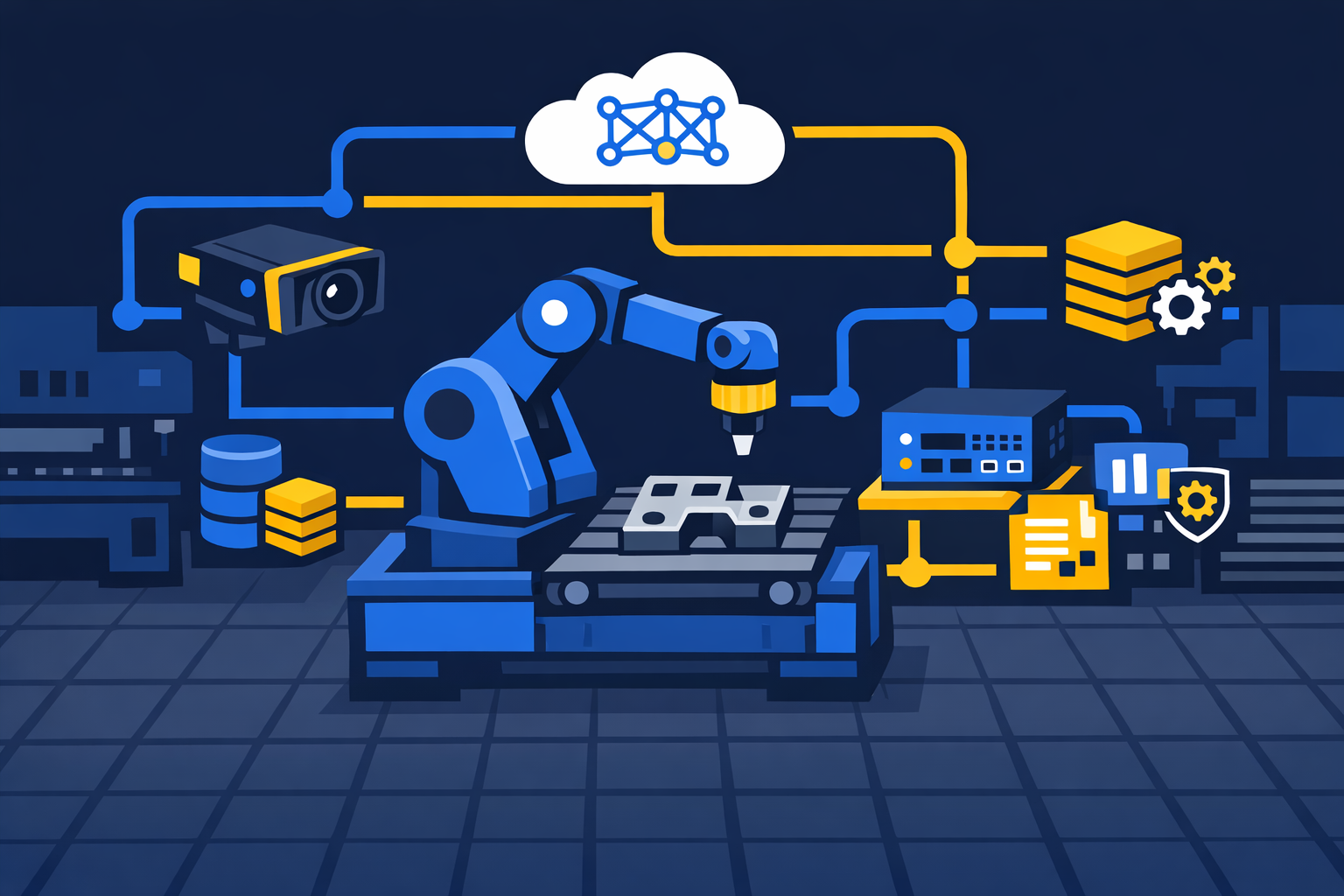
High-mix fabricators adopting standardized vision architectures typically build across five integrated layers:
1. Vision Hardware Multi-modal sensor arrays - 2D area-scan cameras, 3D laser profilers, and thermal imagers - feed the inspection pipeline. Machine vision systems can process hundreds of units per minute, acquiring and analyzing images in less than 20 milliseconds, essential for maintaining throughput on high-speed press brake, laser cutting, and robotic welding cells.
2. Edge Computing Edge AI hardware has matured enough to run inference models directly on production equipment without relying on cloud connectivity. GPU-accelerated edge nodes execute deep-learning classification - detecting cracks, weld porosity, dimensional deviations - in under 200 milliseconds. This local inference architecture eliminates round-trip cloud latency and preserves production cadence during network interruptions. The IEEE P2975.3 recommended practice now provides a software framework specifically for industrial AI at the edge, codifying interface and functional requirements.
3. AI Vision Software Deep learning models - primarily convolutional neural networks - handle defect detection, surface anomaly identification, and dimensional measurement. AI vision systems inspect at line speed without fatigue and generate data trails that satisfy regulatory and quality audit requirements. Unlike rule-based predecessors, these models adapt to product variation without full reprogramming: a new part family requires retraining or fine-tuning an existing model, not rebuilding inspection logic from scratch.
4. Integration and Protocol Layer Standardized protocols carry inspection outputs into broader factory systems. OPC UA's Field Level Communications (FX) initiative[4] extends real-time deterministic communication to field devices, while the forthcoming GigE Vision 3.0 with RoCEv2 integration promises lower CPU overhead and reduced glass-to-glass latency - critical for inspection cells running parallel robotic guidance loops.
5. Traceability and Governance Standardized data schemas tie each inspected part to a timestamped record containing the inspection model version, sensor configuration, raw image, and pass/fail classification. This structure satisfies ISO 9001 audit requirements and, in aerospace supply chains, AS9100 traceability mandates - without requiring manual reconciliation across disparate system logs.
See how these layers interact in the interactive stack explorer below:
[Interactive: AI Vision Inspection Stack Explorer] Click each layer to explore standards, latency benchmarks, and integration touchpoints.
Governance Models for Cross-Vendor Integration
Standardized technology is necessary but not sufficient. Fabricators running multi-vendor cells need an explicit governance framework that assigns ownership of data quality, model version control, and change management across equipment suppliers and system integrators.
Consortia-driven pilot programs - several conducted under the umbrella of the Association for Advancing Automation (A3) and aligned with IEEE 2671-2022, which specifies general requirements for online machine vision detection in intelligent manufacturing[5] including data format and transmission processes - have demonstrated that cross-vendor interoperability is achievable when participants agree upfront on:
- A common data dictionary: Part identifiers, defect taxonomy, and severity classifications shared across all suppliers
- Model version governance: A change-control process ensuring that updated inference models are validated and version-stamped before deployment across cells
- Interface contracts: Documented API specifications between the vision system, robot controller, and MES so that component substitution does not cascade into integration rework
Shops that have adopted these governance models report substantially reduced changeover times[6] because operators no longer hunt for inspection recipe mismatches after a product change.
Practical Hurdles: Data Formats, Cybersecurity, and Supply-Chain Dependencies
Pilot programs that have scaled to continuous production consistently surface three categories of friction.
Data Format Fragmentation Even within OPC UA-compliant networks, vendor-specific information models create semantic gaps. A vision node reporting "surface_anomaly_severity: 3" and a robot controller expecting "defect_level: HIGH" require a translation layer - which, if hardcoded, defeats the purpose of standardization. Successful integrators invest in shared ontologies and semantic middleware before hardware goes live.
Cybersecurity Connecting vision nodes to MES and cloud platforms expands the attack surface of operational technology networks. Manufacturing accounted for over 69% of industrial ransomware incidents in 2024, a figure that concentrates attention on OT security architecture. Deployments that have reached stable full-production status adopt the ISA/IEC 62443 framework[7] for network segmentation, alongside certified OPC UA implementations that provide built-in encryption and authentication.
Supply-Chain Dependencies High-mix operations demand flexible sensor sourcing. Locking a vision architecture to a single camera vendor's proprietary SDK - even when that camera offers superior on-sensor preprocessing - creates procurement risk when lead times stretch or product lines are discontinued. Shops mitigating this risk enforce GigE Vision/GenICam compliance as a procurement prerequisite, accepting a modest performance trade-off in exchange for hardware independence.
⚠️ Important: Cybersecurity is non-negotiable in connected vision deployments. Any cross-vendor vision architecture that opens OT networks to MES or cloud platforms must implement ISA/IEC 62443 segmentation, certified OPC UA encryption, and role-based access controls before going live.
Quality Control and Regulatory Benefits of Consistent Data Protocols
The compliance dividend of standardized vision architectures extends beyond audit convenience. When every inspection event produces a structured, queryable record, quality engineers gain the analytical foundation for statistical process control at scale.
AI vision systems routinely achieve defect detection accuracy exceeding 99%, outperforming human inspectors and maintaining consistent performance across shifts. Paired with standardized data schemas, this accuracy translates into traceable evidence that a given product family met specification - batch by batch, cell by cell - without manual data wrangling.
For fabricators supplying aerospace, defense, or automotive Tier 1 customers, this traceability infrastructure increasingly determines supply-chain qualification. OEM mandates are pushing quality and traceability requirements deeper into the supply chain[8], and fabricators with standardized, auditable vision data are better positioned to meet tightening PPM targets without increasing inspection headcount.
Key Takeaways for Plant Managers and Process Engineers
- Standardize at the hardware layer first. GigE Vision and GenICam compliance eliminates sensor lock-in and reduces integration rework when hardware is refreshed.
- Deploy OPC UA for floor communication, MQTT for cloud handoffs. Each protocol excels in its domain; hybrid architectures eliminate the need to choose.
- Establish a data dictionary and model governance process before scaling. The technology is ready; organizational agreement on data semantics is often the rate-limiting factor.
- Treat cybersecurity as an architecture requirement, not an afterthought. ISA/IEC 62443 and certified OPC UA implementations should be specified at procurement, not retrofitted post-deployment.
- Build traceability for downstream qualification, not just internal QA. Standardized per-part inspection records are becoming a de facto requirement in aerospace and automotive supply chains.
The path from pilot cell to full-production AI inspection in high-mix metal fabrication is now a documented, standards-backed engineering program - not a bespoke software project. Fabricators that align procurement, integration, and governance practices with these emerging blueprints can scale inspection coverage across diverse product lines without rebuilding from scratch at every step.