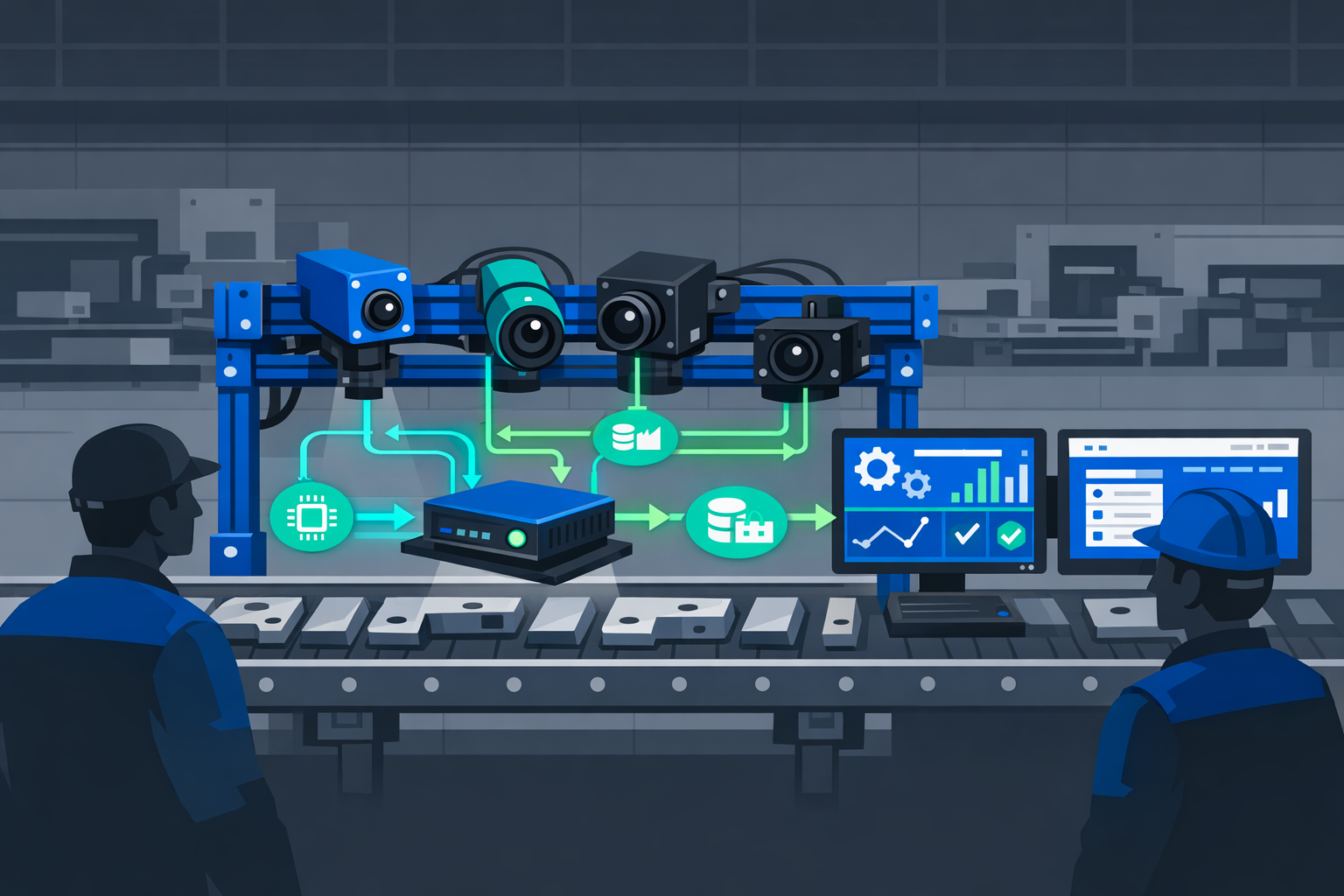
A wave of U.S. metal fabrication facilities has moved AI-powered machine vision inspection from controlled pilots into full-scale production, exposing interoperability, data integration, and software transparency challenges now pressuring vendors to align interfaces, data formats, and security protocols across heterogeneous systems.
The transition is concentrated in high-mix, low-volume (HMLV) job shops and precision fabricators requiring frequent part changeovers, where modern AI vision systems achieve defect detection accuracy of 97-99.5% at full production speed, compared to 60-80% for human inspectors under consistent conditions. Facilities are combining cameras, lighting rigs, and inference hardware from multiple vendors under unified software orchestration layers, creating an integration burden that neither machine vision suppliers nor ERP and MES vendors fully anticipated.
Background
The shift toward AI-based inline inspection in metal fabrication accelerates a longer trend in which vision technology moved from standalone quality-gate stations toward continuous, closed-loop process monitoring. Unlike traditional machine vision that relies on rigid, rule-based systems, AI-based vision has the agility to learn, adapt, and handle day-to-day variability in part geometry, surface finish, and lighting conditions.
The market context is substantial. The machine vision market is projected to reach over USD 41.7 billion by 2030, driven by increased automation in manufacturing and the integration of AI in quality control. Within fabrication specifically, weld defect detection-including porosity, cracks, undercut, and incomplete fusion-has become a primary deployment use case, given the cost of rework and the difficulty of sustaining consistent human visual judgment across shifts.
Research and industry reports consistently show that AI-based predictive maintenance can reduce unplanned downtime by up to 50% and lower maintenance costs by 20-30% across diverse manufacturing settings, making the business case for full deployment compelling beyond quality alone.
Details
The practical challenge now facing production engineering teams is not accuracy-deployed systems routinely meet specification-but integration. Vision systems must scale with production demands and integrate with factory infrastructure including PLCs, MES, SCADA, and ERP, with open standards and middleware easing connectivity with legacy equipment. In cross-vendor configurations, where a camera from one supplier feeds inference software from another and outputs inspection records to a third-party MES, data format mismatches, latency gaps, and inconsistent tagging schemas emerge as primary failure modes during scale-up.
Interoperability between heterogeneous systems such as IoT devices, ERPs, and MES platforms continues to be a bottleneck, with more than 60% of small and medium enterprises reporting integration difficulties due to incompatible formats and software ecosystems, according to published industry research.
Protocols such as OPC UA and MQTT are gaining traction as the connectivity layer of choice. At Hannover Messe 2025, Microsoft and Avanade showcased closed-loop manufacturing demonstrations using AI machine vision for quality control, integrated with Azure IoT Operations leveraging MQTT and OPC UA protocols to streamline data transport and connectivity. This model-vision inference at the edge feeding ERP and MES via standardized messaging protocols-mirrors the architecture increasingly adopted by fabricators running multi-vendor production lines.
On the software security front, deploying AI vision systems in operational technology (OT) environments has accelerated demand for Software Bills of Materials (SBOMs). A Software Bill of Materials is a comprehensive, machine-readable inventory that catalogs all components, libraries, dependencies, and metadata comprising a software application, enabling facilities to track vulnerabilities across vision inference software, edge compute firmware, and third-party model libraries simultaneously. CISA released a draft 2025 guide for Software Bill of Materials on August 22, 2025, updating minimum elements to reflect matured tools, add richer metadata, and prepare for advanced use cases including AI deployments. Procurement managers at fabrication facilities increasingly require SBOM documentation in service contracts for AI vision system vendors as a condition of production deployment, per current procurement practices.
For HMLV runs, recipe management compounds deployment complexity. Systems must adapt to different part variants using inspection recipes and support region-specific defect thresholds, requiring model retraining pipelines and version-controlled configurations that interact directly with job order data in MES systems. Full production integration timelines for complex multi-camera AI vision deployments typically range from three to six months, placing pressure on service contract structures that must account for ongoing model maintenance, not merely hardware upkeep.
Outlook
Standards bodies and major platform vendors are responding. Integrators working to ISA-95 and OPC UA frameworks report that open-standard data models substantially reduce the custom middleware burden when connecting vision outputs to ERP production orders. The EU Cyber Resilience Act has entered into force, with manufacturers preparing for phased SBOM obligations, a regulatory development influencing procurement requirements in U.S. export-facing fabrication operations. As fabricators scale automation across additional lines, service contract renegotiations and supplier consolidation pressure are expected to intensify, with interoperability compliance increasingly treated as a baseline procurement criterion rather than a differentiator.