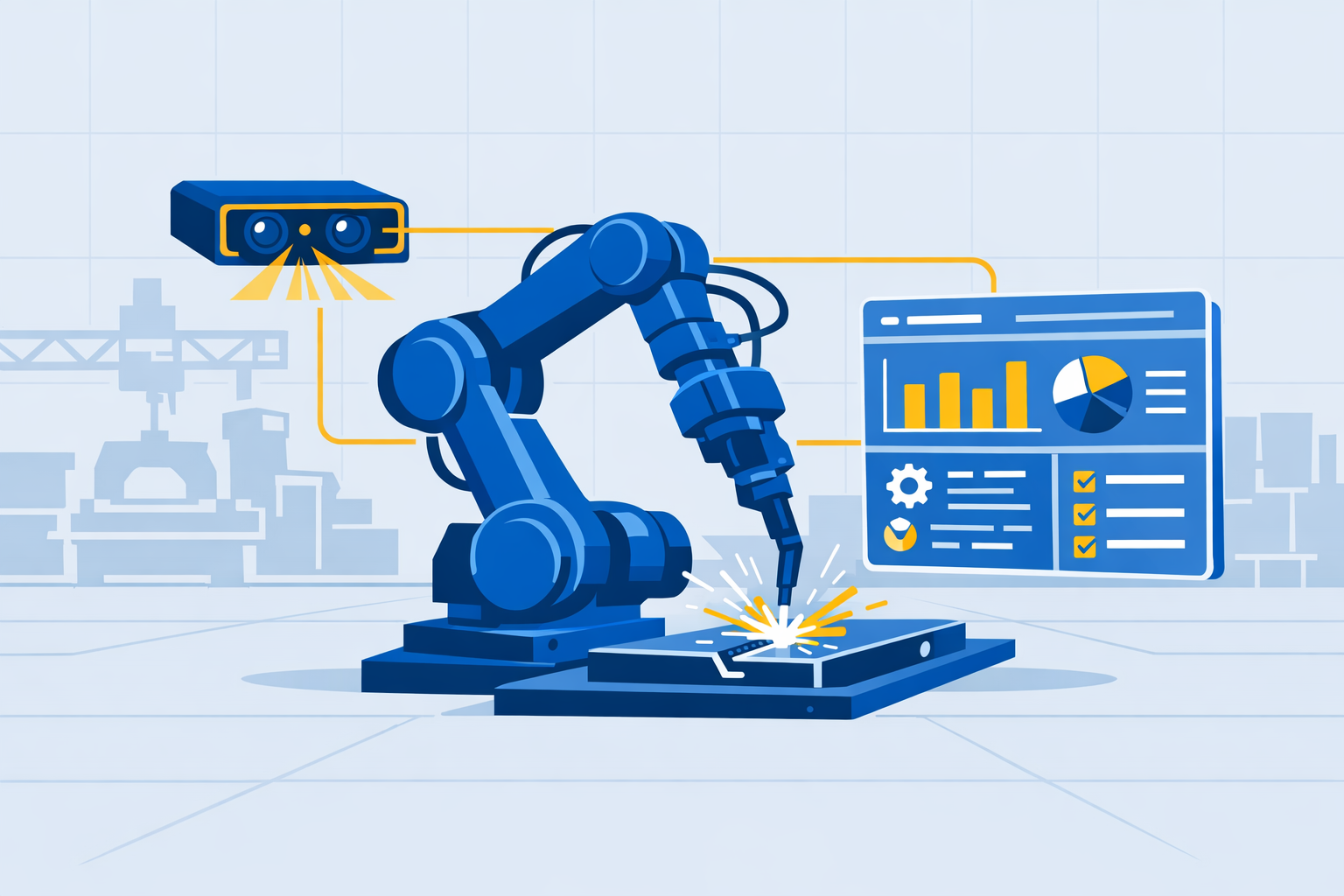
A growing number of metal fabricators are integrating vision-guided robotics with manufacturing execution systems (MES) and enterprise resource planning (ERP) platforms to address the demands of high-mix, low-volume (HMLV) production, while also managing return on investment (ROI) and total cost of ownership.
Manufacturers report that this integration reduces changeover times, enhances part quality, and enables data-driven scheduling in complex production environments. Vision systems provide submillimeter or seam-level precision in robotic operations, supplying real-time data to MES platforms for robust traceability and process control. Despite these advantages, ongoing challenges include data interoperability, cybersecurity, integration of legacy equipment, and expanded training needs for operators and engineers.
Background
HMLV fabrication requires frequent tooling changes and variant-specific process setups. Vision-guided robotics-using 3D cameras, laser scanners, or artificial intelligence (AI)-based recognition-allow robots to dynamically detect weld seams or orient parts, reducing manual fixturing and setup times. MES integration captures process data, quality metrics, and robot performance directly in production control systems, ensuring traceability and supporting automated planning.
Recent industry reports indicate that fully vision-enabled welding systems reduce material waste by 12-18% and enhance weld precision across variable parts. Additionally, the adoption of robotics in German automotive plants has risen by 28% since 2021, bolstered by Industry 4.0 grants covering up to 50% of R&D costs for AI-driven weld optimization technologies.
Details
Vision-guided systems achieve positioning accuracy near ±0.1 mm, enabling adaptive welding where torch angle, voltage, and speed adjust automatically based on detected seam geometry. This supports consistent part quality and minimizes rework, with complete digital traceability incorporated into MES or ISO-compliant quality assurance processes. In sectors such as shipbuilding and wind energy, vision-guided welding demonstrates effectiveness on curved panels and multi-angle joint geometries.
However, integrating robotic welding with MES platforms introduces technical complexity. Communication lag between MES, robot controllers, programmable logic controllers (PLCs), and inspection sensors can cause batch quality variations if data transmission is not real-time. Cyber-physical vulnerabilities and the presence of legacy equipment without network compatibility create additional cybersecurity and interoperability risks. Vision systems are also affected by glare or occlusion on complex surfaces, which may impact sensor accuracy.
Training represents a significant challenge. Engineers and operators must develop skills in vision system calibration, fixture adjustment, MES configuration, and sensor feedback interpretation, particularly when moving away from manual or offline programming workflows.
Outlook
As software matures, solutions such as zero-shot learning and low-code interfaces are emerging to decrease reliance on system integrators and enable more rapid reconfiguration. These technologies have the potential to lower both initial costs and technical barriers. Manufacturers focused on HMLV production are expected to continue balancing the ROI of reduced downtime and higher throughput against the effort needed for successful integration.