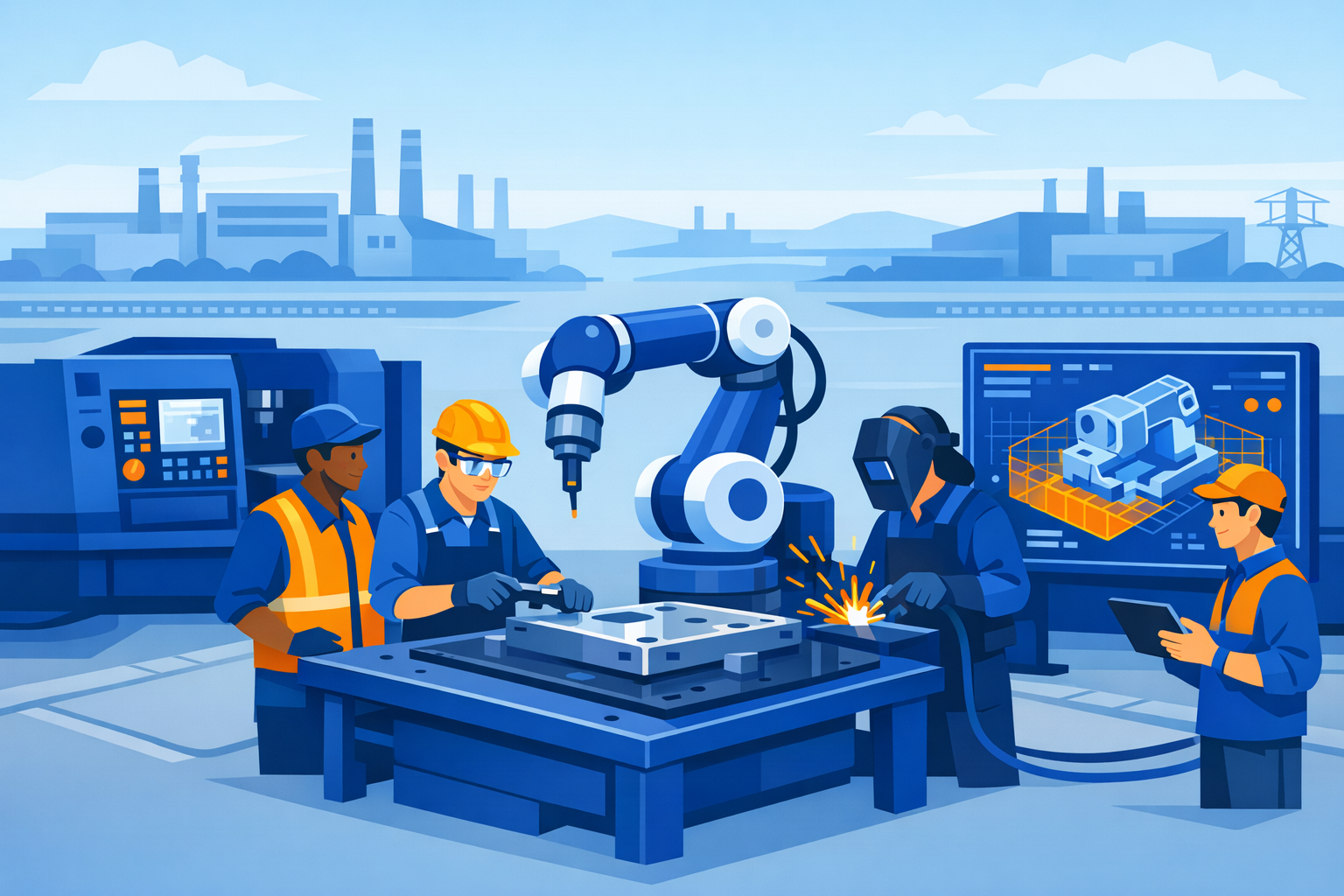
Vision-guided robotics are enabling high-mix metal fabrication facilities to reduce changeover times while maintaining part quality, supported by deeper integration with MES and ERP systems. Vision-enhanced systems adapt in real time to part orientation and reference changes, eliminating manual re-referencing and trimming cycles, according to industry reports. Leading solutions now link vision systems with MES/ERP workflows to support dynamic scheduling and traceability across part families.
Background
Flexible production environments in metal fabrication-characterized by frequent changes in part families-have long challenged automation due to the need for precise positioning and orientation. Traditional robotic programming required rigid setups, limiting responsiveness in high-mix, low-volume contexts. Recent advances in vision technology, such as geometric pattern matching and AI-driven recognition, have addressed these constraints by enabling robots to dynamically locate and distinguish parts in unstructured layouts. This trend has accelerated as manufacturers seek leaner operations with fewer manual interventions. Broader adoption has been facilitated by more intuitive interfaces, reduced costs, and improved automation reliability.[1]
Details
Vision-enhanced robotics now provide dynamic adaptability, enabling systems to handle variations in part orientation, lighting, and positioning without interrupting production. These capabilities are essential in high-mix fabrication, where setups must accommodate multiple variants. Inline vision inspection enables near-instant defect detection, minimizing downstream quality issues.[2]
Solutions from firms such as Apera AI feature pre-trained vision software-such as the "Vue" platform-that can achieve over 99.99% recognition reliability on metal parts within 24 hours of CAD upload, with vision cycle times as low as 0.3 seconds, surpassing legacy systems in speed.[3]
Case studies illustrate practical ROI: In steel mills, Concept Systems deployed vision-guided tagging robots that integrate 3D scanners, six-axis robotic arms, and SQL databases to weld identification tags onto billets. The system operated chiefly unattended, improved traceability, and enabled integration with plant tracking systems, delivering ROI within 24 months.[4]
Market adoption continues to rise. Vision-guided robotics are increasingly used across industries-including metalworking-to load CNC machines and process castings from pallets. Improved reliability has established the technology as a standard in flexible production lines.[1]
Outlook
As integration between vision-guided robotics and MES/ERP platforms advances, metal fabrication shops are expected to achieve tighter changeover cycles and increased traceability. Anticipated developments may route inline quality data to ERP systems for predictive scheduling. Workforce development will be crucial, with technicians requiring expertise in vision calibration, MES/ERP integration, and robotic orchestration to maintain automated cells.