North American automotive Tier 1 suppliers are moving vision-guided robotics from pilot programs into full production on body-in-white (BIW) lines, driven by growing model diversity, tighter dimensional tolerances, and pressure to cut manual inspection costs across high-mix build schedules.
Automotive manufacturers accounted for roughly 25.4% of total industrial robot installations in 2024, with over 70% of those units placed into BIW framing, spot-welding, and paint lines, according to data from the International Federation of Robotics (IFR). The BIW shop remains the single largest application cluster in the global industrial robotics market, and that position is intensifying as platform proliferation forces suppliers to handle more part variants on a single line.
Background
Pressure to automate BIW handling and inspection has built steadily as OEMs expand mixed-model production-simultaneously running internal combustion, hybrid, and battery-electric variants through the same framing cells. Honda North America's upgraded Ohio operations are being configured as a template for flexible ICE, hybrid, and electric vehicle production on a single line, a model that mirrors broader industry requirements trickling down to Tier 1 body module suppliers.
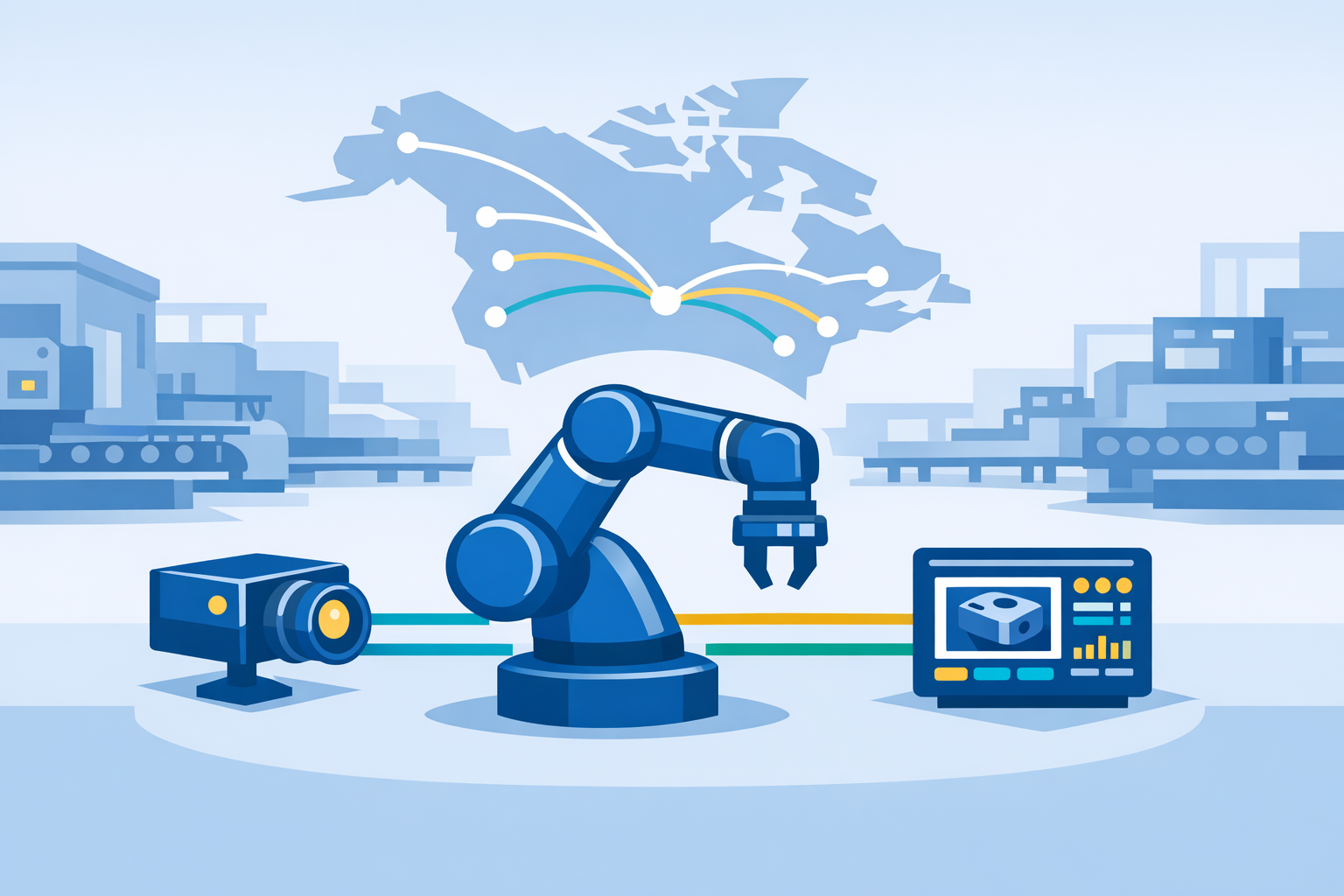
From January through September 2025, North American companies ordered 26,441 robots valued at $1.8 billion-a 6.6% increase in unit volume and 10.6% increase in revenue compared to the same period in 2024, according to the Association for Advancing Automation. Automotive manufacturers drove a significant portion of that increase, reversing an investment lull that followed large capital deployments in 2021 and 2022.
Vision-guided robotics addresses a specific constraint in high-mix BIW production: traditional hard-tooled fixturing is part-specific and must be physically replaced at every model changeover, a process that can cost roughly $100 million per plant per year at scale, according to published robotics research. Flexible vision systems eliminate much of that dependency by using real-time imaging and AI-based part recognition to locate, align, and inspect components without dedicated fixtures.
Details
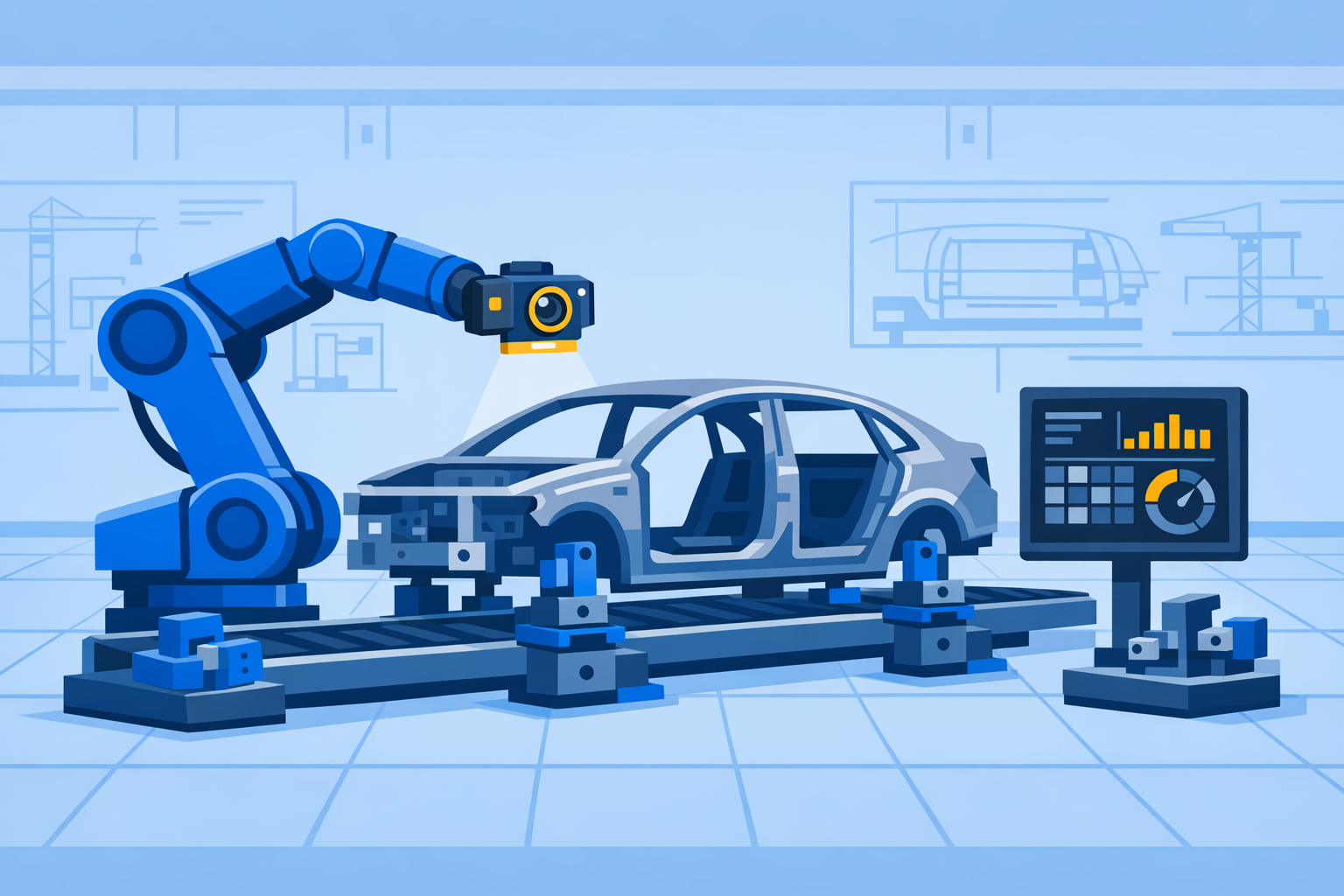
Flexible vision systems can adapt to different product configurations without extensive reprogramming, supporting high-mix manufacturing strategies increasingly common in automotive body assembly, according to market analysis from Emergen Research. In practice, a single robotic cell equipped with 2D and 3D vision can process door inners, roof headers, or sill reinforcements sequentially, re-acquiring part geometry between cycles via structured-light or time-of-flight cameras.
High-resolution cameras exceeding 25 megapixels have become an industry benchmark in 2025, with advanced image-processing software enabling real-time defect analysis and reducing error rates during inline quality control, according to industry observers. AI robotics vision systems introduce greater stability when lighting, contrast, or surface conditions vary, with machine learning tools capable of identifying subtle edges and reflective surfaces that standard rule-based imaging may miss.
Despite the technical capability, integration with plant-level MES and ERP systems remains a critical friction point. Manufacturers are discovering that robotics ROI often stalls at the integration layer, where MES, ERP, and line-level systems fail to scale with automation deployments, according to analysis published by Robotics & Automation News in May 2026. Each weld in modern BIW production now carries a unique identifier logged through real-time IO-Link and MES handshakes, helping OEMs meet stringent crash-test and regulatory documentation requirements, creating a data traceability mandate that vision systems must satisfy alongside mechanical ones.
Flexible factories demand seamless interoperability between software systems-manufacturing execution, product lifecycle management, and enterprise resource planning-and physical assets including robots, conveyors, and sensors, with the architecture described as intricate and failure modes numerous, according to reporting by Automotive Manufacturing Solutions. Major integrators such as Comau, Dürr, and ATS have responded by deploying digital twins during cell design, saving up to eight weeks of commissioning time and trimming rework by 15%, per Astute Analytica industry data published in May 2025.
On ROI, customizing a vision-guided machine vision system for a production line typically costs between $50,000 and $200,000 per cell, with installation taking up to six weeks, while studies indicate that 68% of manufacturing firms require ROI within 18 months to approve such projects. Automotive suppliers have reported a 40% reduction in manual inspection costs following deployment of these systems, a figure that substantially compresses the payback window when deployed across multi-shift BIW operations.
Outlook
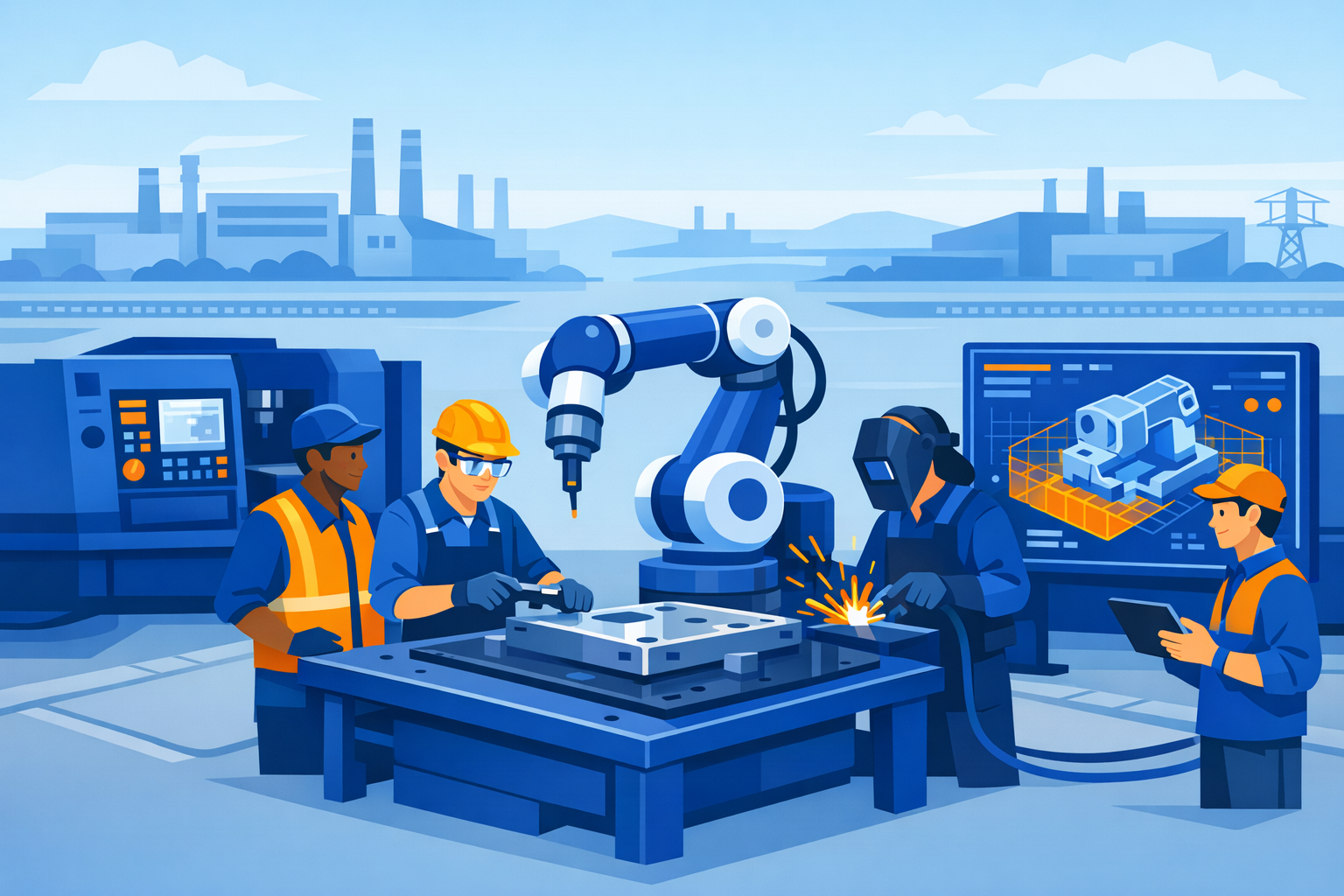
The cobot market in automotive applications grew 68% year-over-year in the third quarter of 2025, per the Association for Advancing Automation, with collaborative robots now representing approximately 13% of total robot orders by unit count in North America. As pilot cells advance to line-wide deployment, workforce composition is shifting in parallel. A 2025 Deloitte survey of 600 manufacturing executives found that 35% cited adapting workers to the Factory of the Future as a top concern, while 28% plan to prioritize investment specifically in vision systems over the next 24 months. Plants deploying comprehensive automation typically maintain comparable headcounts with a fundamentally different skill mix-fewer repetitive manual roles and more technical, supervisory, and continuous improvement positions, according to workforce analysis from iFactory.
As BEV investment cycles extend across North America, BIW lines are projected to preserve their status as the industrial robotics market's single largest application cluster, sustaining demand for high-payload arms, vision-guided sealing heads, and Industry 4.0 management software, according to Astute Analytica. For Tier 1 body module suppliers, the transition from vision-guided pilot to full-production deployment will increasingly determine delivery reliability, changeover agility, and capacity allocation for OEM customers managing their own model-mix volatility.