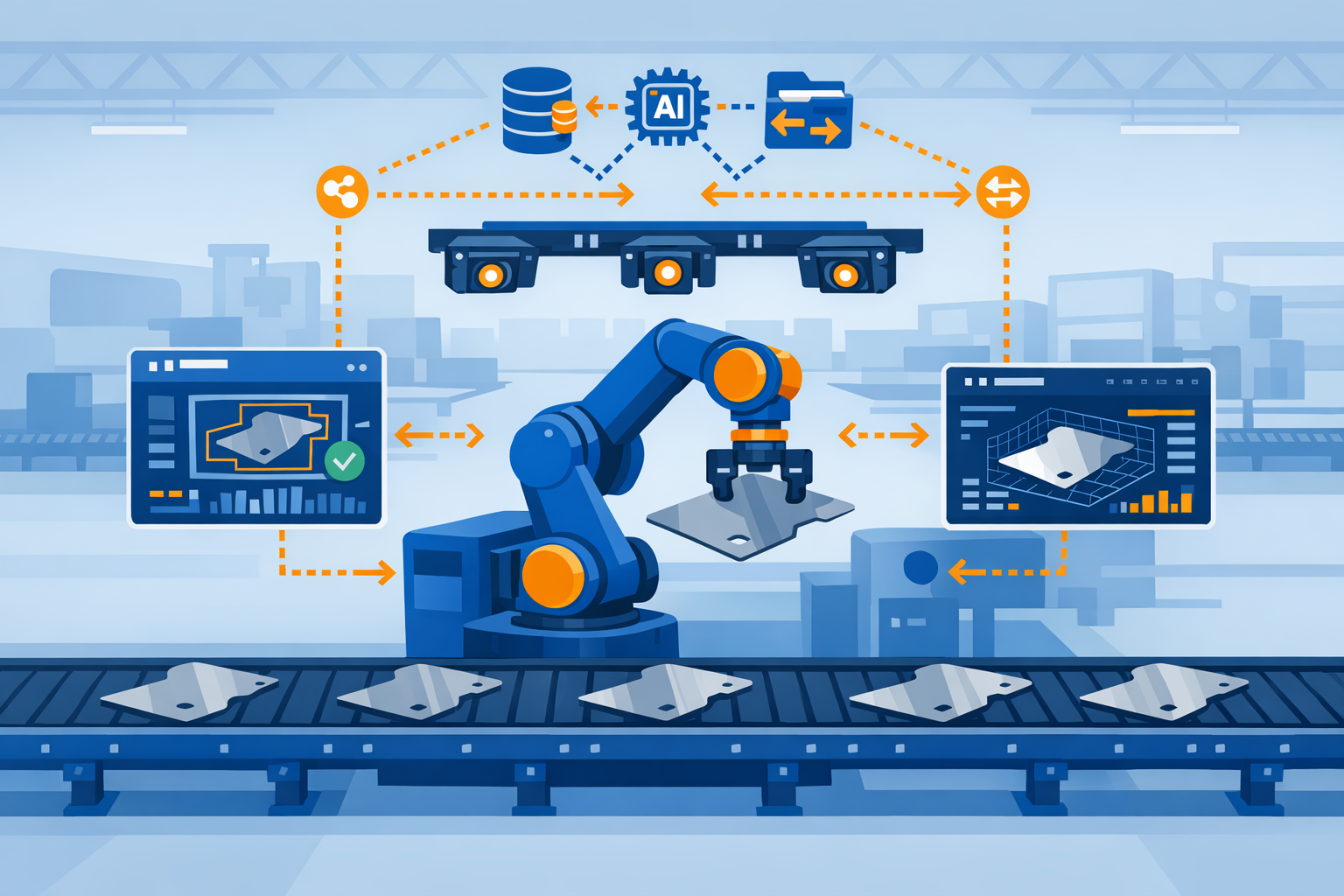
North American Tier 1 metal fabricators are moving AI-powered, vision-guided automation out of controlled pilots and into live production environments. Early plant trial data points to measurable cycle-time reductions, lower defect rates, and accelerated part changeovers in high-mix, low-volume operations. The shift marks a decisive transition from proof-of-concept validation to production-grade scaling, with interoperability standards and software supply chain governance now shaping deployment timelines alongside performance metrics.
Background
High-mix, low-volume fabrication has long resisted full automation because traditional robotic cells require extensive reprogramming each time part geometry, alloy grade, or batch size changes. Vision-guided AI systems capable of recognizing unfixtured parts, compensating for minor orientation drift, and executing automated changeovers without operator intervention are now entering live plant floors at Tier 1 suppliers in North America. The underlying technology infrastructure has matured significantly: the VDMA OPC Machine Vision Initiative released Part 2 of the OPC UA Machine Vision Companion Specification in 2024, establishing a standardized information model for behavior control, recipe management, and result reporting across vision systems from different manufacturers. Four major machine vision standards bodies-A3, EMVA, JIIA, and VDMA-cooperate to prevent specification duplication and conduct interoperability testing events, according to presentations at Automate 2025.
The industry backdrop reflects expanding capital commitment. The global machine vision market was valued at approximately USD 20.4 billion in 2024 and is projected to reach USD 41.7 billion by 2030, reflecting a compound annual growth rate of 13.0%. North America stands as the dominant region in machine vision and vision-guided robotics, supported by widespread Industry 4.0 framework deployment and government-backed investment in next-generation imaging and deep learning inspection systems.
Details
In live fabrication cells, AI vision platforms perform rapid part identification using multi-camera or 3D sensing arrays, enabling robots to handle unfixtured sheet metal blanks, orient them for deburring, grinding, or edge finishing, and monitor downstream stations for bottlenecks-all without hard tooling changes. AI-integrated vision-guided robotic applications require no per-part reprogramming as AI algorithms learn independently to recognize new geometries or part variants. At fabricators deploying these cells, vision systems using 2D and 3D computer vision inspect parts in-line, flag defects early, and feed corrective parameters back into the production process, closing the quality loop without manual intervention.
Interoperability between robotics controllers, vision sensors, and factory data infrastructure remains the most significant technical barrier. Limited standardization across vendors leads to interoperability challenges that restrain seamless integration in multi-supplier environments and slow market penetration in legacy factories. The OPC UA framework is increasingly adopted as a resolution mechanism: OPC UA Companion Specifications for machine vision and robotics provide standardized information models for all robot-related and vision system data, regardless of manufacturer or physical location.
Software supply chain governance is emerging as a parallel requirement. CISA, in collaboration with NSA and 19 international partners, released joint SBOM guidance in September 2025, outlining a shared vision of Software Bill of Materials requirements for cybersecurity. In automated fabrication environments, SBOM adoption enables procurement managers and plant engineers to maintain a traceable inventory of every software component embedded in vision controllers, robot firmware, and edge compute nodes-providing essential visibility into software dependencies and enabling organizations to identify components, assess risk, and take proactive measures to mitigate vulnerabilities. Gartner has predicted that by 2025, 60% of organizations building or procuring critical infrastructure software will mandate SBOMs, up from less than 20% in 2022.
On the workforce side, the transition to adaptive vision-guided cells requires structured retraining programs. Operators previously responsible for manual fixturing and visual inspection are being cross-trained in calibration routines, exception handling, and remote diagnostics. Remote diagnostics and edge AI anomaly detection are becoming standard practice, with predictive maintenance scheduling faults during low-impact windows to minimize unplanned downtime. Calibration drift-gradual degradation of vision system accuracy due to thermal variation, lens contamination, or lighting shifts-remains a persistent operational concern requiring documented verification routines integrated into preventive maintenance schedules.
Early ROI signals are substantive. Analysis of Tier 1 automotive suppliers deploying adaptive vision as a predictive upstream sensor, rather than a downstream checkpoint, shows scrap rate reductions of 22.4% annually attributable to root-cause tracing of defects back to specific die wear patterns or process variations in upstream stamping operations. Broader manufacturing data indicates AI-based predictive maintenance can reduce unplanned downtime by up to 50%. Supply chain component price volatility-recent disruptions have raised vision system component prices by approximately 20%-is nonetheless constraining capital budgets and extending deployment timelines at some facilities.
Outlook
Industry analysts characterize 2025 as the year of pilot validation and 2026 as the phase of production-grade scaling and architectural standardization. Tier 1 procurement teams are expected to intensify pressure on system integrators for standardized telemetry reporting, cross-vendor calibration protocols, and documented SBOM practices as conditions of purchase. The pace at which the OPC UA Machine Vision specification achieves widespread field adoption-particularly in North American plants running mixed installed bases of robotic and vision hardware-will likely determine how quickly the productivity gains documented in early trials can be replicated at scale.