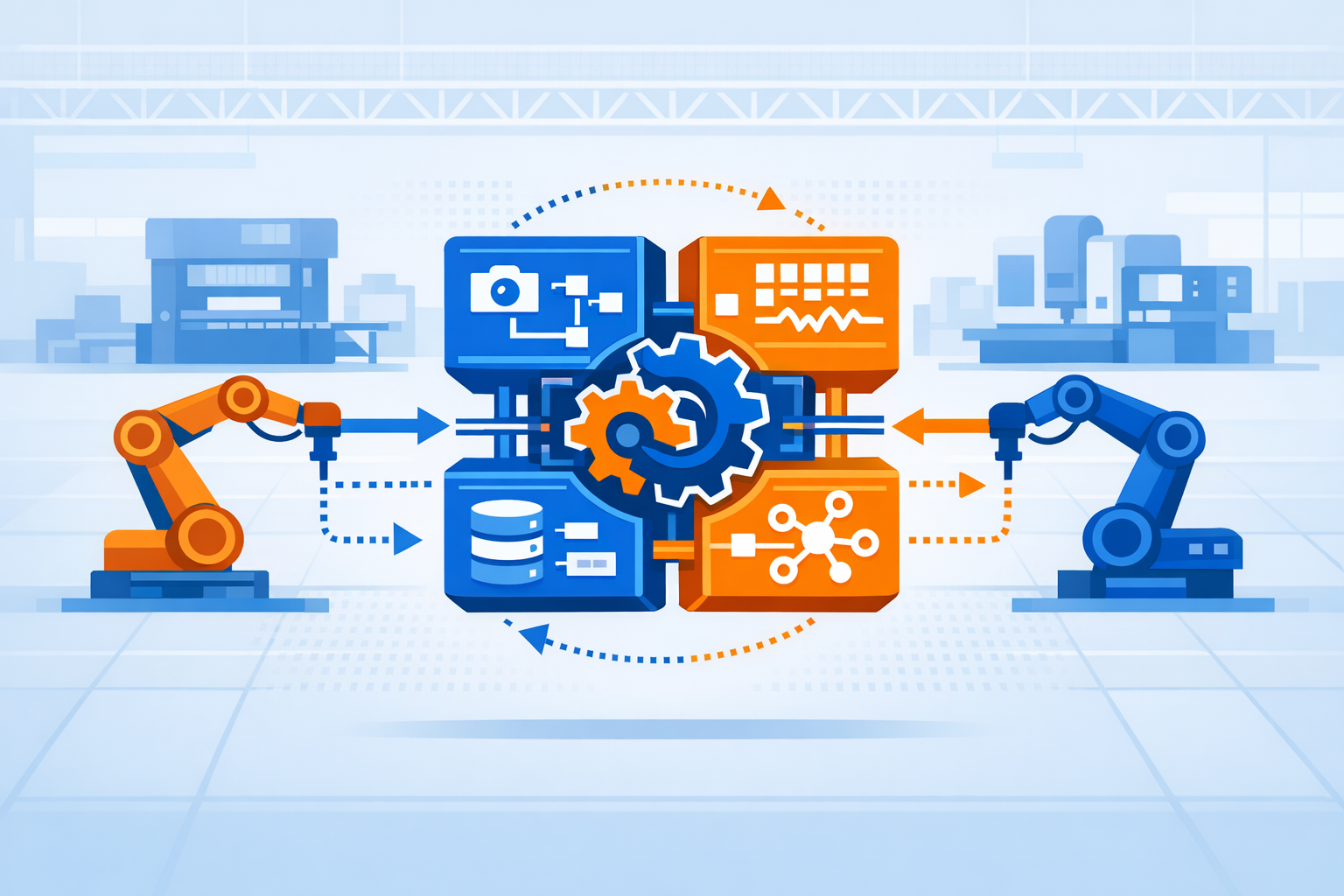
Standardized machine vision interfaces are moving from multi-vendor pilot programs to full-scale production deployment across high-mix metal fabrication facilities in the United States. Fabricators report measurable reductions in integration time, line-side commissioning costs, and first-pass defect rates. The shift follows sustained interoperability testing under industry standards bodies, with equipment vendors now aligning product roadmaps to unified software APIs and data schemas.
Background
High-mix metal fabrication-characterized by frequent part changeovers, variable volumes, and multi-brand equipment floors-has historically imposed heavy integration burdens on automated vision deployments. Custom cabling, proprietary drivers, and incompatible data formats forced costly reconfigurations each time a sensor, robot controller, or edge processor from a different vendor was introduced. A typical manufacturing facility houses equipment from a dozen vendors: a robot from one brand loading parts into a press controlled by another, feeding a conveyor managed by a third, delivering assemblies to a vision station from a fourth. Each system spoke its own language, and getting them to share data reliably required engineers to cobble together proprietary drivers and custom middleware-producing brittle, expensive integrations difficult to scale.
Efforts to resolve that fragmentation accelerated through the global G3 standards group, which comprises the Association for Advancing Automation (A3), the European Machine Vision Association (EMVA), the Japan Industrial Imaging Association (JIIA), the German Mechanical Engineering Industry Association (VDMA), and the China Machine Vision Union (CMVU). These major machine vision standards organizations cooperate to avoid duplication, provide education, and coordinate interoperability events. At the Automate 2025 conference in Detroit, the A3 machine vision standards update covered Camera Link HS, GigE Vision, and USB3 Vision; the EMVA update addressed ISO-24942 (EMVA 1288) and GenICam; and the VDMA update covered the OPC Machine Vision initiative and associated VDI/VDE/VDMA specifications.
Details
The technical foundation enabling plug-and-play robot cells rests on a layered stack of transport and application-level standards. GenDC (Generic Data Container) defines a transport-media-independent data description that allows devices to send or receive virtually any form of imaging data using a uniform, standard format. It completes the GenICam family of modules governing control and data exchange between imaging devices. The specification establishes a generic, self-described imaging data container independent of transport or storage method, with standard mechanisms shared by GigE Vision, USB3 Vision, CoaXPress, and other transport-layer protocols. At the application layer, OPC UA serves as a platform-independent interoperability standard for secure, reliable data exchange in industrial automation. OPC UA companion specifications allow each device to present the same information model with reduced engineering effort. Approximately 60 VDMA companies participate, with a core working group of 17. The OPC Machine Vision initiative addresses the broad variety of devices, systems, applications, results, and time behaviors that have historically created integration risk.
GigE Vision 3.0, which uses RoCEv2 (Remote Direct Memory Access over Converged Ethernet), enables zero-copy image transfer and hardware-delegated error recovery, reducing CPU overhead during high-throughput inspection tasks, according to the A3 Automate 2025 update. The OPC Foundation publishes companion specifications for specific industries and equipment types, defining standard information models for robotics, CNC machines, and other equipment. When vendors implement these companion specs, their equipment becomes genuinely plug-and-play at the data level.
Standards and middleware are simplifying integration further. Protocols such as GenICam for camera interfacing and ONNX for model interoperability extend the addressable scope of standardized vision stacks to include the AI inference layer. At the sensor level, vision systems must scale with production demands and integrate with factory infrastructure such as PLCs, MES, and SCADA systems; open standards and middleware ease connectivity with legacy equipment.[1]
The operational impact on high-mix lines is significant. Vision software enables robots to interpret visual data, recognize patterns, and make autonomous decisions, enhancing operational flexibility and adaptability. AI-powered vision software allows robots to learn from experience, adapt to changing environments, and perform self-diagnostics-capabilities particularly valuable in high-mix, low-volume production. Modern metal fabrication machinery has become extraordinarily productive, but the more productive a machine, the easier it is to exacerbate a bottleneck downstream. More often than not, that bottleneck is manual. Even the most automated fabricators maintain islands of manual operation. Vision-standardized robot cells target exactly those gaps, with sensor-fusion analytics informing adaptive control decisions in real time.
Labor implications are increasingly on plant managers' radar. Rather than fixed-geometry cells requiring specialized programming skills, standardized interfaces enable operators to manage versatile cell configurations focused on troubleshooting cross-vendor data flows and maintaining standardized machine communications. In 2025, North American companies ordered 36,766 robots valued at $2.25 billion, a 6.6% increase in units and 10.1% increase in revenue compared to 2024, according to A3 data, with the non-automotive sector accounting for 59% of all robots ordered in Q3 2025-a segment that includes general fabrication. "The continued growth in robot orders underscores what we've been hearing from our members: automation is now central to long-term business strategy," said Alex Shikany, Executive Vice President at A3. "It's not just about efficiency anymore. It's about building resilience, improving flexibility, and staying competitive in a rapidly changing global market."
The global machine vision market was valued at approximately $20.4 billion in 2024 and is projected to reach $41.7 billion by 2030, reflecting a CAGR of 13.0%, according to Grand View Research. Regulatory and standards bodies are monitoring adoption closely, as broad deployment of cross-vendor interfaces could influence compliance timelines for related safety and reliability requirements under frameworks such as IEC 62443.
Outlook
The OPC Machine Vision initiative Part 1 focuses on client-side control and management of machine vision system behaviors. Part 2, released in April 2024, demonstrated a umati dashboard; next steps include preparation of test cases for certification. Industry participants expect the next 12 to 18 months to deliver broader tolerance windows for part variability and a widening ecosystem of compatible peripherals and software tools as more vendors complete OPC UA companion specification compliance. Industry 4.0 frameworks are pushing manufacturers to adopt machine vision for real-time data capture and process control, AI integration is reshaping how vision systems are trained and deployed for more adaptive automation, and stricter regulatory expectations are reinforcing machine vision's role as a core enabler of high-precision manufacturing.