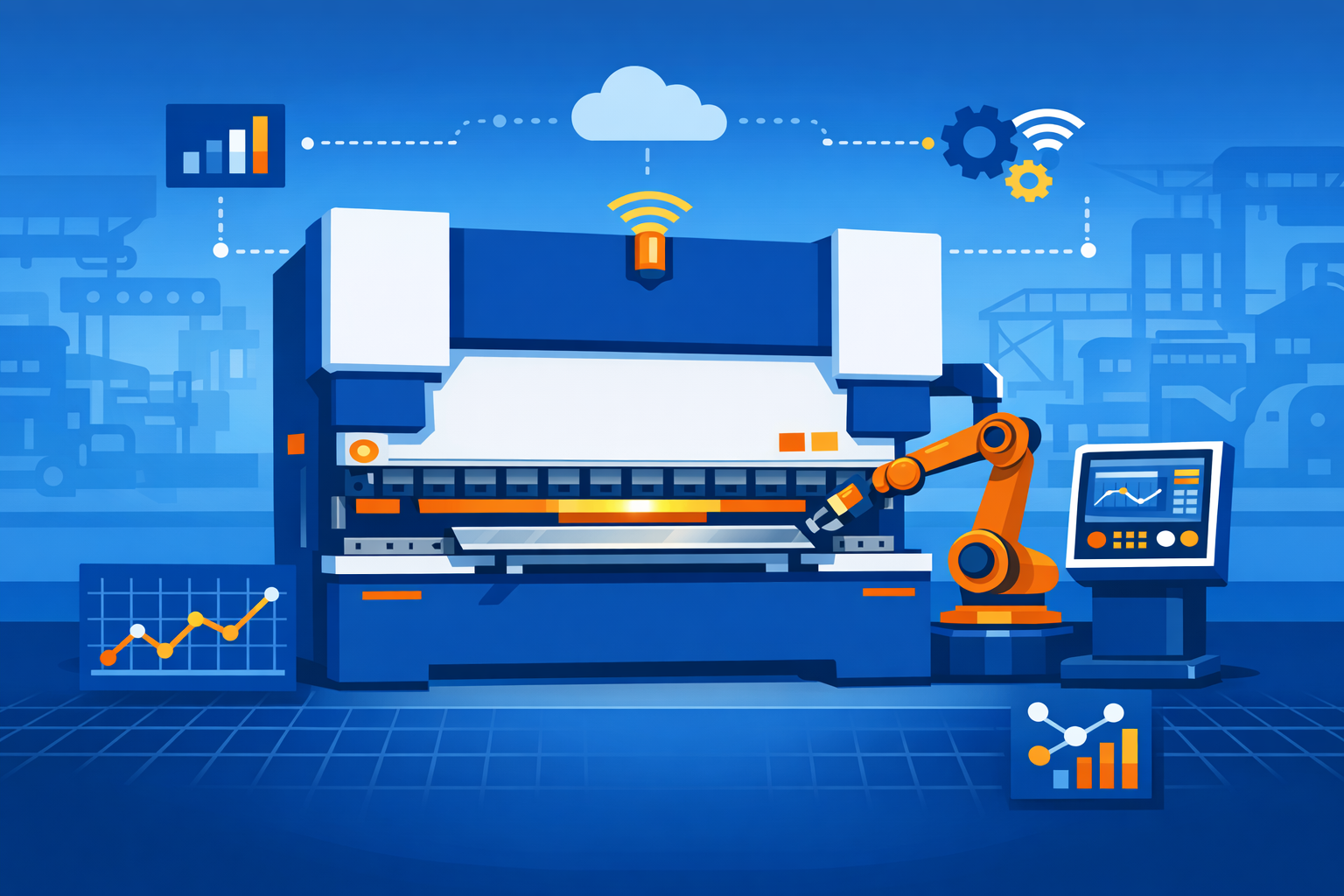
Multiple independent market assessments published in 2025 and 2026 project the global cutting and bending machine sector will nearly double in value over the next decade, driven by accelerating Industry 4.0 adoption, automotive lightweighting programs, and a broad shift from manually operated to sensor-integrated CNC equipment. The transition is realigning capital expenditure priorities for fabricators, OEMs, and aftermarket service providers alike.
Market Scale and Growth Trajectory
According to Future Market Insights, the global cutting and bending machine market is estimated at USD 10.2 billion in 2025 and is projected to reach USD 20.3 billion by 2035, registering a CAGR of 7.1%. A parallel assessment by IndexBox places the broader market's compound annual growth rate at 4.8% over 2026-2035, with an indexed market value reaching 158 by 2035 relative to a 2025 baseline of 100. While methodologies differ, both analyses identify the same structural catalysts: CNC-controlled equipment replacing aging machine parks, expanding fabrication capacity in emerging economies, and rising precision requirements across automotive, aerospace, and construction supply chains.
The automatic bending machine sub-segment reflects similar momentum. Precedence Research estimates the automatic bending machine market will grow from USD 2.72 billion in 2025 to USD 4.47 billion by 2035 at a CAGR of approximately 5.1%. Within that category, the automotive segment held a 32% end-use share in 2025, according to the same source, sustained by demand for precision-formed components-including battery trays, chassis sections, and cooling lines-tied to electric vehicle production.
Regional Divergence and Supply Chain Implications
Regional growth patterns are crystallizing along distinct lines. Asia-Pacific dominated the automatic bending machine market with a 42% share in 2025, according to Precedence Research, driven by expanding manufacturing infrastructure in China, Japan, South Korea, and India. China alone recorded a 6.3% CAGR forecast and accounted for over 31% of global bending machine demand in 2023, with more than 28,000 machines installed, according to Future Market Insights and Market Reports World respectively.
In Europe, Germany maintained a 36.2% regional market share in 2025 and is projected to grow at a 6.8% CAGR, underpinned by deep Industry 4.0 integration and stringent manufacturing standards across industrial clusters in Baden-Württemberg, Bavaria, and North Rhine-Westphalia. Germany alone accounted for over 9,000 machine installations in 2023, with more than 1,000 bending robots in active use, according to Market Reports World. In the United States, the North American automatic bending machine market is estimated at USD 1.14 billion in 2025 and is projected to reach USD 1.90 billion by 2035, per Precedence Research, supported by defense, aerospace, and construction sector demand.
Integrated Intelligence Reshaping Maintenance and Operations
The technology profile of new installations is shifting markedly. By 2024, more than 17% of global press brake installations were linked with centralized data control systems, with those integrations reducing setup time by 43%, minimizing material wastage by 18%, and increasing part output by up to 22% in synchronized production lines, according to Market Reports World.
AI-driven predictive maintenance is advancing from pilot programs to standard procurement criteria. Smart factories utilizing AI-powered predictive maintenance have demonstrated a 15-25% improvement in overall equipment effectiveness (OEE), according to a 2025 review published in the Journal of Information Systems Engineering and Management. A 2025 Springer-published study demonstrated a cost-effective predictive maintenance framework for CNC milling machines using low-cost vibration sensors and an unsupervised autoencoder neural network to detect wear, imbalance, and early-stage faults without requiring pre-labeled fault data.
Industry analysts also note that unplanned downtime across the manufacturing sector carries losses estimated at up to USD 852 million per week, with 61% of manufacturers surveyed by Fluke in October 2025 reporting at least one unplanned downtime event in the prior year. That exposure is accelerating procurement decisions toward machines with embedded condition-monitoring capabilities.
According to Market Reports World, training programs for operators of multi-axis CNC bending systems typically last two to four weeks and cost between USD 3,000 and USD 7,000 per technician-a cost burden driving demand for AI-assisted setup and guided operator interfaces, particularly among small and mid-sized fabricators.
Outlook
IndexBox projects that the 2030-2035 period will account for 66% of the decade's total value creation in the linkage bending machine segment, as advanced automation integration, CNC-enabled controls, and smart factory compatibility redefine bending performance standards. Suppliers competing primarily on hardware specifications face growing pressure to expand service portfolios; analysts from Future Market Insights note that players with strong after-sales networks and predictive maintenance offerings are expected to outperform hardware-centric competitors. Component lead-time volatility, including steel and alloy-based input costs that rose an average of 14% year-over-year between 2022 and 2024, according to Market Reports World, remains an active risk for capital planning across the value chain.