Tightening emissions regulations across the European Union and the United States are accelerating investment in digital twin platforms and energy-efficiency infrastructure at metal and glass manufacturing facilities, as producers face binding compliance deadlines with direct financial consequences.
Background
The manufacturing industry faces a critical challenge: drastically reducing carbon emissions within a compressed timeframe. The task is particularly daunting for energy-intensive sectors such as glass, steel, and cement, which rely on heat-generation processes that cannot be fully electrified.
Regulatory pressure is intensifying. The revised EU Energy Efficiency Directive (Directive 2023/1791) reshapes corporate energy obligations across the European Union. Adopted in 2023 and transposed into national law by October 2025, its most material business impacts begin in 2026, when mandatory audits, documentation, and efficiency-first decision-making take effect. By October 2026, companies with annual energy consumption above 10 terajoules must carry out regular, independent energy audits unless they already operate a certified energy management system. By October 2027, companies consuming more than 85 terajoules annually must implement a certified energy management system, such as ISO 50001, or an equivalent nationally recognized scheme.
Concurrently, the European Commission has adopted the 2025-2030 working plan for the Ecodesign for Sustainable Products and Energy Labelling Regulations, with steel and aluminium among the priority products slated for eco-design requirements and energy labelling within the next five years. Mandated product information will include carbon and environmental footprint data, largely delivered via Digital Product Passport.
Details
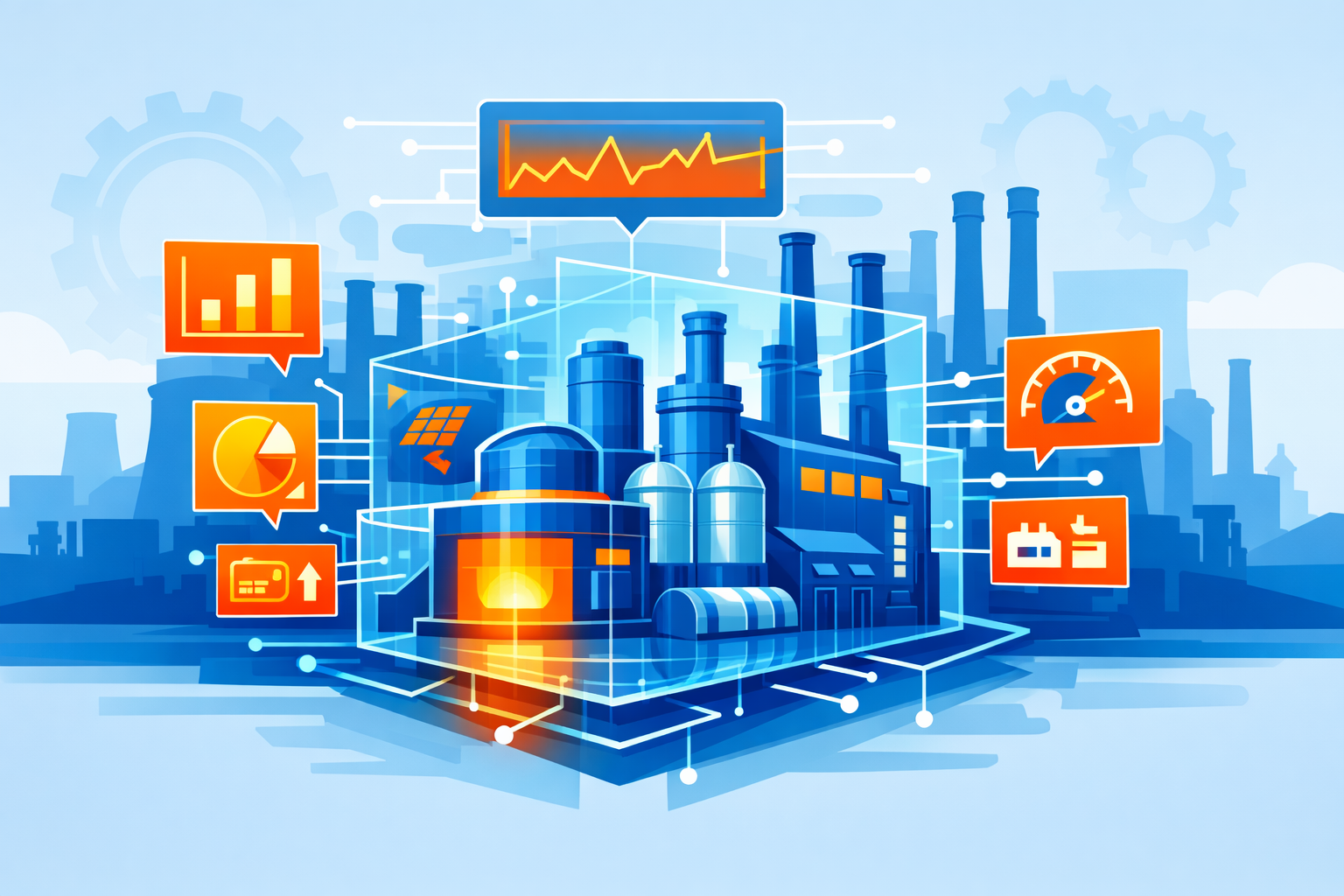
Digital twin platforms-virtual replicas of physical assets synchronized in real time through IoT sensor fusion and bidirectional data flows-are emerging as a primary tool for simultaneous compliance and cost reduction. By integrating real-time simulation models with predictive capabilities, digital twins enhance industrial furnace design, operation, and maintenance. Findings indicate they can facilitate the transition to furnace electrification and zero-carbon fuels, significantly reducing emissions and optimizing overall furnace performance.
In glass manufacturing, a notable initiative is underway in the UK. Glass Futures and the Virtual Engineering Centre (VEC) have launched a £1.5 million AI-GLASS project focused on decarbonization. The initiative will deliver a virtual replica of the glass manufacturing process, integrating advanced physics modelling and artificial intelligence. It will empower manufacturers to experiment with variables-such as transitioning to hydrogen or biofuels and adjusting batch compositions-without disrupting production, instantly predicting the impact on energy use, emissions, melt quality, and operating costs.
In metalworking, published research from a Frontiers in Mechanical Engineering case study documents quantifiable returns. Introducing a digital twin in automotive component manufacturing enabled simulation and optimization of the assembly process, reducing cycle time by 25% and increasing production by 20%-translating into annual operating cost savings of $500,000. A separate application in an industrial refinery showed the digital twin driving operational adjustments that improved energy efficiency by 15% and cut emissions by 18%, lowering energy costs from $10 million to $8.5 million annually while maintaining compliance with environmental regulations.
For mid-market producers evaluating return-on-investment timelines, a five-year ROI analysis from the same metalworking deployment is instructive: based strictly on data from the implemented case, the analysis showed a return of 233% over five years. At the market level, predictive maintenance applications of digital twins have demonstrated a 20-40% improvement in downtime reduction across industrial manufacturing deployments.
Adoption barriers remain material for smaller producers. Chief among them are data integration complexity at brownfield sites, cybersecurity concerns from OT/IT convergence, skill shortages in data science and simulation engineering, and ROI uncertainty for mid-sized manufacturers that struggle to quantify benefits before deployment. Model reliability challenges and high upfront investments in IT and connectivity infrastructure further limit widespread adoption.
Outlook
The global digital twin market is projected to grow from USD 36.19 billion in 2025 to USD 180.28 billion by 2030, representing a CAGR of 37.87%. North America leads in cloud infrastructure and software with a projected 35.4% CAGR, supported by U.S. Department of Energy investments in digital simulation platforms. Europe leads in regulatory frameworks and manufacturing excellence, with Germany's Industrie 4.0 initiative allocating EUR 3.5 billion for digital infrastructure.
For plant managers and capital allocation teams, the deployment window is narrowing. From 2026 to 2030, the EU Energy Efficiency Directive transforms energy efficiency into a regulated corporate obligation, with mandatory audits in 2026, compulsory energy management systems by 2027, and escalating efficiency requirements thereafter. Workforce upskilling in data science, sensor integration, and simulation engineering is increasingly recognized as a prerequisite for 2030 readiness.