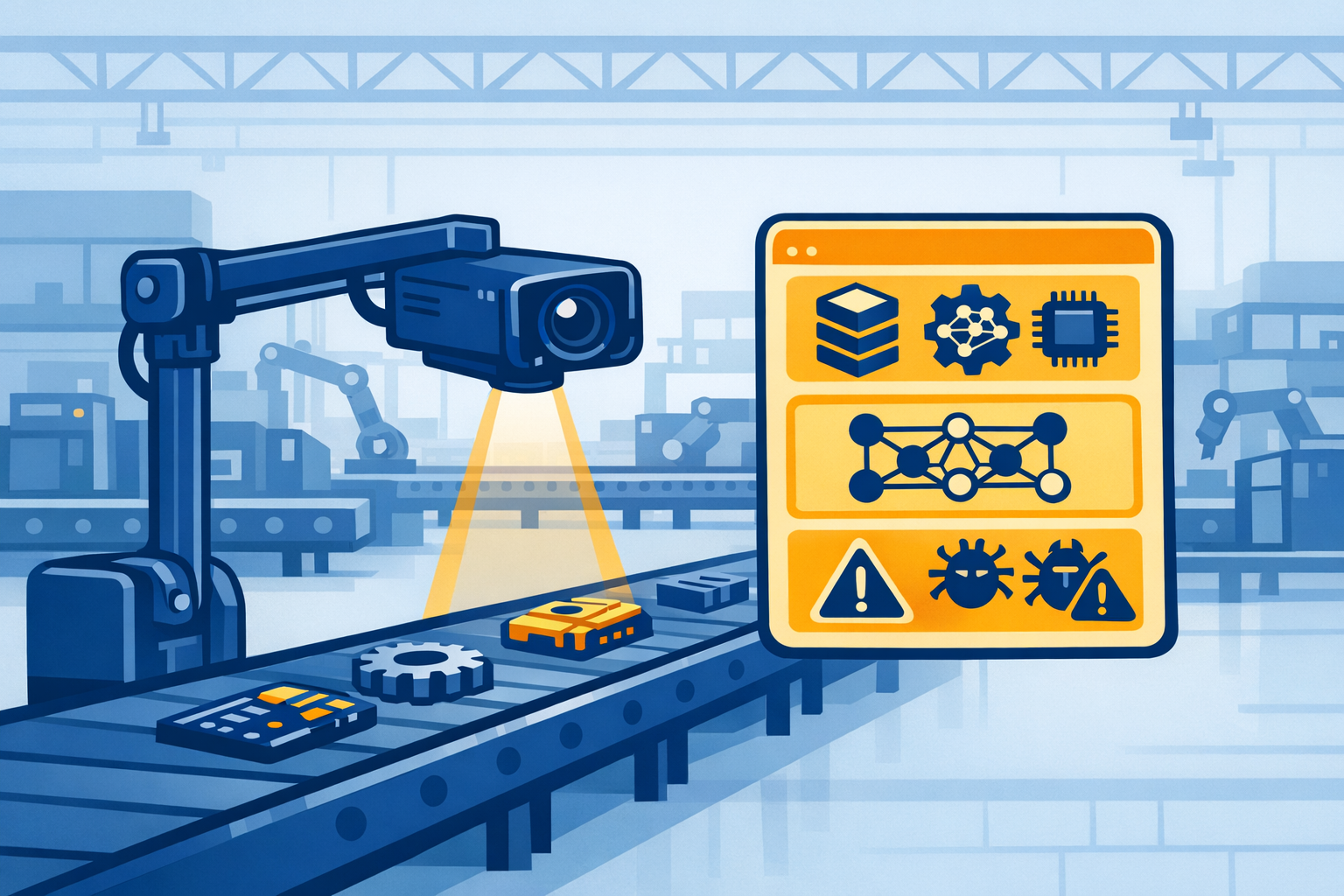
Most North American fabrication shops running AI-based defect detection pilots have treated compliance as someone else's problem - an IT concern, a future agenda item, a box to check later. That calculation is changing fast. New federal cybersecurity mandates and an expanding software bill of materials (SBOM) regulatory framework are reclassifying AI vision inspection systems as regulated software assets, attaching the same supply-chain transparency requirements to a weld-seam inspection camera as to any enterprise application sold to a government buyer.
The result is an accelerating shift from cautious pilots to full production deployment - not because the technology suddenly matured, but because compliance timelines are forcing a decision. Shops that defer now risk losing defense, aerospace, and automotive contracts as procurement officers begin inserting SBOM clauses into supplier agreements.
What SBOM Requirements Actually Mean for an AI Inspection Platform
A software bill of materials is, at its most fundamental level, an ingredients list for software - a nested inventory that helps organizations understand their supply chains and make risk-informed decisions about protecting critical systems.
For a typical AI defect detection cell, that inventory spans far more components than most plant managers realize: deep-learning inference frameworks (PyTorch, TensorFlow, ONNX), camera firmware, edge compute operating system packages, OPC-UA communication libraries, MES integration middleware, and the pre-trained model weights themselves. Every one of these constitutes a software component that can carry vulnerabilities.
SBOMs are rapidly evolving from a conceptual framework to a cornerstone of modern cybersecurity practice. Over the past five years, U.S. federal policy and industry collaboration have advanced SBOMs from a pilot concept into a functional requirement for software supply chain transparency.
The regulatory timeline has compressed sharply:
- In 2021, Executive Order 14028 required federal agencies to request SBOMs from software vendors.
- A 2022 OMB directive, Enhancing the Security of the Software Supply Chain through Secure Software Development Practices, requires agencies to use SBOMs aligned with CISA guidance.
- The EU Cyber Resilience Act (CRA) requires all organizations bringing "products with digital elements" to market to provide detailed SBOMs, handle vulnerabilities, and deliver patches promptly - going into effect in December 2024, with full enforcement starting in 2026.
- The 2025 CISA Minimum Elements Draft reflects real-world lessons, codifies new requirements, and prepares agencies for advanced use cases such as SaaS and AI.[1]
- The G7 Cybersecurity Working Group released SBOM for Artificial Intelligence - Minimum Elements guidance in May 2026,[2] introducing a seven-cluster framework that explicitly covers AI model metadata, training datasets, key performance indicators, and security properties.
For fabricators supplying defense primes, medical device OEMs, or automotive Tier 1s, the downstream pressure is already arriving in RFQs. While SBOM requirements have not been widely rolled out in solicitations yet, contractors can expect to see component-level inventory requirements in certain programs.
The Compliance Mandate Table: What Applies to Your AI Inspection Stack
| Framework / Mandate | Scope for Fabricators | Status (2026) | Required Action |
|---|---|---|---|
| EO 14028 (U.S. Federal) | Software sold to federal agencies | In force; procurement active | SBOM per NTIA/CISA minimum elements |
| CISA 2025 SBOM Minimum Elements | Federal agencies + commercial suppliers; includes AI | Draft finalized | Machine-readable SBOM; VEX integration |
| OMB M-22-18 | Software suppliers to U.S. federal agencies | In force | Attest to secure development; provide SBOM on request |
| EU Cyber Resilience Act (CRA) | Products with digital elements; affects NA exporters | In force; full enforcement 2026 | Full SBOM for all firmware/software; vulnerability disclosure |
| ISA/IEC 62443 | Industrial automation & AI inspection cells | Cited in CISA OT guidance Aug 2025 | Zone/conduit design; Cybersecurity Management System (CSMS) |
| G7 SBOM for AI (May 2026) | AI systems across G7 economies | Guidance issued; not mandatory | Document model metadata, datasets, KPIs, security properties |
Why This Is Accelerating Full-Scale AI Defect Detection Deployments
The compliance pressure is producing a counterintuitive effect: it is shortening AI inspection deployment timelines rather than extending them. Here is why.
Compliance requires documented, auditable systems - pilots are neither. A vision inspection cell running as an informal pilot typically operates outside the plant's formal IT/OT asset inventory, lacks documented software versions, and has no patch-management process. Bringing it into compliance means formalizing it - which in practice means committing to a production deployment with defined architecture, vendor support agreements, and MES integration.
Federated AI platforms hold a structural advantage. Inspection platforms that use edge inference with centralized model management can generate SBOMs at both the edge node and model levels. This architecture maps naturally onto the G7's seven-cluster SBOM for AI framework, organized around Metadata, Models, Dataset Properties, System Level Properties, Key Performance Indicators, Security Properties, and Infrastructure. Platforms designed for compliance from the ground up require far less remediation than legacy rule-based automated optical inspection (AOI) systems with opaque software stacks.
The operational case has never been stronger. Beyond compliance, production performance data on AI defect detection is compelling enough to justify the investment independently. Human visual inspection misses 20-30% of defects under real production conditions, with accuracy degrading 15-25% after just two hours of continuous observation. Inter-inspector agreement on defect severity runs only 55-70%, meaning identical products receive different quality verdicts depending on the inspector and shift.
AI vision inspection systems now achieve 95-99% detection accuracy, inspect 10,000+ parts per hour at sub-100ms inference speed, and maintain identical quality standards around the clock - with documented results showing 37% defect reduction, 85% fewer customer complaints, and 374% three-year ROI with 7-8 month average payback.
For a mid-market fabricator running $15-$50 million in annual revenue, the cost of poor quality averages 20% of total revenue - a figure that concentrates management attention quickly.
Practical Steps: From Pilot to Compliant Full Production
Shops moving an AI inspection pilot toward production deployment under the new regulatory environment must execute across six distinct workstreams. The compliance and operational tasks are not sequential - they must run in parallel.
1. Conduct a Component Inventory of the AI Inspection Stack
Before any SBOM can be produced, every software dependency within the defect detection platform must be documented: inference engines, vision libraries, edge runtime packages, communication protocols, and pre-trained model weights. SBOMs provide a detailed inventory of software components, enabling organizations to identify vulnerabilities, assess risk, and make informed decisions about the software they deploy.
2. Select the Right Machine-Readable SBOM Format
CycloneDX prioritizes vulnerability tracking with native VEX support, while SPDX focuses on licensing compliance and has broader tool adoption. For OT security workflows, CycloneDX is generally the stronger choice. SPDX adoption came early in the automotive and industrial sectors, so fabricators with significant automotive-tier exposure may need to support both formats. Confirming requirements with key customers before committing avoids the format-mismatch problems that have caused federal submission rejections.
⚠ Format Mismatch Is a Real Risk. Different federal agencies and customers specify different SBOM formats. The FDA has rejected device submissions over format discrepancies. Before committing to a single format, confirm requirements with your largest customers and any federal procurement officers. Most mid-market fabricators will need both CycloneDX (security workflows) and SPDX (automotive and industrial supply chain) in their toolkit.
3. Automate SBOM Generation - Manual Is Not Sustainable
Automation is essential because manual processes cannot keep pace with modern development cycles or the scale of current environments. Automation keeps SBOMs current and builds security and compliance directly into pipelines. For AI inspection platforms that receive model updates or inference engine upgrades on a rolling schedule, manual SBOMs become stale within weeks. Integration with Vulnerability Exploitability Exchange (VEX) enables rapid vulnerability correlation and prioritization, empowering teams to respond faster and reduce risk.
4. Apply ISA/IEC 62443 Zone Architecture to AI Inspection Cells
AI inspection nodes must be placed within a defined security zone and managed through formal conduits that control data flows to and from the corporate network, MES, and external model registries. The ISA/IEC 62443 series - the leading standards for operational technology cybersecurity - were included in CISA's August 2025 guidance document "Foundations for OT Cybersecurity: Asset Inventory Guidance for Owners and Operators." This guidance covers creating and maintaining an OT asset inventory along with an accompanying taxonomy to reduce cyber risk and ensure mission and service continuity.
For context on the broader cybersecurity risks facing fabrication environments, see our previous analysis in Vision-Guided Robotics Boost ROI in High-Mix Metal Fabrication, which documented that manufacturing accounted for over 69% of industrial ransomware incidents in 2024.
5. Establish a Vulnerability Disclosure and Patch Protocol
Vulnerability management processes should identify, assess, and remediate vulnerabilities without delay, with security updates issued separately from functionality updates where feasible. For AI inspection software specifically, this means defining maximum response windows for critical CVEs affecting inference libraries or camera firmware, documenting the patch authority within the OT organization, and establishing a test protocol that validates patches against inspection accuracy before production release.
6. Share SBOMs Across the Supply Chain
CISA encourages organizations to share and update SBOM data across the supply chain with need-based access controls. For fabricators, this translates to having SBOM documentation ready for export in customer-specified formats, establishing a distribution workflow (email, portal, or API), and updating SBOMs every time a material software change is pushed to the inspection platform.
Financial and Operational Implications for Mid-Market Fabricators
The investment case for compliant AI defect detection involves three distinct cost categories that plant managers should separate analytically.
Technology deployment costs for a single AI inspection station typically range from $30,000 to $200,000 depending on camera count, inference hardware, and software licensing. Most systems achieve ROI within 6-18 months through reduced labor costs, improved quality, and decreased scrap rates.
Compliance overhead - SBOM tooling, format validation, VEX integration, and ISA/IEC 62443 architecture work - adds a one-time cost that experienced integrators estimate at $15,000-$40,000 for a two-to-four node deployment, with ongoing toolchain maintenance running $5,000-$12,000 annually. This cost is largely fixed regardless of inspection station count, meaning the per-station compliance cost drops substantially in larger deployments.
Risk-mitigation value is harder to quantify but operationally significant. By shifting focus from reactive patching to proactive transparency, SBOMs enable organizations to anticipate risks, shorten response times to new vulnerabilities, and strengthen procurement decisions. For a fabricator serving defense primes, the ability to demonstrate SBOM compliance during an audit or source qualification review is increasingly a contract prerequisite rather than a differentiator.
Treating SBOMs as a strategic asset rather than a compliance checkbox delivers significant business value. A mature SBOM program provides the intelligence needed to operate securely and efficiently in a complex software landscape.
Deployment Timeline: What Realistic Schedules Look Like
Based on current integrator guidance and regulatory adoption curves, mid-market fabricators should plan around the following phases:
- Months 1-3: Software component inventory, SBOM format selection, integrator/vendor qualification, ISA/IEC 62443 zone design
- Months 4-6: Pilot-to-production conversion on one line, automated SBOM generation toolchain deployment, VEX feed integration
- Months 7-9: Expansion to additional inspection stations, supply chain SBOM sharing workflow established, staff training on patch protocols
- Months 10-12: Full production across target lines, first audit cycle against CISA minimum elements, CRA readiness review for EU-facing business
Shops that have already completed a genuine pilot - with labeled training data, validated detection accuracy, and documented edge architecture - can compress phases one and two significantly. The primary timeline risk is not the AI technology itself but OT cybersecurity remediation, particularly in facilities where legacy PLCs and older SCADA systems share network segments with newer inspection nodes.
Key Takeaways
- SBOM compliance is now a procurement requirement for fabricators serving federal, defense, automotive, and medical device customers - not a future consideration.
- AI defect detection platforms with federated edge architectures are structurally better positioned for SBOM compliance than legacy rule-based AOI systems.
- CycloneDX and SPDX are the two dominant machine-readable SBOM formats; most mid-market fabricators will need fluency in both.
- ISA/IEC 62443 zone architecture is the appropriate OT cybersecurity framework for AI inspection cells and is now cited in CISA's official OT asset inventory guidance.
- The operational ROI case stands independent of compliance - documented AI inspection results of 37%+ defect reduction, 85% fewer customer complaints, and sub-12-month payback make the business case on their own merits.
- Compliance overhead is largely fixed per deployment, not per station - larger rollouts amortize the SBOM and cybersecurity architecture costs across more production capacity.
Frequently Asked Questions
Does SBOM compliance apply to AI inspection systems purchased as commercial off-the-shelf products? Yes, in most cases. Under EO 14028, software vendors selling to federal agencies must provide SBOMs for commercial off-the-shelf (COTS) products. Fabricators that purchase a third-party AI inspection platform and integrate it into a federally scoped supply chain should request SBOM documentation from the platform vendor as a standard procurement condition.
What is the difference between an SBOM and an SBOM for AI? A standard SBOM covers all software components, dependencies, and versions. An SBOM for AI, as defined in the G7's May 2026 guidance, extends this to include AI-specific elements: model metadata, training dataset provenance, key performance indicators, and security properties of the AI system itself. Both documents are required for a compliant AI inspection deployment.
Can a small fabrication shop realistically produce and maintain SBOMs? Yes, provided the AI inspection platform vendor offers SBOM generation tooling or APIs. Most platforms entering the market in 2024-2026 include automated SBOM export as a compliance feature. The incremental burden for a shop with one to four inspection stations is manageable with a defined internal process and a clear owner - typically the manufacturing or process engineering team in coordination with IT.
What happens if an AI inspection system cannot produce a compliant SBOM? The system's software components remain invisible to vulnerability management processes, leaving the shop unable to respond to CVE alerts in a documented, auditable way. In a contract audit or source qualification review, this creates a finding that can delay or disqualify contract awards. It also leaves the OT network exposed to known vulnerabilities in AI framework libraries - a risk category that threat actors actively target in manufacturing environments.
How does SBOM compliance interact with quality certifications like ISO 9001 or IATF 16949? SBOM compliance does not replace or overlap with quality management system certifications. However, the traceability and documentation disciplines required for SBOM maintenance - software versioning, change records, validation testing after updates - align naturally with the documented process controls required under both ISO 9001 and IATF 16949. Shops with mature QMS documentation practices will find SBOM compliance less burdensome than those without.