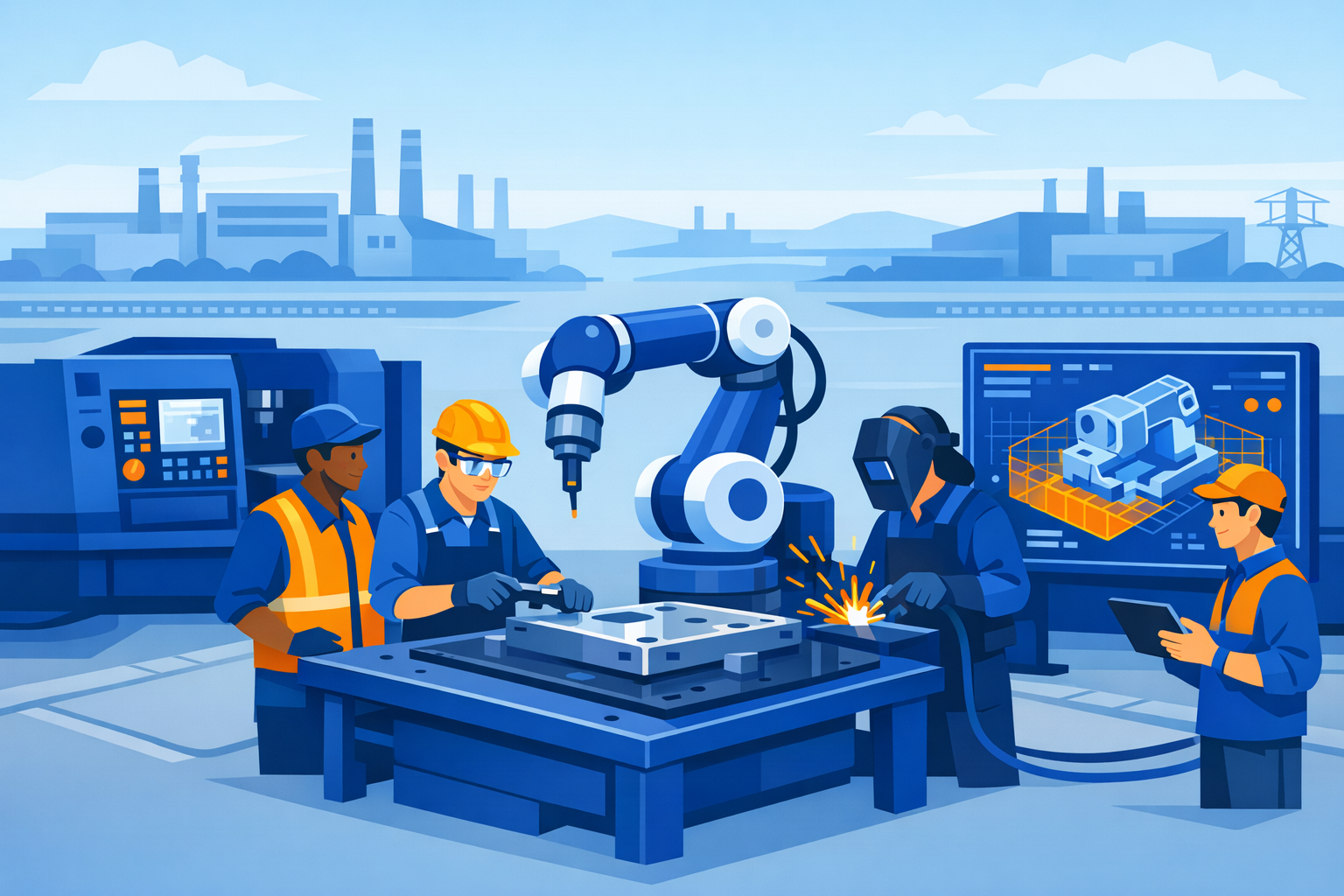
The share of industrial manufacturers expecting to highly automate key processes will rise from 18% to 50% by 2030, according to PwC's Global Industrial Manufacturing Sector Outlook released in February 2026-a forecast with direct capital planning and workforce implications for metalworking and fabrication operations worldwide.
Background
The report draws on responses from 443 senior executives across 24 territories spanning North America, South America, Europe, Asia, and the Middle East and places the global industrial manufacturing sector-valued at approximately US$16 trillion-at what PwC describes as a "historic inflection point." AI, advanced robotics, and broader automation technologies are identified as the primary forces driving a structural shift in how factories are designed, operated, and monetized.
The findings reinforce a trajectory already visible in hardware deployment data. China alone installed roughly 295,000 industrial robots in 2024-approximately 54% of global demand that year-and its operational robot stock has crossed 2 million units, according to International Federation of Robotics data cited by industry analysts.
Details
The headline figure from PwC's survey is stark: the median share of executives indicating their company's activities are largely reliant on advanced technologies is set to more than double by 2030, rising from 26% to 68%. In production and operations-the area most directly relevant to shop floor management-heavy use of advanced technology is projected to reach 76% of respondents by 2030, up from 29% today. Product design and development follows closely, forecast to rise from 37% to 72%.
The report identifies a widening performance gap between what PwC terms "future-fit" manufacturers-the most agile 20% of survey respondents-and the rest of the industry. Future-fit companies already report a median of 29% of processes as highly automated, versus 15% for other firms, and plan to reach 65% automation by 2030 compared with 45% for laggards.
For capital allocation decisions, PwC's research distinguishes between robotics and AI in terms of expected payoff: robotics investment is seen primarily as a productivity driver by 78% of respondents, while AI is viewed as equally likely to deliver growth (47%) and productivity gains (46%).
Ryan Hawk, Global Industrials and Services Leader at PwC US, tied competitive differentiation not to technology access but to integration. "The question is no longer whether companies will adopt new technologies, but how fast they can integrate them," Hawk said in commentary published alongside the report. "As automation becomes ubiquitous, the advantage shifts from who has tools to who can orchestrate them across the enterprise."
The workforce dimension carries equal urgency. Deloitte research shows more than one-third of manufacturing executives cite workforce skills as their top talent concern as investment accelerates in automation, analytics, and smart manufacturing. In the United States, manufacturing job openings ranged from roughly 440,000 to 510,000 through Q1 2026, reflecting a structural shortage of technicians capable of programming, maintaining, and optimizing automated systems. The World Economic Forum has projected that from 2025 to 2030, half of all workers globally will require new skills due to automation-a figure pointing toward significant reskilling investment for plant managers and HR functions across the fabrication sector.
Beyond the factory floor, PwC notes a parallel shift in business models: manufacturers project that 44% of total revenue will come from outside traditional industrial and consumer product manufacturing by 2030, with companies repositioning as providers of integrated hardware, software, and service solutions. That transition carries implications for procurement structures and supplier relationships in fabricated metal components.
Outlook
The divergence between technology leaders and laggards is projected to compound rather than narrow by decade's end, as early automation investments build interoperable data infrastructure that accelerates subsequent deployments. For fabrication operations assessing capital expenditure timing, the PwC data underscores pressure to move beyond pilot deployments toward enterprise-wide automation architectures before 2030. Business support functions such as finance and human resources-currently among the lowest in automation penetration-are forecast to see nearly a fourfold increase in advanced technology use by 2030, suggesting the transition will extend well beyond production equipment into the broader operational stack. The full report, PwC's Global Industrial Manufacturing Sector Outlook 2026, is available through PwC's global website.