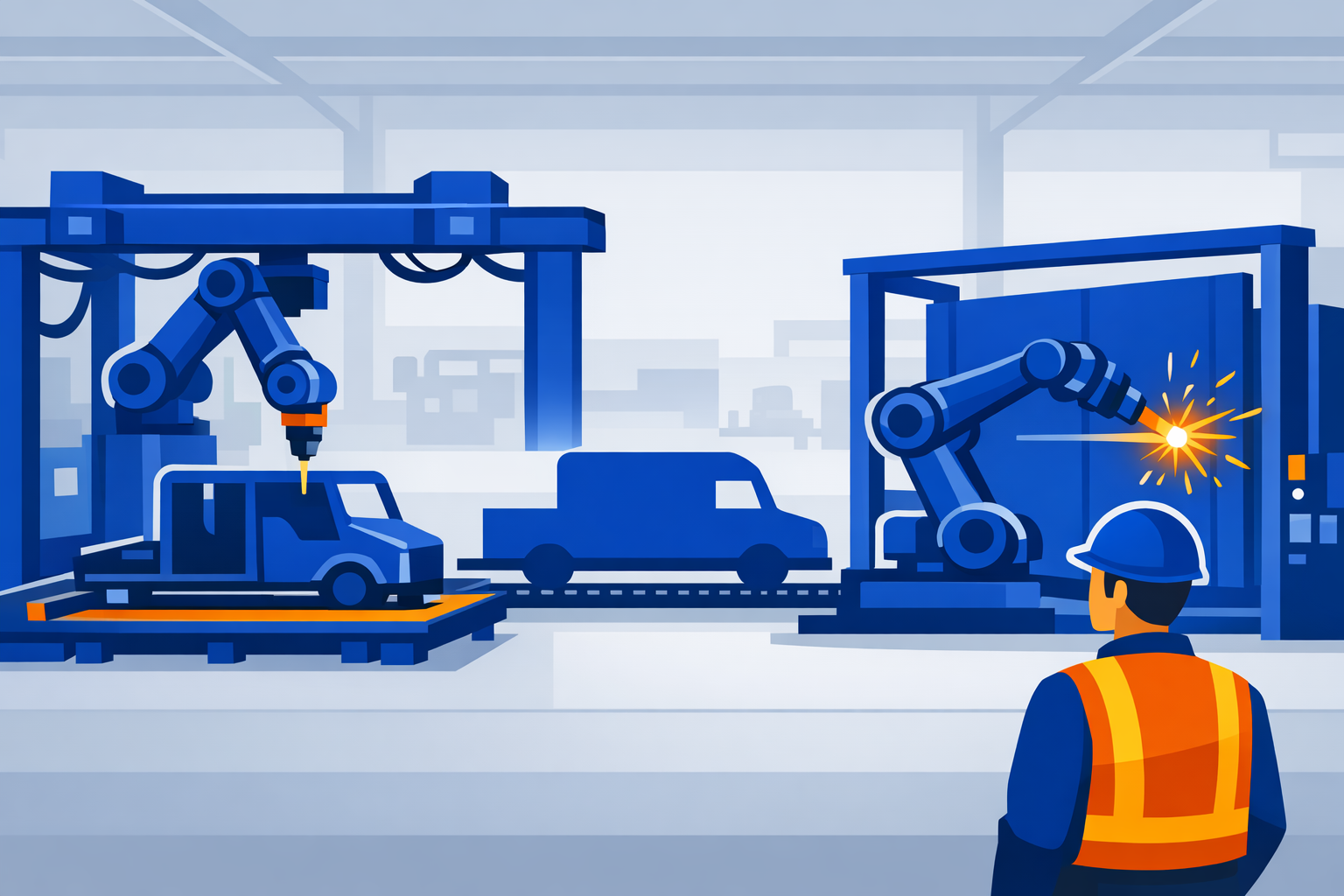
Marion Body Works has brought two major automated fabrication systems online at its Shawano, Wisconsin, facility, completing a phased rollout the company describes as an industry first in commercial truck body manufacturing. The deployments target wall panel assembly and floor construction-historically among the most labor-intensive operations in body fabrication-and signal a broader shift toward integrated, cell-based automation in the North American specialty vehicle sector.
Background
Founded in 1905, Marion Body Works is a family-owned manufacturer of commercial truck bodies, fire and emergency apparatus, and defense vehicles, operating out of Marion and Shawano, Wisconsin. The company's Shawano operation produces a range of commercial dry-freight and specialty truck bodies requiring high dimensional consistency across repeated mixed-product runs. Prior to the automation investment, wall and floor sub-assembly relied predominantly on manual drilling, fastening, bonding, and sealing-processes that introduce operator-dependent variability and constrain throughput at higher volumes. The investment reflects a wider trend across North American fabrication floors, where modular, plug-and-produce automation cells increasingly displace dedicated fixed tooling as manufacturers seek faster changeover between product variants without sacrificing tolerance control.
Details
The automated floor assembly gantry system was installed in November 2025, replacing manual drilling and fastening with a servo-controlled, automated process. According to The Fabricator, the system's integrated router capabilities improve the accuracy, fitment, and appearance of pipe pockets and D-ring installations-features subject to recurring wear and dimensional drift under manual production. The wall automation cell became operational in April 2026, consolidating material preparation, fastening, bonding, and sealing into a single integrated robotic process. A key process element is plasma surface treatment technology, which the company states enhances adhesion and the long-term structural durability of bonded wall panels.
Zach Brockdorf, senior director of operations in Shawano, attributed the investment to both operational and workforce objectives. "We're not just investing in equipment; we're investing in our future," Brockdorf said, adding that the automation is intended to help employees grow their skills and work more safely, supporting long-term talent retention.
Kevin Ignacio, president of Marion Body Works, said the systems advance the company's competitive position. "The fully automated wall assembly and plasma-treated bonding put us at the forefront of innovation in the commercial truck body market," Ignacio stated, noting the investment enables more consistent product quality and faster delivery.
According to Trailer Body Builders, the systems reduce variability in drilling, fastening, sealing, and material preparation, while consolidated processes and predictable cycle times enable higher output with reduced reliance on manual labor. The company also cited reduced lead times as a direct operational benefit, attributing the gain to increased production capacity across both lines.
Outlook
Marion Body Works has confirmed that additional automation projects are planned at other facilities as part of a broader strategy to modernize operations and support long-term growth. The Shawano deployment will serve as the reference architecture for those follow-on investments, according to company statements. For fabricators evaluating similar transitions, the Marion rollout illustrates a phased commissioning model-floor systems first, wall cells second-that allows production lines to remain operational while capital infrastructure is sequentially integrated.