Automated wall and floor production lines at North American modular construction facilities have moved decisively beyond pilot status, with measurable throughput gains, documented waste reductions, and new commercial partnerships signaling a transition to full industrial scale. The shift is driven by persistent labor shortages, housing demand, and a widening performance gap between CNC- and robotics-equipped offsite factories and their manual counterparts - lessons that fabricators and production engineers across adjacent industries are studying closely.
Background
Modular construction has long been favored over traditional site-built methods for its potential to shorten project timelines and lower costs, yet manual assembly has remained slow and error-prone, limiting efficiency gains.[1] Despite the structural advantages of offsite construction, many adopters struggle to unlock its full potential - often because factories reproduce traditional manual workflows rather than redesigning processes around digital tools and automation, causing productivity gains to fall short of expectations.
North America held the largest market share in the robotic panelized homebuilding sector in 2025, with Asia-Pacific positioned to grow fastest during the forecast period. Strategic alliances among startups, factory builders, policymakers, and infrastructure agencies are accelerating industrialization, while state-level incentives and pilot projects help overcome regulatory inertia.
Production Line Performance Data
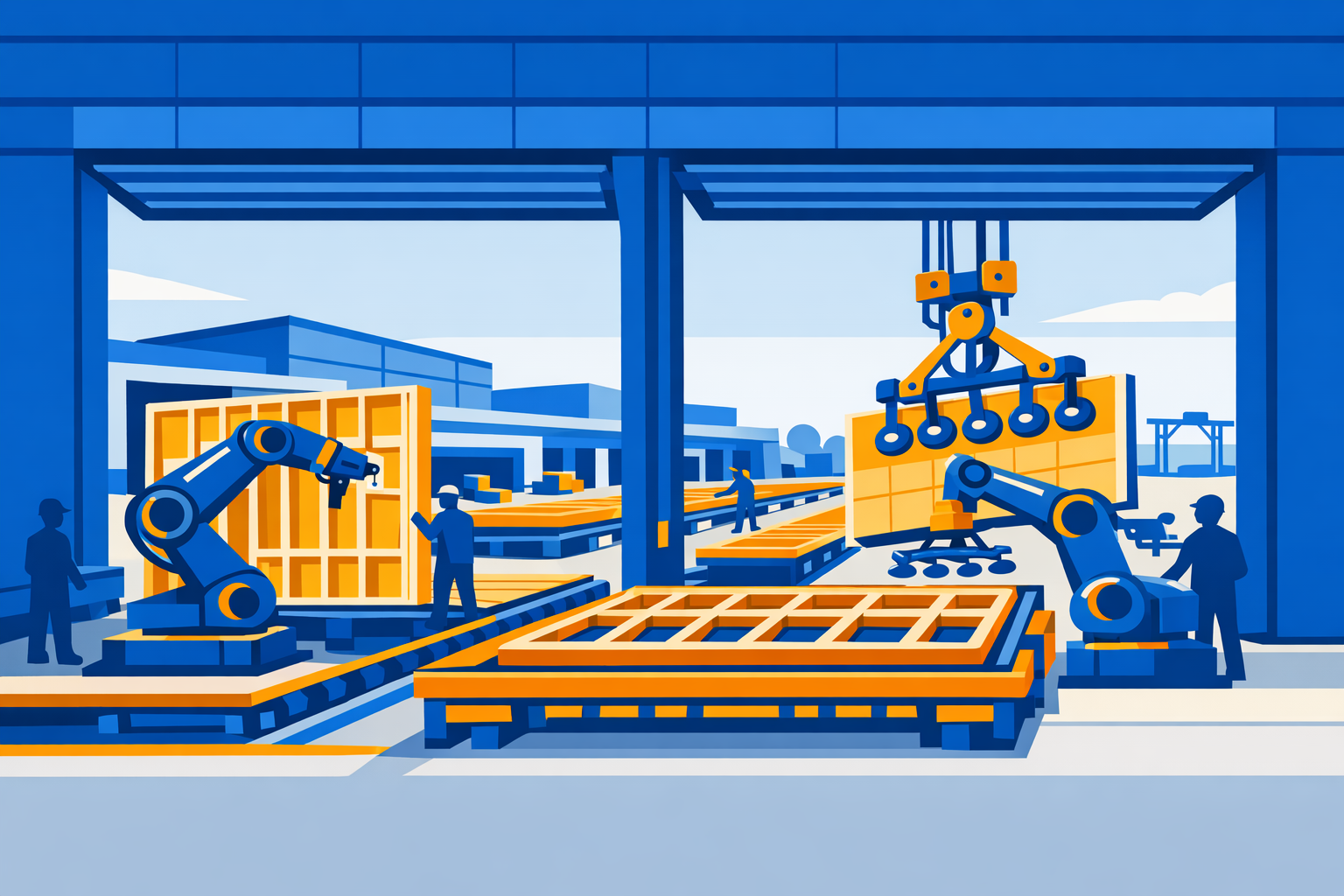
Documented throughput figures from operating automated facilities illustrate the scale of the productivity gap. A fully automated 23-meter wall line using Weinman equipment deploys robots to assemble wall frames - placing pre-cut studs, nailing them, and adding wall boards via vacuum lifter on both sides - producing approximately 55 walls per day before moving them to a buffer area. Electrical wiring, water, and heating components are integrated into the wall panels, while the floor production line operates across six stations using Randek equipment, producing 12 panels per day in an eight-hour shift with pre-cut beams delivered at correct length and assembly sequence for MEP installation.
ABB Robotics reported that on a U.S. project, robotic assembly of modular homes boosted production efficiency by 15% and accelerated output by more than 38%, while cutting waste by approximately 30%. Research published in the Journal of Construction Engineering and Management (ASCE, 2025) by the Modular Building Institute found that CNC-driven fabrication of floor frames and ceilings achieved speeds up to 30% faster, with automated precision cuts ensuring smoother, quicker assembly.
At Autovol's facility in Nampa, Idaho - described by the company as America's top-producing multifamily modular plant - the operation reached a 4,000-module production milestone in 2025, having transformed approximately 24 million board feet of lumber into fully finished apartments and hotel rooms. The wall assembly line runs four stations - sub-element, sub-sub-element, main element, and wall sheathing - averaging roughly 30,000 to 50,000 fasteners per day across all four automated stations.[2]
Supplier Interoperability and Workforce Implications
On the commercial partnership front, Promise Robotics announced a multi-year strategic partnership in September 2025 with Mattamy Homes' Alberta Division - North America's largest family-owned homebuilder. The deal marks a significant milestone as Promise moves to scale its technology across North America, with its systems supporting delivery of single-family, semi-detached, and multi-family residences across two master-planned communities in Alberta.
Promise Robotics deployed its production lines at a new 60,000-square-foot warehouse in Calgary, Alberta, with the facility capable of producing up to 1,000,000 square feet of housing annually. The company's platform combines automated design, robotic fabrication, and streamlined jobsite delivery into one integrated solution, enabling builders to produce code-compliant wall panels and floor assemblies at high speed and precision.
Interoperability between design software and factory execution systems remains a persistent friction point at scale. BIM adoption in modular construction faces technical integration challenges, as compatibility issues between different BIM platforms complicate seamless data exchange. Workforce-related challenges further hinder adoption due to a shortage of professionals with expertise in both BIM and modular construction methodologies.
The workforce dimension is also evolving. In a modular build, up to 80% of traditional labor activity can move offsite to the manufacturing facility, with skill-intensive work - including mechanical, electrical, and plumbing tasks - handled by manufacturing workers. The more standardized, automated factory environment is capable of doubling productivity compared to traditional builds. Autovol reported a female workforce share of approximately 21% as of April 2025, more than double the approximately 10% industry-wide average for U.S. construction production roles, according to the company, reflecting how the factory model is reshaping hiring demographics.
Outlook
Factory robotics, AI-driven quality control, and code-standardized components are expected to scale production further, while disaster resilience initiatives integrate pre-built modules into recovery systems. Promise Robotics has identified expansion targets including Houston, Dallas, Phoenix, Atlanta, Charlotte, Austin, and Nashville as part of its plan to grow homebuilding partnerships across the United States and Canada. High initial costs, advanced maintenance requirements, and the need for specialized operational expertise remain key barriers to widespread adoption. Purchasing robotic systems, integrating production lines, and modifying factory layouts require substantial capital - a particular concern for affordable housing projects.