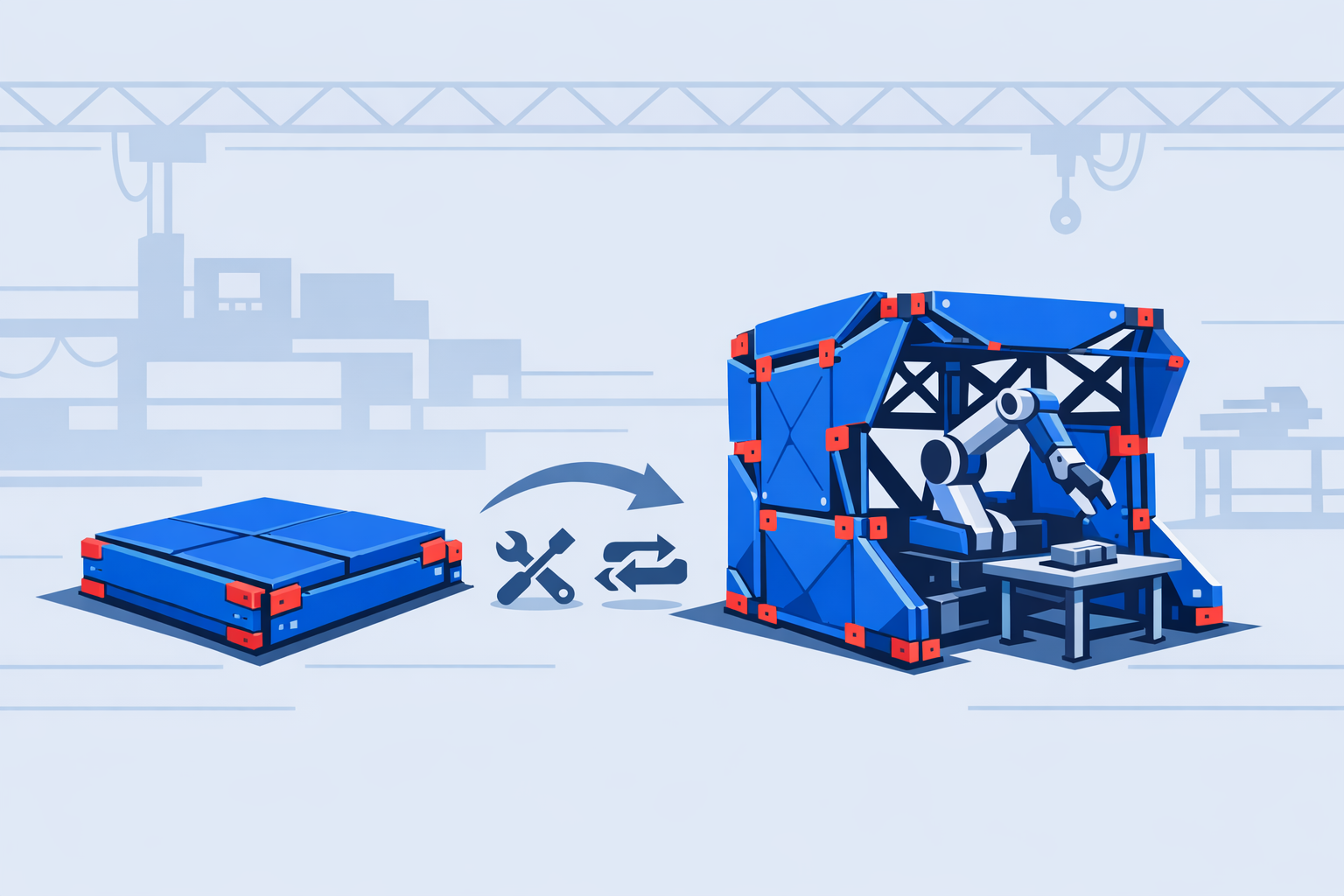
Developers of reconfigurable automation equipment are applying geometric folding principles drawn from Japanese origami to build deployable robotic modules for metal fabrication shops and construction sites, where rapid line changeovers and limited floor space have long constrained automation adoption.
The approach adapts kirigami and origami-derived fold patterns-established in aerospace and biomedical device research-to industrial-scale automation hardware, producing units that ship flat, deploy on-site without fixed infrastructure, and reconfigure between production runs. Proponents argue the format directly addresses the economics of high-mix, low-volume (HMLV) fabrication, where job-specific retooling costs frequently render conventional robot cells impractical.
Background
Origami-inspired engineering applies geometric folding principles to create structures that are compact for storage yet strong and functional when deployed, according to research published in September 2025 by TechXplore. The principle has underpinned advances in deployable spacecraft components, soft modular robots, and miniaturized medical devices over the past decade. Researchers at institutions including the University of Pennsylvania have developed origami fabrication methods capable of producing functional robotic kinematic chains within days.
The commercial parallel is a rapidly expanding modular robotics sector. The global modular robotics market was valued at approximately $14.26 billion in 2025 and is projected to reach $27.92 billion by 2030, according to Mordor Intelligence. A narrower sub-segment covering self-reconfigurable robots-the category most closely aligned with deployable, shape-shifting automation-stood at $1.56 billion in 2025 and is forecast to reach $1.88 billion in 2026 at a CAGR of 20.3%, according to Research and Markets.
High capital barriers remain a key restraint. Purchasing robotic systems, integrating automated production lines, and modifying factory layouts require substantial capital, raising concerns about financial feasibility, particularly for high-mix projects, noted a 2025 Frontiers in Built Environment study on automated modular construction manufacturing. Deployable, flat-pack module designs directly address that barrier by eliminating permanent installation requirements.
Details
The structural appeal of origami-derived mechanisms lies in their ability to reconcile stiffness with reconfigurability. Researchers writing in Science Robotics documented a self-locking foldable robotic arm in which a single electric motor drives both shape and stiffness changes through a perpendicular-folding stiffening mechanism, resolving what has historically been the primary limitation of origami-inspired industrial designs: insufficient structural rigidity under load.
For fabrication and construction environments, material selection moves well beyond paper. Traditional paper used in origami prototyping has been gradually replaced with metal foils, polymer films, and composite laminates for improved mechanical properties, according to a 2025 review in PMC's open-access robotics literature. In industrial-grade deployable modules, aluminum composite panels, high-strength PET laminates, and thermally actuated shape memory alloys provide the fold-and-lock functionality required to meet workshop-floor load and vibration tolerances.
Software integration presents an equally significant engineering challenge. Modular and reconfigurable robotics-the ability to quickly reconfigure robot hardware and software for different tasks-is identified as a key driver of flexibility in high-mix, low-volume production for 2026, according to Mitsubishi Manufacturing. Industry safety compliance guidance for deployable reconfigurable units falls under existing frameworks: ISO 10218-1, ISO 10218-2, and ISO/TS 15066 define safety requirements for industrial robots and collaborative robot systems, and are increasingly applied to modular configurations, according to market analysis from Research and Markets. Compliance requires validation across all possible deployed configurations, adding engineering overhead for systems that reconfigure mid-shift.
Pilot-scale interest is growing across both sectors. At Evertiq Expo Tampere in April 2026, modular robotics and pragmatic automation for high-mix, low-volume production took centre stage, with industry leaders outlining how manufacturers can unlock agility through reconfigurable robotic systems. In construction, voxel-based modular inchworm robots using snap-fit connections and gripper-based placement are being evaluated for structural assembly tasks, according to reporting by Construction Connect in May 2026. In November 2025, Direct Drive Technology launched the D1, a fully modular embodied intelligence platform capable of autonomously reconfiguring its structure for diverse industrial and service tasks within smart manufacturing settings, according to Research and Markets.
The workforce implications are substantial. The need for skilled workers to operate and maintain sophisticated reconfigurable robotic systems poses a hurdle to wider adoption, particularly in smaller fabrication companies, according to Data Insights Market. Training programs targeting multi-axis cobot hand-guiding, fold-state verification, and module-to-PLC communication protocols are expected to become prerequisites for shop-floor operators working alongside deployable automation cells.
Outlook
After several years of cautious spending, many manufacturers are releasing delayed automation investments in 2026, recognizing that delaying automation creates competitive risk, according to Rapid Electronics. Standardization of inter-module communication protocols and fold-state verification procedures will be critical to broader adoption in fabrication environments where dimensional accuracy and weld repeatability are non-negotiable. Analysts at Research and Markets project the self-reconfigurable robot segment will reach $3.96 billion by 2030 at a CAGR of 20.5%, driven by rising investment in smart manufacturing and the ongoing push for rapid-response production capacity across metalworking and construction sectors.