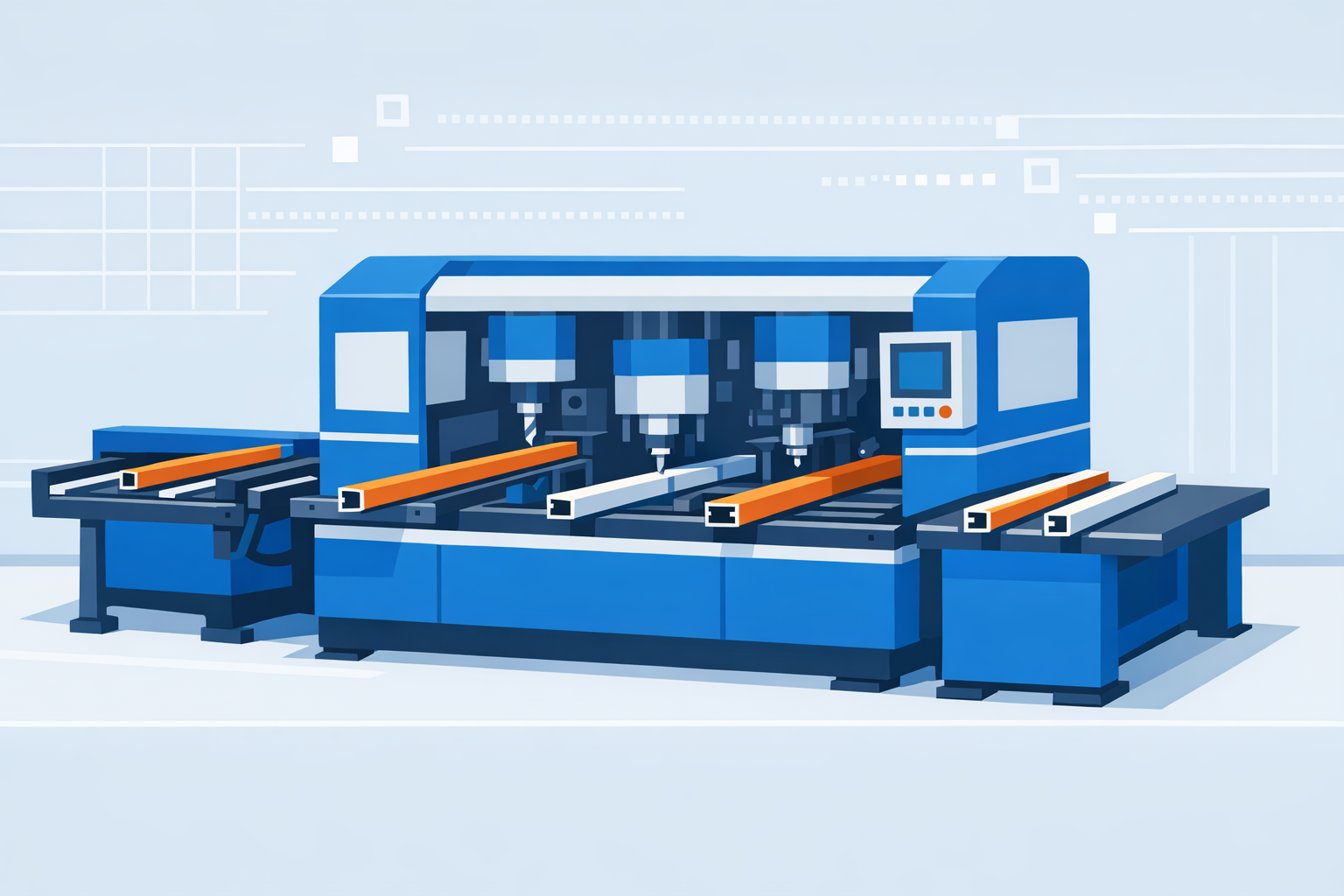
PDS IG, LLC has launched a fully automated Muntin Machining Center - a three-axis CNC platform that cuts and punches muntin bars for insulating glass units without the die-change overhead common to conventional equipment. The Prairie du Sac, Wisconsin-based manufacturer says the system processes both contour and flat bars, including two-tone materials, in a single automated workflow. The architecture signals a wider push toward end-to-end CNC automation in low-to-medium-volume fenestration fabrication.
Background
Muntin bars - inserted into the gas space between glass panes to create the visual appearance of divided lites - have historically been produced on dedicated punch presses requiring operators to swap expensive, profile-specific dies when shifting between bar geometries. Without an automated system, switching between different muntin bar assembly sizes forces manual jig and tooling changes, generating extended downtime that compounds as market demand for customized muntin assemblies grows. For fabricators running mixed product schedules, a routine condition in custom window and door manufacturing, that changeover friction directly compresses throughput and complicates delivery commitments.
PDS IG Equipment traces its origins to Infinite Edge Technologies, founded in 2008 by Eric Rapp, former president of Cardinal IG. PDS IG Equipment was formed in 2011 to develop equipment supporting those technology platforms. Since inception, the company has focused on high-speed, highly automated, cost-effective solutions for the insulating glass and window fabrication industries.
The launch comes as the cutting CAD/CAM software market, estimated at $15 billion in 2025, is projected to reach approximately $28 billion by 2033 at an 8% compound annual growth rate, according to market analysis - reflecting sustained capital investment in digitally connected fabrication infrastructure across the manufacturing sector.
Details
The Muntin Machining Center uses three-axis CNC technology to cut and punch muntin bars, eliminating the need for expensive dies that wear out on conventional machines. The machine features an automated muntin feed for 152-inch bars, handles both rectangles and contours with two-tone capabilities, and includes an "explosion-proof" vacuum system, according to company information.
The platform processes both contour and flat bars, including two-tone materials, while removing the financial burden of traditional punches and dies. By routing geometry data directly to CNC toolpaths rather than interchangeable hard tooling, the system shifts variant management from the toolroom to the control software - reducing changeover to a program call rather than a physical die swap.
This integration pattern aligns with developments elsewhere in connected manufacturing. Collaboration between CAM systems and IT solutions such as MES, PLM, and tool management platforms is increasingly common. Industry observers note a move toward fully connected engineering environments where design, simulation, and shop-floor execution are tightly linked through modern CAD/CAM systems rather than isolated point solutions. For fabricators evaluating the PDS IG platform, that context matters: the value of a die-free CNC cell scales directly with how cleanly upstream design data - window dimensions, grid patterns, bar profiles - can be handed off to the machine controller without manual re-entry.
A critical aspect of advancing manufacturing automation is building a robust "digital thread" that allows data to flow seamlessly across the entire production lifecycle. In practice, CAD-to-CAM data handoffs must be validated before deployment: toolpath post-processors must match the machine's controller firmware, and any MES or ERP order-routing logic must be tested against the automated feed sequence to avoid bar-length conflicts at the machine queue level.
The broader CNC automation landscape is shifting rapidly toward fully autonomous, AI-driven machining environments. Large-scale adoption of robotic tending, self-optimizing toolpaths, edge-based AI monitoring, digital twins, and adaptive machining is in evidence across 2026. Die-free, CNC-based muntin production fits that trajectory: probing cycles in current-generation CNC systems feed dimension data directly into offset registers, enabling adaptive corrections to errors as small as 0.002 mm, according to industry sources - a tolerance range relevant to the precise notching geometry required for muntin bar interconnects.
Outlook
For fenestration fabricators running high-mix, low-to-medium-volume schedules, the PDS IG system offers a concrete reference point for evaluating CNC-based automation beyond traditional high-volume commodity applications. Manufacturing in 2026 is defined by Industry 4.0 principles - interconnected systems, data-driven decision-making, and smart automation. Manual programming and isolated design processes are considered too slow, too error-prone, and too costly in a market where customization and rapid turnaround are expected. Manufacturers considering similar investments should map KPI targets - cycle time per bar, changeover frequency, scrap rate - against current performance before committing to integration scope, and plan operator retraining around CNC program management rather than tooling setup procedures.