The share of industrial manufacturers with highly automated key processes will more than double by 2030, according to PwC's Global Industrial Manufacturing Sector Outlook published February 27, 2026. The proportion is forecast to rise from 18% to 50%, a shift with direct consequences for capital allocation, workforce structure, and competitive positioning across the metalworking and fabrication sector.
Background
The study surveyed 443 senior executives across 24 territories and finds the global $16 trillion industrial manufacturing industry at a historic inflection point, with AI, advanced technologies, and automation accelerating growth and productivity. The report arrives as manufacturers continue to absorb cost pressures from supply chain disruption, skilled labor shortages, and intensifying competition from Asian producers. For fabricators and metalworking plants, automation decisions now carry consequences well beyond individual production lines - they affect long-term plant viability and sourcing relationships.
The research reveals a widening divide: a future-fit cohort is pulling ahead by combining technology with clean data, interoperable systems, and cultures that learn and adapt quickly, while others risk falling behind due to skills gaps, fragmented infrastructure, and organizational friction.
Key Data
The median share of manufacturers indicating their operations are largely reliant on advanced technologies is set to rise from 26% to 68% by 2030, according to PwC's survey of 443 executives. Within the value chain, production and operations and product design and development will lead adoption, with heavy use reaching 76% (from 29%) and 72% (from 37%), respectively. Business support functions such as finance and human resources, where adoption remains low today, are set to quadruple by the end of the decade.
PwC identifies the top 20% of surveyed companies as "future-fit," currently reporting a median of 29% highly automated processes versus 15% for all others - a gap projected to widen to 65% versus 45% by 2030.
The report also signals a structural revenue shift. Respondents expect 44% of total revenue to come from outside the manufacturing of industrial or consumer products by 2030. As automation surges, manufacturers are positioning themselves as providers of integrated solutions combining hardware with software, data, services, and technology support.
Ryan Hawk, Global Industrials and Services Leader at PwC US, attributed the performance gap to integration rather than adoption alone. "The question is no longer whether companies will adopt new technologies, but how fast they can integrate them," Hawk said. "As automation becomes ubiquitous, the advantage shifts from who has tools to who can orchestrate them across the enterprise."
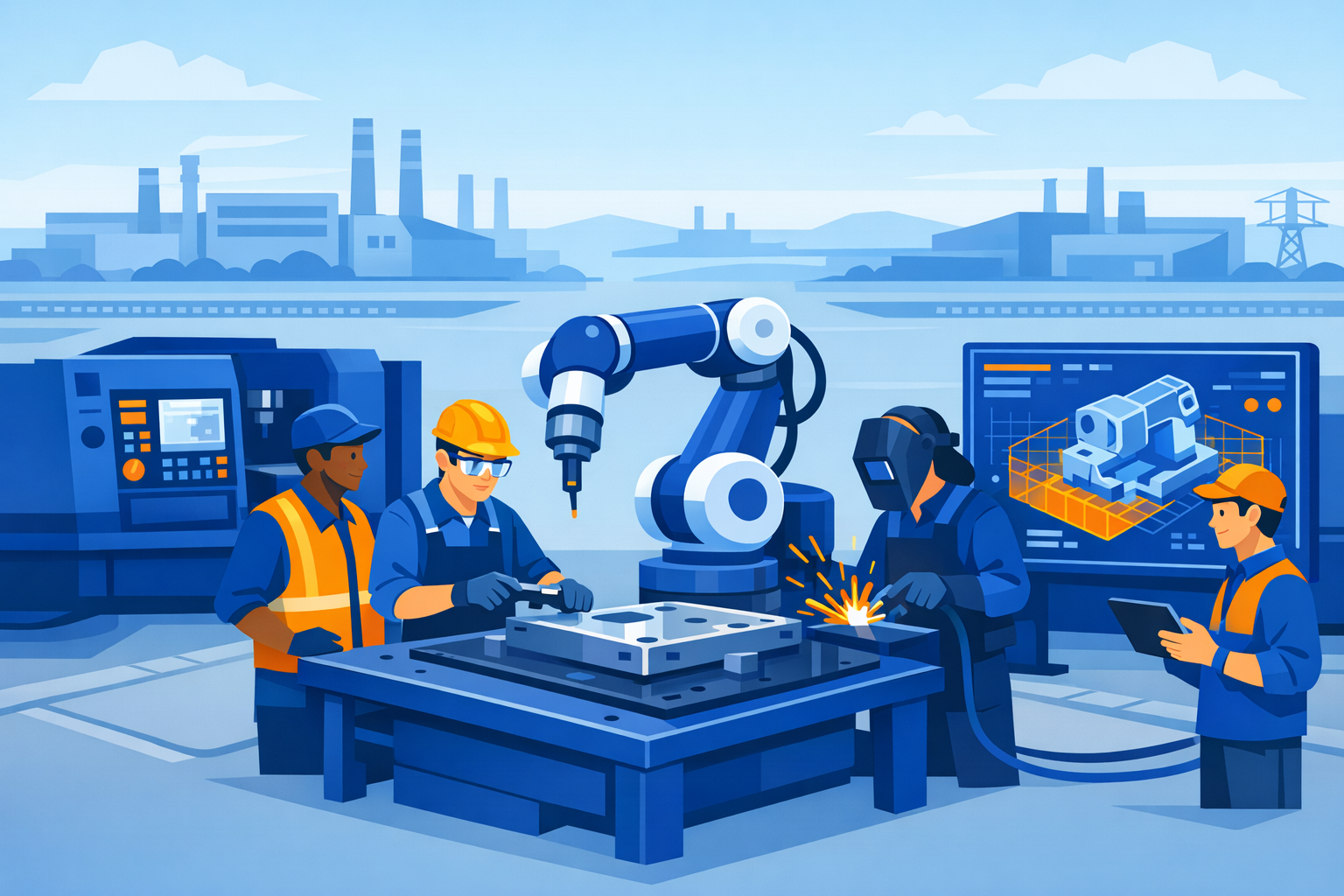
For metalworking operations specifically, the data points to accelerating deployment across welding, cutting, and material handling cells - areas where automation intensity correlates directly with throughput, defect rates, and tooling utilization. Workforce dynamics continue to challenge manufacturers across North America. Skilled labor shortages and an aging workforce are forcing organizations to rethink production models, as automation helps maintain throughput and quality while reducing dependence on manual, repetitive tasks.
Outlook
Although 70% of manufacturers say developing capabilities internally is their top approach to accessing growth opportunities, many risk underinvesting in workforce reskilling and digital and data infrastructure - a gap the report identifies as the primary barrier to realizing projected productivity gains. The divide between future-fit companies and those falling behind due to poor data quality, skills gaps, or fragmented systems could widen further as technology and capability advantages compound. Fabricators and plant operators evaluating capital expenditure timelines will need to weigh automation investment not only against near-term ROI, but against the risk of falling irreversibly behind peers accelerating toward integrated, AI-orchestrated production.