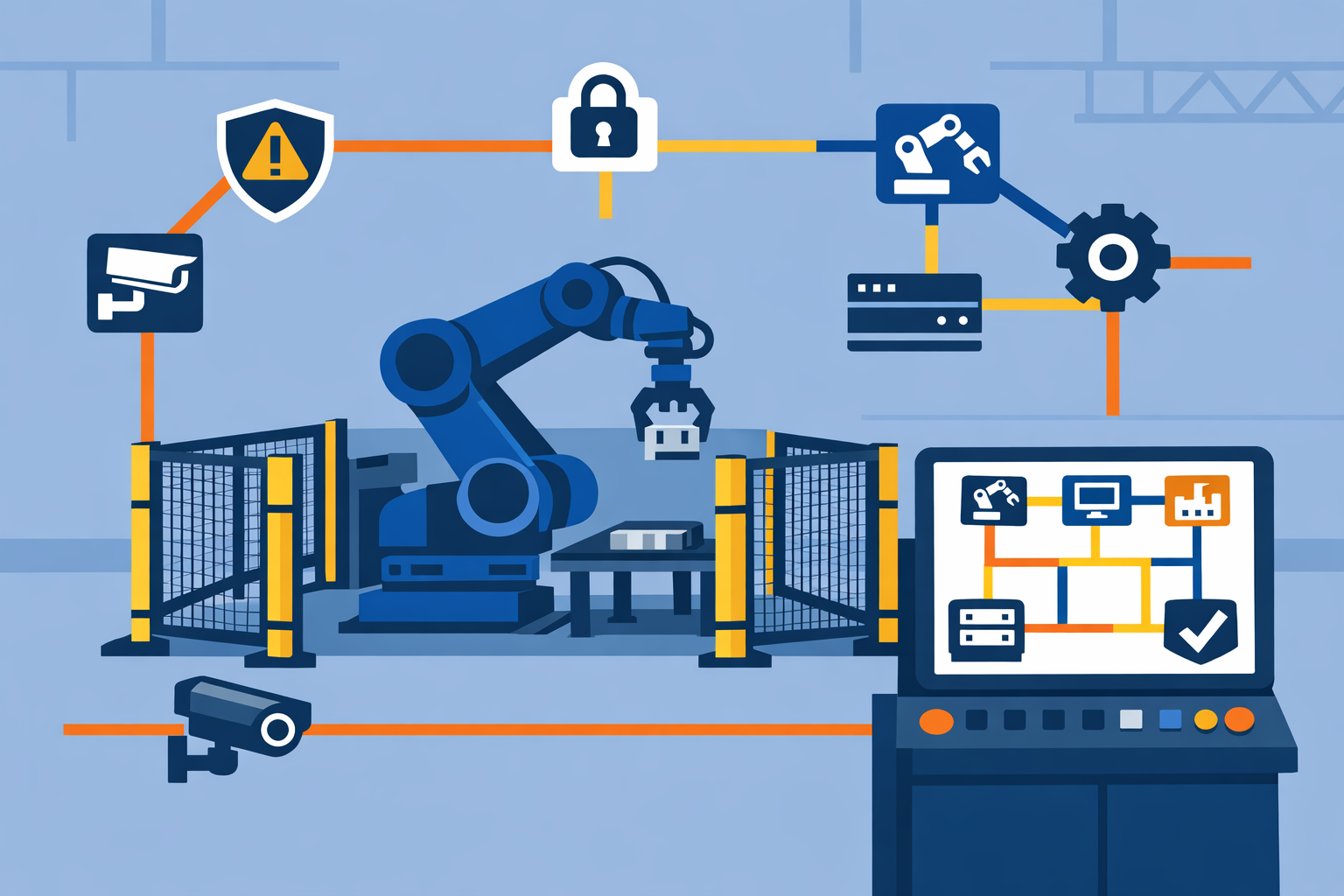
The Association for Advancing Automation (A3) and the American National Standards Institute (ANSI) have published ANSI/A3 R15.06-2025, the first comprehensive revision to the U.S. national industrial robot safety standard in over a decade. The update introduces clarified functional safety requirements, explicit cybersecurity guidance, and updated frameworks for cross-vendor system integration-changes with direct compliance implications for metal fabrication shops and manufacturers operating mixed-vendor robot cells.
Background
A3 and ANSI announced publication of R15.06-2025, adapted from ISO 10218-1:2025 and ISO 10218-2:2025, both jointly published in January 2025. This marks the first major revision to R15.06 in nearly 15 years. In the U.S., R15.06 is a voluntary consensus standard that falls under OSHA's General Duty Clause, which obligates employers to maintain a workplace free from recognized hazards.[1]
No specific OSHA standards exist for the robotics industry. Instead, OSHA enforcement of robotics safety has historically relied on the General Duty Clause alongside existing national consensus standards. OSHA applies a three-factor approach to safety that places responsibility on the robot designer/manufacturer, the system integrator, and the employer. The employer must also ensure that system integration includes site acceptance testing (SAT), a process confirming robotic equipment performs as expected given the site's machine interfaces, environmental characteristics, and utilities.
More than 4.2 million industrial robots were deployed worldwide as of 2023, with new installations continuing to grow globally across industries including automotive, aerospace, supply chain logistics, and additive manufacturing.
Key Technical Changes
The scope and depth of the update are substantial. ANSI/A3 R15.06-2025 expanded from 162 to 374 pages, with ISO 10218-2 growing from 72 to 223 pages, according to A3. The standard, which took seven years to revise, does not represent a radical change in requirements but provides significantly more clarification. It covers safety for industrial robots as manufactured and their integration into applications. "There are now more than 30 safety functions in the 2025 version, whereas the 2012 document only had two to three," a standards expert told ISHN.[2]
The new R15.06 Parts 1 and 2 feature extensive updates focused on making functional safety requirements explicit rather than implied-a shift that enhances clarity and usability, making compliance more straightforward for manufacturers and integrators. For facilities integrating sensing, safeguarding, and control components from multiple vendors-a common configuration in mid-market fabrication shops-the explicit treatment of safety functions provides a clearer framework for validating cross-vendor robot cells.
Key enhancements include clarified functional safety requirements that improve usability and compliance; integrated guidance for collaborative robot applications, consolidating ISO/TS 15066; new content on end-effectors and manual load/unload procedures; updated robot classifications with corresponding safety functions and test methodologies; and cybersecurity guidance now included as part of safety planning and implementation.
The definition of "safeguarded space" now encompasses dynamic protections such as sensors and area scanners, extending beyond traditional fences or barriers. This revision is directly relevant to welding, cutting, and press-tending cells in metal fabrication, where laser-area scanners and light curtains from third-party vendors must now be evaluated within a defined, standards-compliant risk assessment workflow.
Terminology has also been revised. The term "safety rated-monitored stop" has been renamed "monitored standstill" for technical accuracy, as it applies beyond collaborative applications.[3] The terms "collaborative robot" and "collaborative operation" do not appear in the revised ISO 10218; "collaborative application" is used instead, as only the actual use of the robot can be designed, tested, and confirmed as a collaborative application.
Functional safety requirements have been clarified and cybersecurity requirements pertaining to industrial robot safety have been added. According to KEBA automation engineers, the requirements for functional safety and cybersecurity should not be underestimated, as development times of several years-including certification by an accredited body-are not unusual.
A new Part 3, targeting end-users directly, was published on October 29, 2025. While Parts 1 and 2 represent the U.S. national adoption of ISO 10218, Part 3 is a new, U.S.-developed standard. Because ISO standards do not address user requirements, Part 3 was developed domestically in collaboration with standards development experts in both the United States and Canada.
Industry Response and Outlook
Carole Franklin, director of standards development for robotics at A3, said the standard "delivers clearer guidance, smarter classifications, and a roadmap for safety in the era of intelligent automation." Franklin added: "With automation evolving at an unprecedented pace, it is essential that safety standards keep up with the latest advancements. This is a critical step in ensuring that as automation grows, worker safety remains a top priority."
Regulatory convergence is expected, with greater alignment anticipated between ISO, ANSI/RIA, and regional authorities such as those enforcing the EU Machinery Regulation-including harmonized definitions, standardized test procedures, and global force and pressure benchmarks. In Europe, the standard is expected to take effect alongside the EU Machinery Regulation on January 20, 2027.
For fabricators and manufacturers currently running legacy robot cells built to the 2012 standard, the transition will require a structured review of safety function documentation, risk assessment records, and third-party safeguarding equipment. Employers integrating any robotic system should maintain records of all testing performed and track system safety over time, as these records become valuable during future safety inspections. Compliance means more than selecting a "safe" robot-it requires application-specific risk assessments, validated safety functions, and ongoing reviews as processes change.