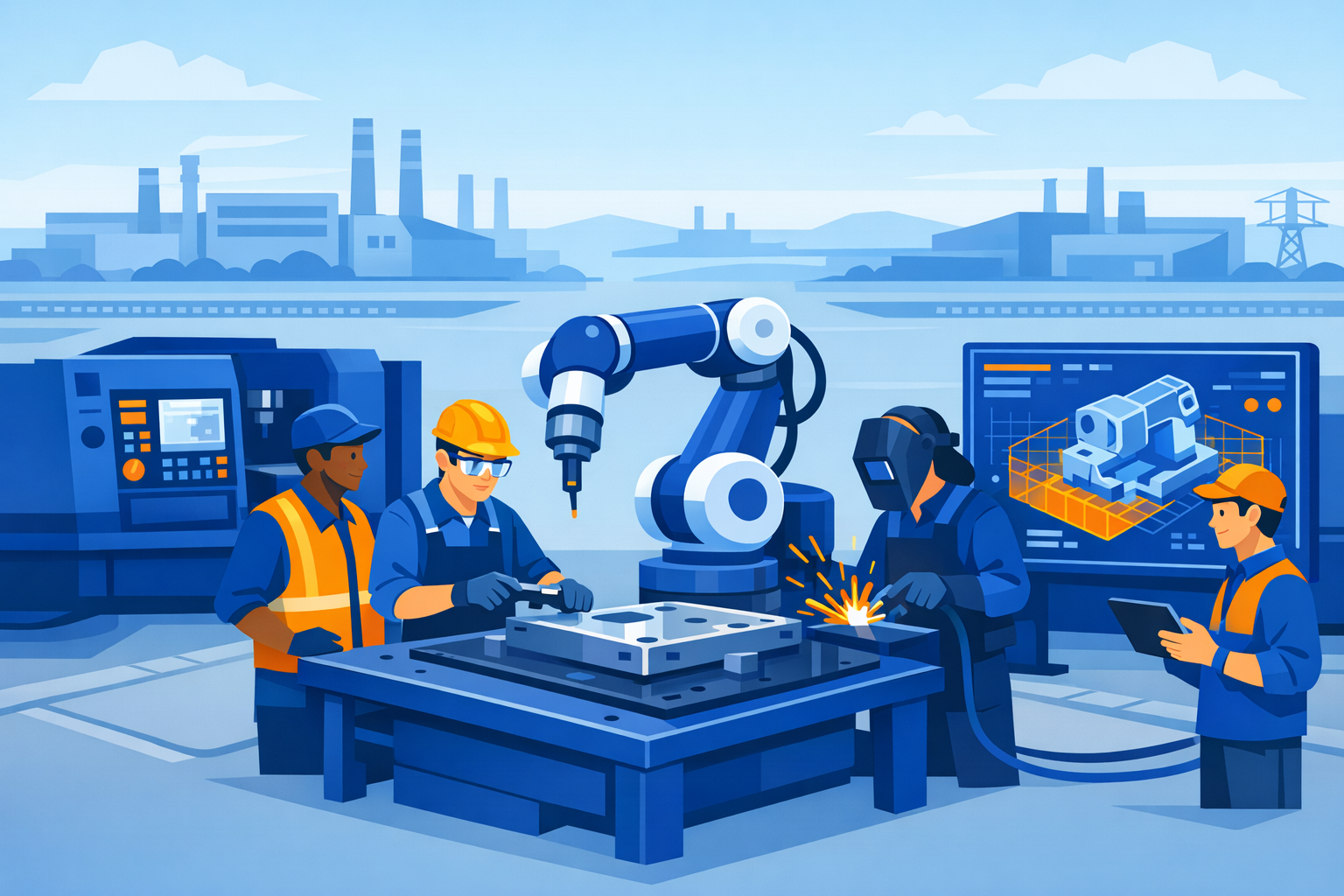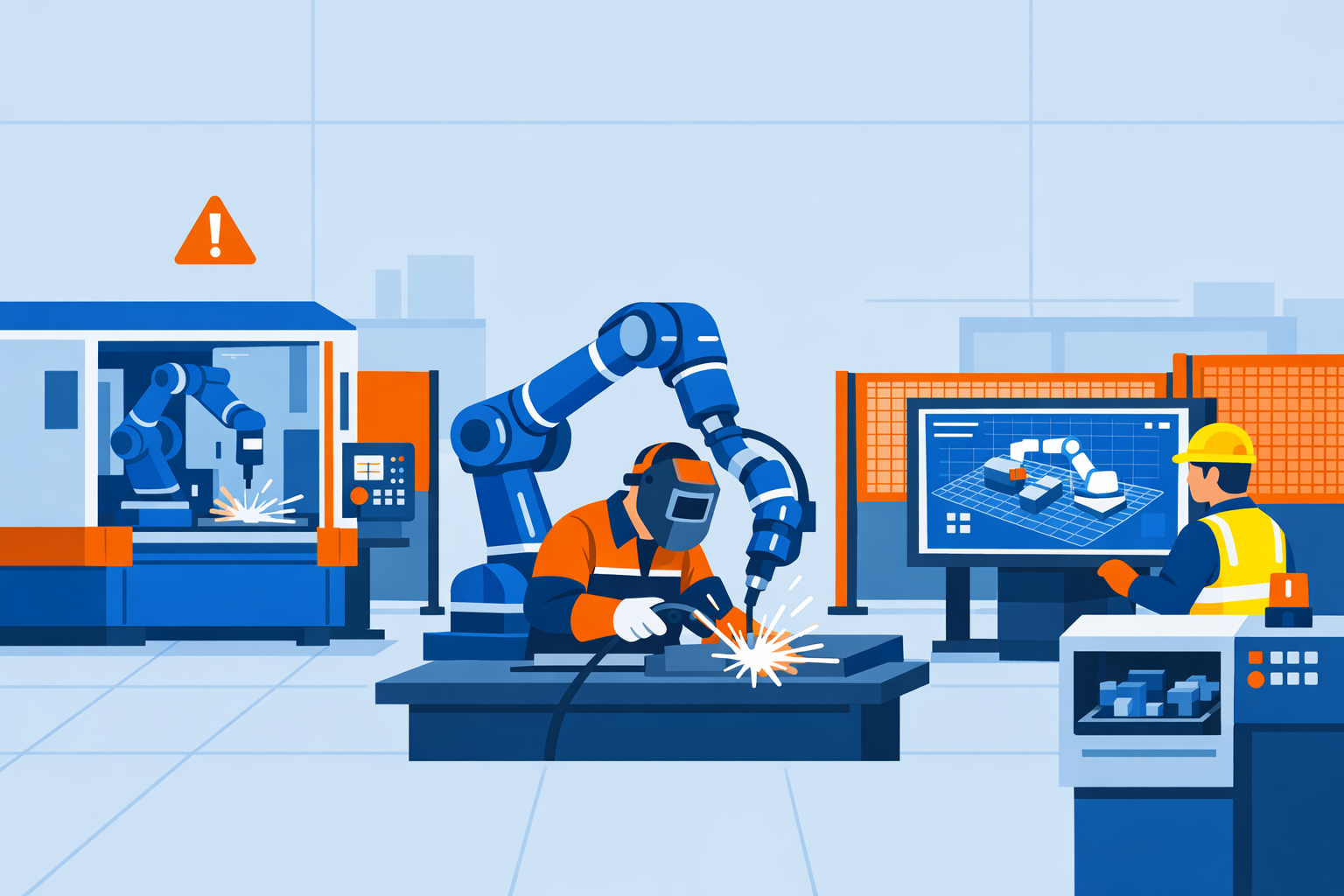
Collaborative robots are moving from pilot programs to production-floor fixtures in North American metal fabrication shops, driven by updated safety regulations, a persistent skilled-labor shortage, and demonstrated payback periods that satisfy capital expenditure committees. The shift coincides with a landmark revision of industrial robot safety standards and an acceleration in cobot unit shipments that analysts describe as a structural, not cyclical, trend.
Background
The labor pressure underpinning this expansion is substantial. One study projects that 2.1 million U.S. manufacturing jobs could go unfilled by 2030 due to a skills gap, according to industry research cited by cobot solution providers. Metal fabrication has felt this acutely: the welding industry faces a shortage of approximately 320,500 unfilled positions projected by 2029, according to workforce analyses tracking cobot welding ROI.
Against that backdrop, U.S. cobot installations increased 18% year-over-year between 2023 and 2025, with metal fabrication ranking among the highest-growth verticals, according to market intelligence firm Global Growth Insights. North America currently holds a 32% share of global cobot revenue, and cobots now account for over 39% of SME automation budgets in the region, the same source reported.
The regulatory environment also shifted materially in late 2025. The Association for Advancing Automation (A3) published ANSI/A3 R15.06-2025 in September 2025, marking the first major revision to the U.S. industrial robot safety standard in over a decade, according to A3. The updated standard is the U.S. national adoption of ISO 10218-1:2025 and ISO 10218-2:2025. Critically, the revised standard replaces the term "collaborative robot" with "collaborative application," establishing that safety must be defined at the application level rather than by the robot hardware itself, according to A3 and the ISO standards committee. Carole Franklin, director of standards development, robotics at A3, described the update as delivering "clearer guidance, smarter classifications, and a roadmap for safety in the era of intelligent automation."
Details
On the shop floor, cobots are deployed most intensively in welding, plasma cutting, machine tending, deburring, and part loading/unloading-tasks characterized by high repetition and ergonomic risk. Hirebotics, a Nashville-based cobot solutions provider and Universal Robots' top OEM award winner for three consecutive years, reports that over 800 fabrication shops now use its systems across metal fabrication, shipbuilding, aerospace, and related sectors.
Hirebotics states that cobots equipped with its Beacon cloud platform can be operational within hours of delivery, with first production welds achievable in under 15 minutes without prior programming experience, according to the company. Matt Bush, co-founder and CEO of Hirebotics, told The Robot Report that metal fabrication, palletizing, and data center construction are leading cobot adoption, with rural labor markets-where finding certified welders is "difficult, if not impossible"-driving some of the fastest uptake.
Universal Robots used FABTECH 2025 in Chicago to unveil the UR8 Long cobot, engineered specifically for fabrication welding. The UR8 Long weighs approximately one-third of a traditional industrial welding robot yet achieves an arm reach of just under 69 inches, matching larger industrial models, according to The Fabricator. Its compact footprint allows repositioning across a shop without facility modifications-a key criterion for high-mix, low-volume environments where part families change frequently.
AI-enabled cobots with autonomous path planning and vision-based object detection represent 15% of new installations in 2025, a figure expected to rise sharply over the next decade, according to Global Growth Insights. Vectis Automation's Clarity Data Insight Dashboard, also showcased at FABTECH 2025, captures production metrics including arc-on time, cycle times, and program efficiency to support predictive maintenance and uptime planning.
On the financial case: ROI analyses from fabrication deployments consistently indicate a payback window of 12 to 24 months, driven by throughput gains, reduced rework, and labor redeployment, according to multiple industry benchmarking sources. High-utilization shops running multi-shift cobot welding operations frequently achieve payback in under 12 months, according to fabrication automation specialist Jagco. A cobot serving three CNC machines through vision-guided machine tending typically achieves payback in 10 to 14 months, with machine utilization-not labor savings alone-as the primary driver, according to deployment data compiled by automation consultancies.
Industry observers caution that the fastest returns occur where cobots complement skilled labor rather than displace it outright. Bush noted that companies replacing welders with cobots frequently "trade one challenge for another"-exchanging a welder shortage for a programmer shortage-and that system design should allow shop-floor operators, not engineers, to manage the equipment.
Outlook
The global cobot market crossed $3.5 billion in 2025 with nearly 150,000 units shipped, and analysts at Omdia expect the market to more than double within three years, according to Manufacturing Dive. IMARC Group forecasts the U.S. cobot market will reach over $8 billion by 2033, implying a compound annual growth rate of approximately 28% from 2025, reflecting sustained adoption momentum across fabrication, logistics, and adjacent sectors.
For fabrication shops weighing broader rollouts, the evolving compliance landscape under ANSI/A3 R15.06-2025 requires plant safety teams to conduct formal risk assessments at the application level, integrating force/torque monitoring, speed supervision, and cybersecurity controls into each deployment cell-a procedural shift that safety engineers expect will standardize human-robot interaction protocols across North American shop floors.