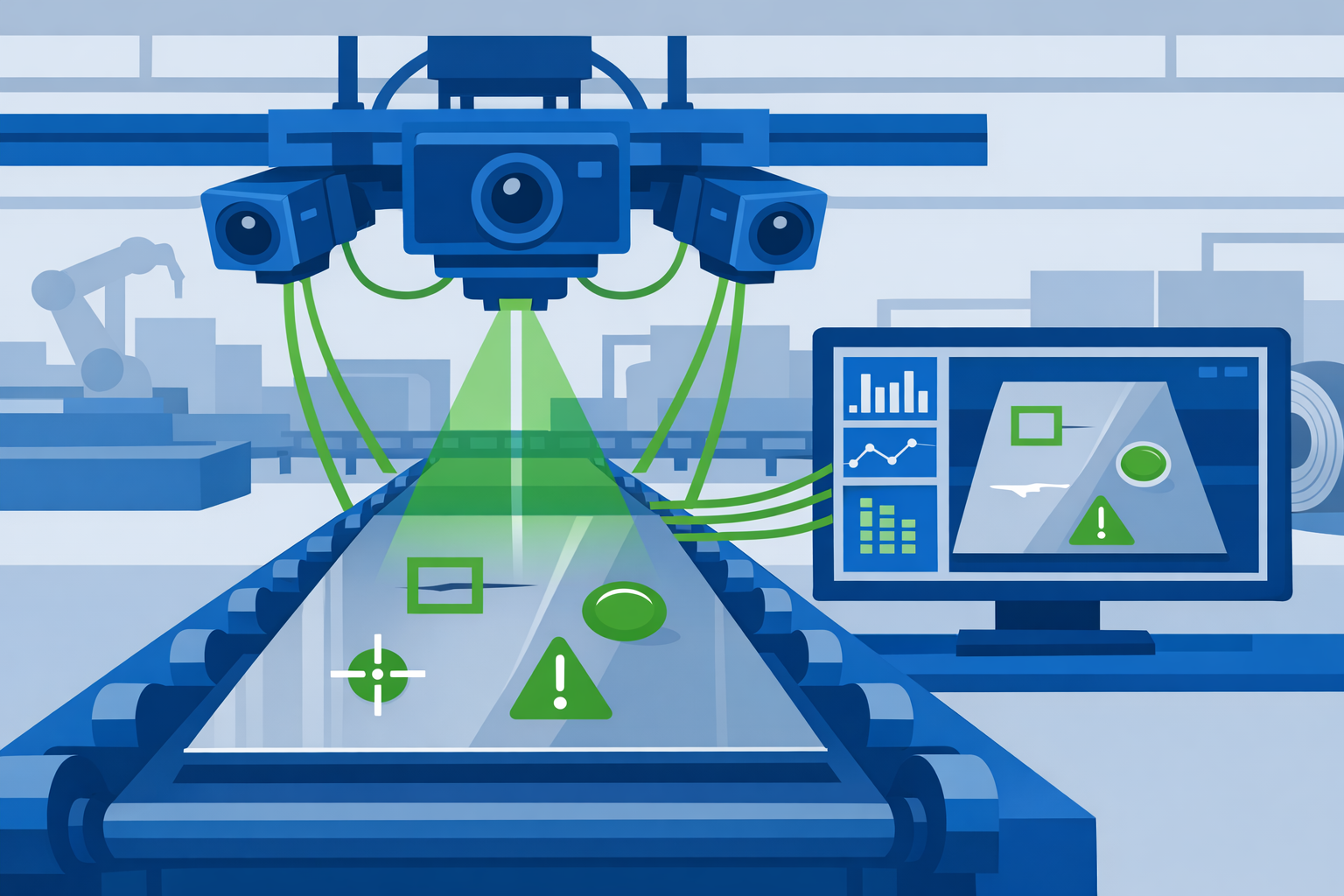
U.S. metal fabricators are advancing AI-driven defect detection from controlled pilot programs to full multi-line production floors, driven by tightening software transparency requirements and growing cross-plant telemetry demands from customers and regulators alike. The shift marks a turning point for mid-size shops that previously lacked the IT infrastructure to sustain enterprise-grade machine vision deployments. It arrives alongside a broader federal push to standardize how embedded industrial software is documented and disclosed.
Background
Automation of quality inspection in metal fabrication has accelerated sharply. The global AI industrial defect detection market is projected at approximately $2.66 billion in 2025, according to industry analysts, reflecting rapid adoption across rolling mills, stamping lines, and weld inspection stations. For most of the past decade, deployments remained confined to single-line pilots at larger producers. The challenge for mid-size fabricators was sustaining model performance across varied part geometries, alloy finishes, and shift-to-shift lighting conditions.
Regulatory pressure now adds urgency to the scaling effort. In August 2025, the Cybersecurity and Infrastructure Security Agency (CISA) and the Department of Homeland Security released a draft revision of the Minimum Elements for a Software Bill of Materials (SBOM) - the first major update since 2021, according to CISA and RunSafe Security. The draft introduces mandatory fields including component hashes, license data, and generation context, substantially raising the documentation bar for AI inference software embedded in production-line controllers and edge devices. For fabricators deploying machine-vision stacks on shop-floor hardware, those requirements extend directly into OT environments.
On the cybersecurity front, the stakes are quantifiable. IBM's 2026 X-Force Threat Intelligence Index reported that manufacturing accounted for 27.7% of all cyber incidents observed in 2025, making it the most attacked industry for the fifth consecutive year, according to market research cited by Global Reports Store. Honeywell's 2025 Cyber Threat Report found that ransomware attacks targeting industrial operators rose 46% from Q4 2024 to Q1 2025.
Details
Performance data from live deployments illustrates why shops are committing capital. AI vision systems now detect and classify over 200 types of metal surface defects at full production speed - up to 2,000 meters per minute - with 95-99% detection accuracy and a minimum resolvable defect size of 0.1 mm, according to iFactory. By contrast, human inspectors working an eight-hour shift detect 60-70% of surface defects under good conditions, dropping to 40-50% on night shifts, and cannot resolve anomalies below 0.5 mm at line speeds above 300 meters per minute.
A leading U.S. steel producer that deployed Matroid's AI defect detection system achieved 99.8% precision and 98.8% recall on transverse and longitudinal crack detection in steel slabs, compared with a 60-70% human accuracy baseline, according to Matroid. The deployment unlocked over $2 million in annual labor redirection savings by freeing metallurgists from routine slab inspection to focus on upstream process optimization.
The economics of full-line scaling follow a consistent pattern. A comprehensive AI surface inspection deployment covering hot strip, cold mill, and coating lines runs $2 million to $5 million, with most mills achieving payback within 12 to 18 months from downgrade reduction alone - generating $3 million to $12 million per year in saved material downgrades and $1 million to $4 million per year in reduced customer claims, according to iFactory data.
Integration complexity, however, remains the primary friction point for shops scaling beyond a single pilot line. An IDC study found that legacy OT assets are 15 or more years old in roughly half of manufacturing organizations, cited by Dassault Systèmes. Legacy PLCs and SCADA systems typically lack native connectivity for real-time AI telemetry streaming, requiring edge connectors or API-layer bridges that must themselves carry SBOM documentation under the updated CISA guidance. Vendors are responding: In April 2025, Cisco introduced upgraded industrial security capabilities that extend unified OT telemetry into its platform architecture, enabling improved asset visibility and automated governance across connected production systems, according to MarketsandMarkets.
For quality engineers overseeing scale-ups, the transition also carries workforce implications. Rather than replacing inspectors outright, most production deployments redirect experienced operators toward root-cause analysis and model governance - tasks requiring engineering judgment that automated classifiers cannot replicate. AI systems automate repetitive inspection tasks and improve consistency, while human experts focus on root-cause analysis, process optimization, and handling edge cases, according to AI-Innovate. Re-skilling programs centered on defect annotation, model validation, and telemetry monitoring are becoming prerequisites for shops deploying AI across multiple lines.
Outlook
The U.S. OT security market is projected to grow from $4.64 billion in 2025 to $9.37 billion by 2030, at a compound annual growth rate of 15.1%, according to MarketsandMarkets - a trajectory reflecting the cost of securing the telemetry pipelines that AI inspection systems depend on. CISA's SBOM revision is expected to be finalized later in 2025, after which procurement contracts for industrial AI software, including machine-vision inference engines, will face new documentation requirements in federal supply chains. Fabricators supplying aerospace, defense, or government-tier automotive customers should expect those requirements to flow downstream into commercial contracts within 12 to 24 months, making IT/OT alignment and SBOM readiness a procurement prerequisite rather than a voluntary best practice.