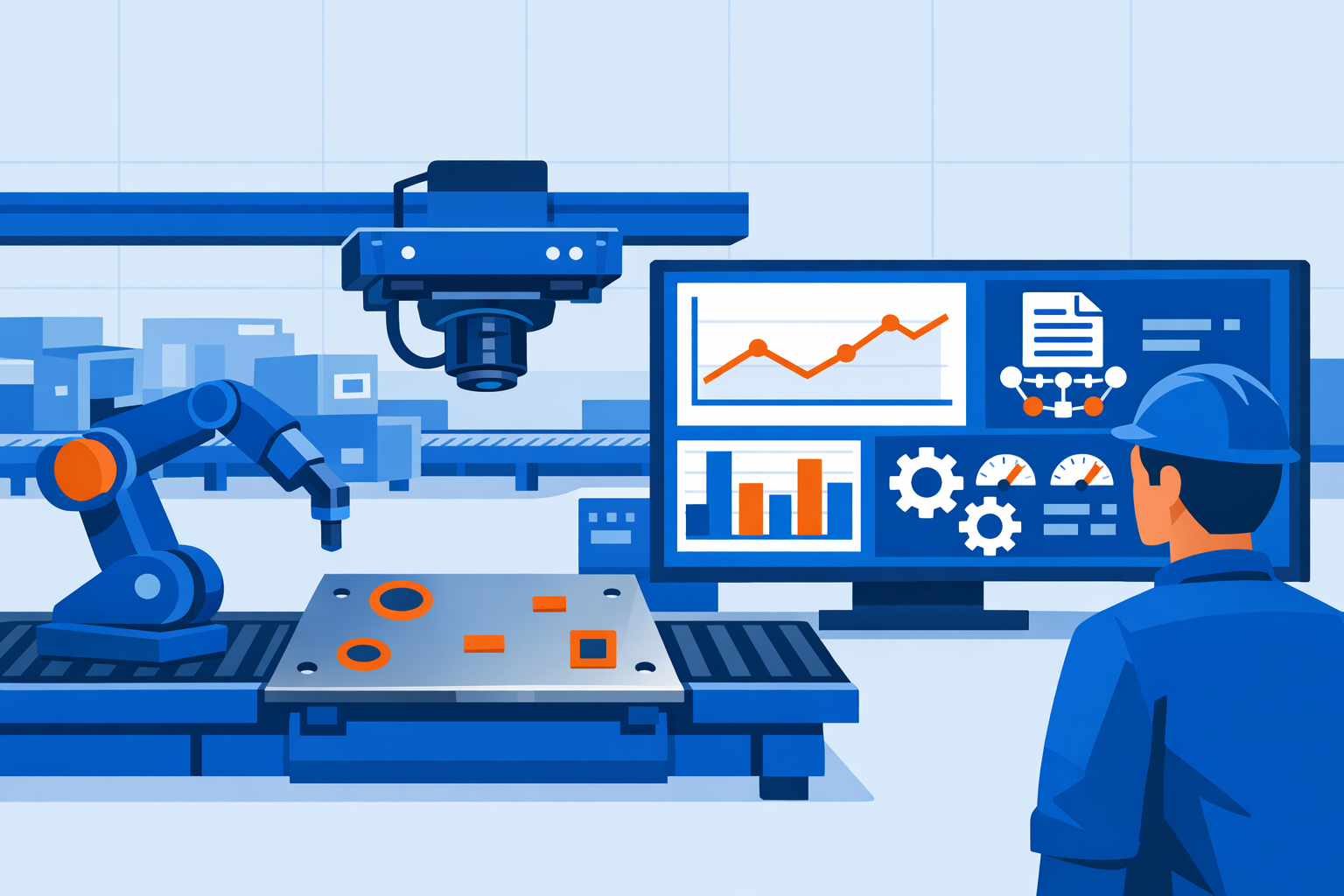
Manual visual inspection catches roughly 70-80% of surface defects under real production conditions - a gap that translates directly into scrap, rework, warranty exposure, and, in aerospace and defense supply chains, potential regulatory non-conformance. That performance floor is no longer acceptable in 2026, and U.S. metal fabricators know it.
Across the industry, AI-powered defect detection is completing its most consequential transition: from controlled pilot programs to full-scale production deployment. The driver is not technology novelty - deep learning vision systems have been technically capable for several years. What changed is the regulatory environment. Tightening federal requirements around Software Bill of Materials (SBOM) documentation and operational technology (OT) telemetry are forcing fabricators to overhaul both their quality infrastructure and their software governance simultaneously.
From Pilot to Production: What Has Actually Changed
The pilot-to-production gap in industrial AI has historically been wide. According to McKinsey's State of AI 2025 report, 88% of organizations use AI in at least one business function, yet only about one-third have scaled AI across the enterprise - with smaller manufacturers disproportionately stuck at the pilot stage.
For metal fabricators, the sticking points have been consistent: heterogeneous part portfolios with diverse surface geometries, inconsistent lighting conditions across shifts, and the absence of standardized data interfaces between vision systems and manufacturing execution systems (MES). What changed in 2025-2026 is the emergence of open, interoperable AI vision stacks built on common data models - including OPC-UA and MQTT-based telemetry schemas - that allow cross-vendor camera hardware, edge inference software, and MES platforms to exchange quality data without proprietary middleware.
The result: a mid-size fabricator running aerospace brackets on one line and automotive stampings on another can now deploy a single AI inspection framework across both product families, with defect data feeding a unified telemetry dashboard rather than two siloed inspection reports.
AI computer vision inspection systems achieve 97-99% detection accuracy versus 70-80% for manual sampling under production conditions, according to published industry benchmarks. The economics of closing that gap are now well established.
The SBOM Imperative: Why OT Software Governance Can No Longer Wait
The arrival of AI inference engines on the shop floor has introduced a category of software complexity that OT security teams were not designed to manage. A modern AI vision stack running on an industrial edge server may contain dozens of open-source libraries, pre-trained model weights from third-party repositories, camera firmware components, and inference runtime dependencies - none of which were previously inventoried as part of a facility's OT asset registry.
CISA's 2025 SBOM Minimum Elements guidance introduced new mandatory data fields - including Component Hash, License Information, Tool Name, and Generation Context - expanding requirements significantly beyond the 2021 NTIA baseline.
Key compliance implication for fabricators: Any AI inference software deployed within an OT network is subject to the same SBOM and vulnerability management obligations as other industrial control system (ICS) components. Facilities supplying federal contractors or defense primes face the most immediate exposure, given that the U.S. Army SBOM Directive took effect in February 2025, requiring SBOMs for nearly all software-related contracts, including commercial off-the-shelf (COTS) products.
The practical response from compliance-forward fabricators has been to require SBOM artifacts as part of vendor procurement criteria for AI vision platforms - before a system is qualified for production deployment, not after. Camera, edge compute, and inference software suppliers are responding by publishing CycloneDX- and SPDX-format SBOMs alongside standard technical documentation.
Fragmentation across SBOM formats, standards, and compliance frameworks remains the main obstacle preventing SBOMs from reaching their full potential as scalable cybersecurity tools, per OpenSSF analysis. Fabricators evaluating multi-vendor AI stacks should validate that all components support at least one machine-processable format - CycloneDX for security-focused automation or SPDX for compliance documentation workflows.
Technology Choices That Ease Compliance
Not all AI vision architectures carry equal compliance overhead. Several design decisions meaningfully reduce the SBOM management burden and OT telemetry surface area:
On-device edge inference over cloud routing. Industrial-grade edge computers with dedicated GPUs process images in real time without cloud connectivity, ensuring fast response times and keeping production data secure. Keeping inference local also reduces the number of network segments that must be secured and documented.
Open data interfaces. Vision platforms built on OPC-UA or MQTT publish telemetry - defect counts, confidence scores, model version identifiers - in standardized formats consumable by SCADA, MES, and cybersecurity monitoring tools without custom integration work.
Model versioning and audit trails. Production-grade AI deployments must maintain a traceable record of which model version was active during each inspection event. This requirement intersects directly with SBOM obligations: model weights are themselves software artifacts with provenance that must be documented.
The AI architecture choice also affects inspection capability. The three main approaches serve different production contexts:
| AI Approach | Best Fit | Key Trade-off |
|---|---|---|
| Classification | High-throughput binary pass/fail, mass production | No spatial defect location data |
| Object Detection (YOLO-family) | Mid-volume precision parts; need location + class | Moderate compute; strong balance of speed and detail |
| Segmentation | High-value or safety-critical parts (aerospace, defense) | Compute-intensive; slower throughput |
Deployment Economics: CapEx, OpEx, and the ROI Case
Manufacturers deploying AI inspection typically achieve full payback within 6-12 months through labor redeployment, reduced scrap, fewer customer returns, and faster throughput.
The financial structure of these deployments is evolving. Early AI vision systems required significant upfront capital - purpose-built camera arrays, GPU servers, and integration engineering. The current market increasingly supports an opex-weighted model, where fabricators pay subscription fees for AI inference software and model management while sourcing commodity edge hardware separately. This structure lowers the capital hurdle for mid-size shops and shifts model retraining and SBOM maintenance obligations to the software vendor.
For facilities that have consolidated their telemetry data, the financial case strengthens further. Manufacturers that unified IT/OT data and deployed AI across operations reported up to 457% projected three-year ROI, though this figure reflects enterprise-scale deployments with broad AI application beyond quality inspection alone.
A more conservative but verifiable benchmark: on a mid-sized plant running $50M in annual cost of goods sold, a 10% reduction in scrap and rework translates to $5M in recovered margin.
Quality defects account for a substantial share of total production costs across discrete manufacturing. AI quality systems that move facilities from reactive end-of-line detection to inline, real-time feedback fundamentally change that cost structure - not by inspecting more, but by catching deviations before value accumulates on non-conforming parts.
Fabricators looking to understand how vision-guided automation integrates with high-mix line configurations can reference our earlier analysis on vision-guided automation in high-mix metal fabrication, which covers MES integration patterns and PLC feedback loops in detail.
Organizational Shifts: New Skills, New Roles
Full-production AI defect detection is not a technology procurement event - it is an organizational transformation. Facilities that have successfully scaled beyond pilots consistently report the need for three new capability areas:
Data labeling and annotation management. Model performance in production depends on the quality and diversity of labeled training data. Mid-size fabricators are establishing dedicated labeling workflows, often combining internal domain expertise with active learning pipelines that route uncertain model predictions back to human reviewers.
Model monitoring and maintenance. Production models drift as materials, tooling, and surface conditions change. A formal model governance process - tracking detection accuracy, false positive rates, and confidence score distributions over time - is required to maintain inspection integrity without halting production for manual recalibration.
OT cybersecurity and incident response. Integrating AI inference software into OT networks expands the attack surface. AI-integrated industrial networks saw a 34% year-over-year increase in cyberattacks from 2024 to 2025, reinforcing the need for network segmentation, asset inventory (supported by SBOM data), and defined incident response procedures for AI system anomalies.
Ecosystem Dynamics: Avoiding Vendor Lock-In
The most significant structural development in the AI vision supply chain is the alignment of camera, edge compute, and inference software vendors around common industrial standards. Historically, integrated AI vision bundles from a single vendor simplified deployment but created long-term dependency on proprietary data formats and model containers.
The current generation of production deployments reflects a modular approach: industrial cameras from one vendor, GPU edge servers from another, and AI inference software from a third - all communicating through standardized APIs. SBOM documentation across this stack ensures that any component - a camera firmware update, a deep learning runtime patch - can be assessed for vulnerability impact and swapped without disrupting the broader system.
For procurement managers qualifying AI vision vendors, key evaluation criteria now extend beyond detection accuracy to include: SBOM format support, model portability between inference runtimes, telemetry export compatibility with existing SCADA and MES infrastructure, and contractual clarity on SBOM maintenance responsibilities across the product lifecycle.
Outlook for 2026 and Beyond
The regulatory momentum behind SBOM and OT telemetry requirements shows no sign of reversing. The EU Cyber Resilience Act, which mandates SBOMs for all products with digital elements, went into effect in December 2024 and will be fully enforced starting in 2026 - adding export compliance considerations for U.S. fabricators serving European OEMs.
Domestically, CISA's ongoing guidance updates and the expansion of defense procurement SBOM requirements will continue raising the baseline for software transparency across the manufacturing supply chain. Fabricators that treat SBOM compliance as an operational workflow - rather than a one-time documentation exercise - will be better positioned to absorb future regulatory changes without disrupting production.
Facilities that moved AI defect detection into full production in 2024-2025, and simultaneously built SBOM governance into their OT asset management, are now entering a compounding advantage phase: cleaner telemetry data, continuously improving models, and auditable software supply chains that satisfy both quality customers and regulatory reviewers.
Key Takeaways for Plant Managers and Quality Engineers
- Require SBOM documentation from AI vision vendors before qualification, not after. Specify CycloneDX or SPDX format compatibility in RFPs.
- Deploy on-device edge inference to minimize network exposure, reduce cloud latency, and maintain inspection continuity during connectivity events.
- Integrate defect telemetry into existing MES and SCADA systems via OPC-UA or MQTT rather than building parallel reporting infrastructure.
- Establish model governance processes - accuracy monitoring, drift detection, and retraining triggers - before scaling to additional lines.
- Budget for organizational change: data labeling workflows, OT cybersecurity skills, and model maintenance account for 20-30% of total AI deployment cost in brownfield facilities.
- Use the pilot-to-production transition as the trigger point to segment OT networks, document software assets, and align with CISA's 2025 SBOM Minimum Elements.
Frequently Asked Questions
What is an SBOM, and why does it matter for AI vision systems on the shop floor? A Software Bill of Materials (SBOM) is a machine-readable inventory of every software component, library, and dependency within a given system. For AI vision stacks deployed in OT environments, an SBOM enables fabricators to identify vulnerable components quickly, demonstrate provenance to auditors, and comply with CISA's 2025 Minimum Elements and Executive Order 14028 obligations.
How long does it typically take to move from an AI defect detection pilot to full production? Most fabricators see measurable pilot results within 6-10 weeks. Full production rollout - including MES integration, SBOM documentation, and multi-line scaling - typically takes 6-18 months depending on facility complexity and the number of product families covered.
What AI model architecture works best for metal surface defect detection? Classification models are fastest and suit high-throughput binary pass/fail decisions. Object detection (YOLO-family models) provides defect location data alongside class identification, well suited for mid-volume precision parts. Segmentation models deliver pixel-level precision for safety-critical components such as aerospace brackets, at the cost of higher compute demand and lower throughput.
What new skill sets do quality teams need at full-production scale? Full-production AI quality deployments require personnel capable of data labeling and annotation management, model performance monitoring, OT cybersecurity governance including SBOM lifecycle management, and incident response for AI system anomalies.
Is edge compute or cloud inference better for metal fabrication inspection? Edge compute is preferred in production environments. On-device GPU inference eliminates cloud latency, keeps sensitive production data on-premises, and maintains inspection continuity during network outages - critical for high-speed stamping, rolling, and machining lines where a connectivity gap cannot pause the line.