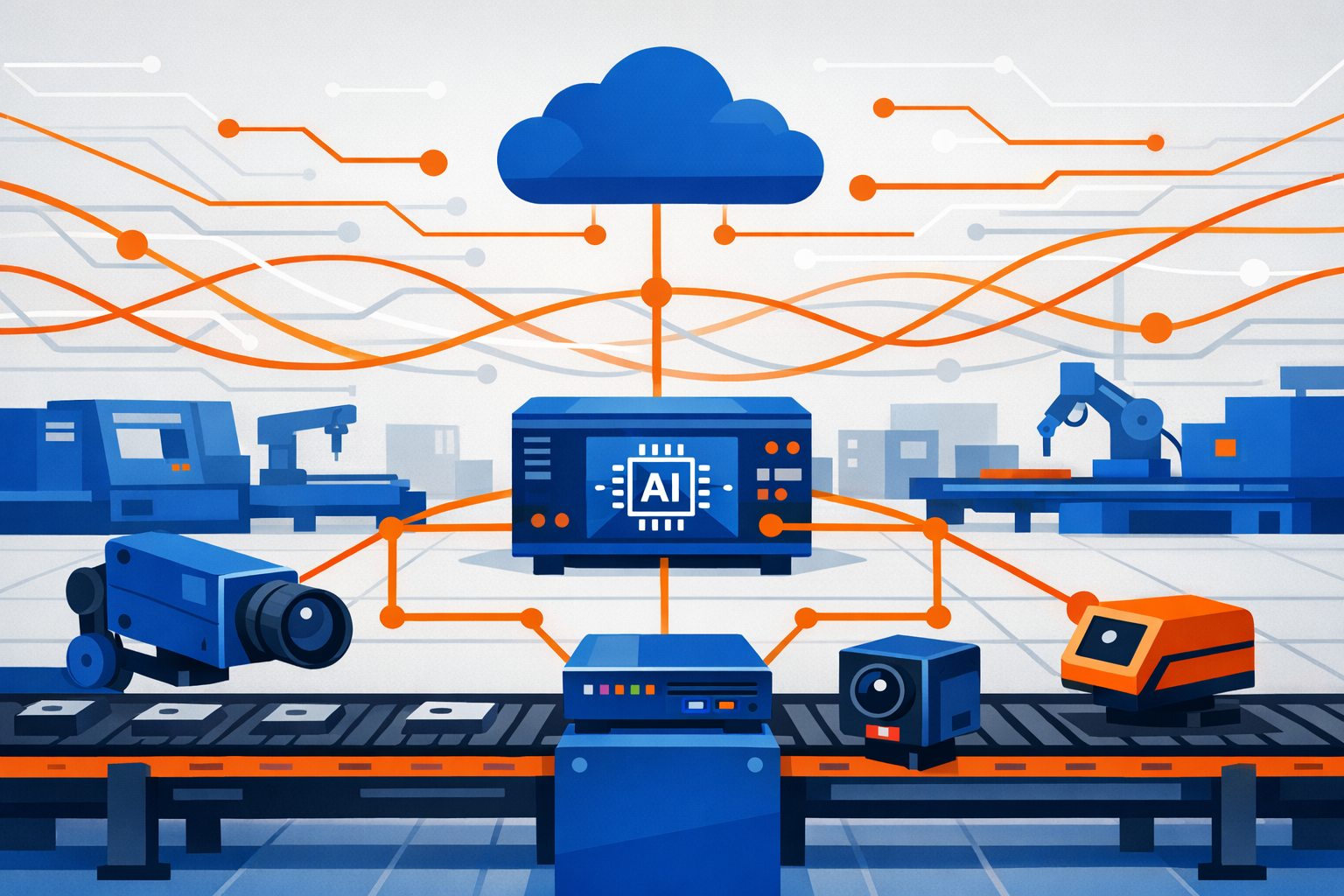
AI-enabled vision inspection is crossing the threshold from pilot program to full-scale production in U.S. metal fabrication facilities, driven by a coordinated push from standards bodies, system integrators, and engineering procurement contractors (EPCs) toward cross-vendor interoperability. The transition addresses persistent barriers-vendor lock-in, proprietary data silos, and inconsistent defect classification-that previously confined deployments to single-vendor environments on dedicated lines. Fabricators running high-mix, low-volume (HMLV) product portfolios are among the primary beneficiaries, as interoperable architectures allow AI models to be retrained and redeployed across product families without hardware replacement.
Background
For years, AI-based machine vision in metalworking operated within closed ecosystems, where inspection software, camera hardware, and data pipelines were tightly coupled to a single supplier. This created integration friction whenever shops needed to connect inspection data to manufacturing execution systems (MES) or enterprise resource planning (ERP) platforms. Standards play a vital role in ensuring interoperability, ease of integration, and long-term scalability. Without consistent frameworks, deploying complex machine vision solutions across platforms, devices, and applications becomes time-consuming, costly, and error-prone.
To address these challenges, organizations including the Association for Advancing Automation (A3)-along with global partners such as EMVA, JIIA, VDMA, and CMVU-have developed a suite of international machine vision standards through the G3 global standards group. These standards simplify integration, reduce costs, and accelerate adoption across manufacturing sectors. They include GigE Vision for Ethernet-based multi-camera networks, the GenICam Standard Features Naming Convention (SFNC) for cross-vendor camera configuration, and CoaXPress 2.1 for high-bandwidth image transfer.
At the software and connectivity layer, the OPC Foundation and VDMA's OPC Machine Vision specification provides the critical bridge. Part 1 establishes the infrastructure layer that enables simplified, uniform integration of machine vision systems into higher-level IT production systems, including PLCs, SCADA, MES, ERP, and cloud platforms. A separate working group is examining how GenICam could combine with OPC Vision to enable new applications and business models. The International Electrotechnical Commission (IEC) is developing AI-specific standards for machine vision applications, focusing on model interoperability and secure cross-system data sharing. The IEEE 2671 standard series further specifies connectivity requirements for online detection based on machine vision within intelligent manufacturing systems, covering interoperability architecture, compatibility requirements, communication protocol and interface requirements, data access requirements, and information safety requirements.
Details
In production environments, the payoff of standards-compliant architectures is measurable. Research from MarketsandMarkets indicates that manufacturers integrating AI into machine vision systems have achieved up to a 25% reduction in defect rates, yielding significant quality control improvements. Visual AI systems can detect assembly or soldering defects in under 200 milliseconds, enabling real-time corrections that minimize error propagation and reduce rework.
For HMLV fabrication shops-where part geometries, surface finishes, and alloy specifications change frequently-continuous learning loops and robust calibration procedures are critical success factors. AI models can be updated continuously with new product images and defect types, allowing manufacturers to adapt to emerging quality challenges across diverse product categories. Rather than merely detecting anomalies, deep learning-based systems precisely recognize distinct error patterns and consistently eliminate pseudo-defects, while automatic logging and storage ensures all defect types remain documented and traceable.
MES and ERP integration is now a baseline expectation in production deployments. Industrial vision systems integrate with quality management frameworks including ISO 9001 and IATF 16949, connecting directly to MES and ERP systems to create real-time traceability records that satisfy FDA, GMP, and OSHA compliance requirements. Vision systems output pass/fail decisions, defect classifications, dimensional measurements, and defect images. These feed into MES for real-time quality dashboards, statistical process control, and reject gate control via PLC. ERP receives aggregated quality records for traceability, warranty tracking, and supplier quality management.
Vendor lock-in and data governance remain the most frequently cited barriers to broader rollout. Limited interoperability with third-party platforms outside a single vendor's ecosystem remains a documented constraint for several leading vision platforms. Edge-based inference has emerged as a mitigation strategy for latency concerns on the shop floor. Processing large volumes of visual data in real time is a critical requirement in modern manufacturing, especially when decisions must be made in milliseconds. Edge AI brings computation directly to the production line, reducing latency and eliminating the need to transmit image data to centralized servers.
Workforce reskilling is accompanying the technology transition. System integration with existing workflows and technologies-including machine PLCs, SAP, and Salesforce-enables effective communication across different stages of the manufacturing process. While modern vision platforms are designed for operation by production engineers and quality technicians rather than computer vision specialists, establishing initial logic and maintaining calibration typically requires a system integrator or trained technician.
Outlook
The global machine vision market stood at approximately USD 20.4 billion in 2024 and is projected to reach USD 41.7 billion by 2030, growing at a 13% CAGR, according to industry analysts, with quality assurance and inspection remaining the dominant application segment. Standards activity is expected to intensify: subsequent parts of the OPC Machine Vision specification aim to replace proprietary elements with standardized information structures and semantics, including configuration, recipe, and result data. Fabricators evaluating readiness for broader rollout should track false-reject rate, inspection latency, MES integration completeness, and model retraining cycle time as primary metrics-and should confirm that prospective vendors support open protocols such as OPC UA, GigE Vision, and standardized REST APIs before committing to production-scale deployment.