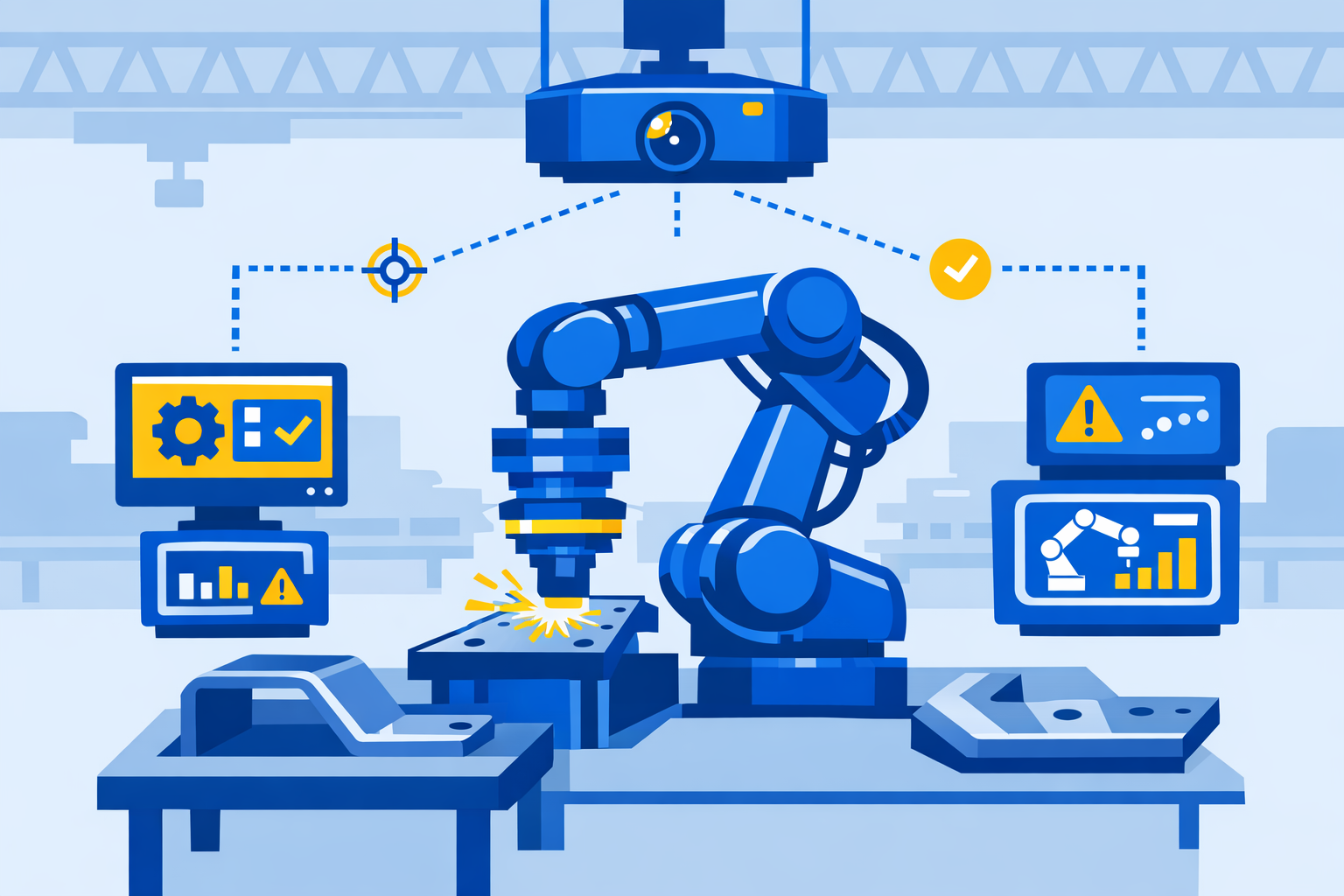
AI-powered machine vision is crossing a critical threshold in North American metal fabrication, moving from isolated pilot cells into facility-wide deployments across high-mix, low-volume (HMLV) job shops. The shift stems from converging pressures: a tightening skilled-labor market, rising demand for part-mix flexibility, and ROI timelines short enough to clear capital committee review.
Background
High-mix, low-volume manufacturing has historically resisted automation. Traditional industrial robots require specialist engineers, complex code, and lengthy integration cycles - making them impractical for operations running dozens or hundreds of SKUs with variable geometries. The result is a persistent automation gap between job shops and high-volume production lines.
That gap is narrowing at a measurable pace. The global machine vision market is expected to grow from USD 15.83 billion in 2025 to USD 23.63 billion by 2030, at a CAGR of 8.3%, according to MarketsandMarkets. The fastest-growing segment is AI-based software - the intelligence layer enabling variant-flexible inspection and robotic guidance without hard-coded programming.
Labor scarcity is a structural accelerant. The World Economic Forum reports that manufacturing industries worldwide face difficulty filling 87% of skilled positions, with quality control and precision assembly roles most affected.
Details
North American deployments have expanded across grinding, deburring, part sorting, and inline inspection. A vision-guided grinding cell installed at Accurate Metals Illinois in Rockford, Ill., uses a camera mounted above the cell to provide a wide-field view, while scanners integrated at the robot arm's end capture finer geometric detail. Through its Teqram subsidiary, Tollenaar Industries has developed vision-based automation systems tailored for custom fabricators; Tosec and sister fabricator Rime GmbH served as initial proving grounds before commercial rollout.
For surface finishing - among the most geometry-sensitive processes in fabrication - 3D machine vision enables robotic grinding, polishing, and deburring across part families that previously required days to weeks of per-SKU programming. By allowing robots to perceive real-world geometry in real time, vision systems eliminate fixture dependency and the exponential complexity of managing programs across expanding SKU portfolios.
On the quality side, AI-based systems achieve defect detection rates of approximately 97%, compared with 85-90% from traditional methods. Machine vision systems running around the clock are documented to cut rework by 30 to 50%.
ROI benchmarks are proving central to adoption decisions. Estimates range from two to ten months when cobots replace manual labor valued at approximately US$60,000 per year, while complete cobot-and-vision setups may cost US$75,000 or more, depending on sensor and tooling requirements. Most machine vision deployments achieve ROI within 6 to 18 months through reduced labor costs, improved quality, and decreased scrap rates.
Integration with existing plant infrastructure, however, remains the most cited deployment hurdle. ERP and MES connectivity is now a hard requirement for production-grade installations, not an afterthought. Vision systems must scale with production demands and interface with factory infrastructure - PLCs, MES, SCADA, and ERP - with open standards and middleware easing connectivity to legacy equipment. Inline inspection systems detect defects as they occur, enabling immediate corrective actions and communicating directly with robotic systems and PLCs for real-time parameter adjustments.
Operator training typically ranges from two to five days per person, while integration expenses often comprise 20-50% of the robot's base cost. Vision-guided robots offer greater flexibility than laser-guided alternatives, but implementation can be complex, requiring calibration, sensor integration, lighting optimization, and programming. ROI often remains problematic for small-scale operations due to high initial investment and required technical resources.
An emerging constraint is OT cybersecurity. As vision cameras and inspection nodes become networked OT assets, OT-targeted cyberattacks have grown persistent, with attackers exploiting unpatched vulnerabilities in industrial devices. Procurement teams at larger manufacturers now require Software Bills of Materials (SBOMs) from vision platform vendors.
Outlook
Three converging factors drive scale-up: AI vision platforms that eliminate manual programming, tightening skilled-labor markets, and ROI timelines short enough to satisfy capital committees. System integrators report that barriers separating pilot projects from full production rollouts are dissolving rapidly. These tools are not limited to large manufacturers - smaller shops are finding ways to integrate robotics incrementally, starting with repetitive tasks and expanding as ROI becomes clear. Facilities tracking throughput per labor hour, first-pass yield rates, and unplanned downtime intervals are best positioned to quantify operational resilience as deployments scale.