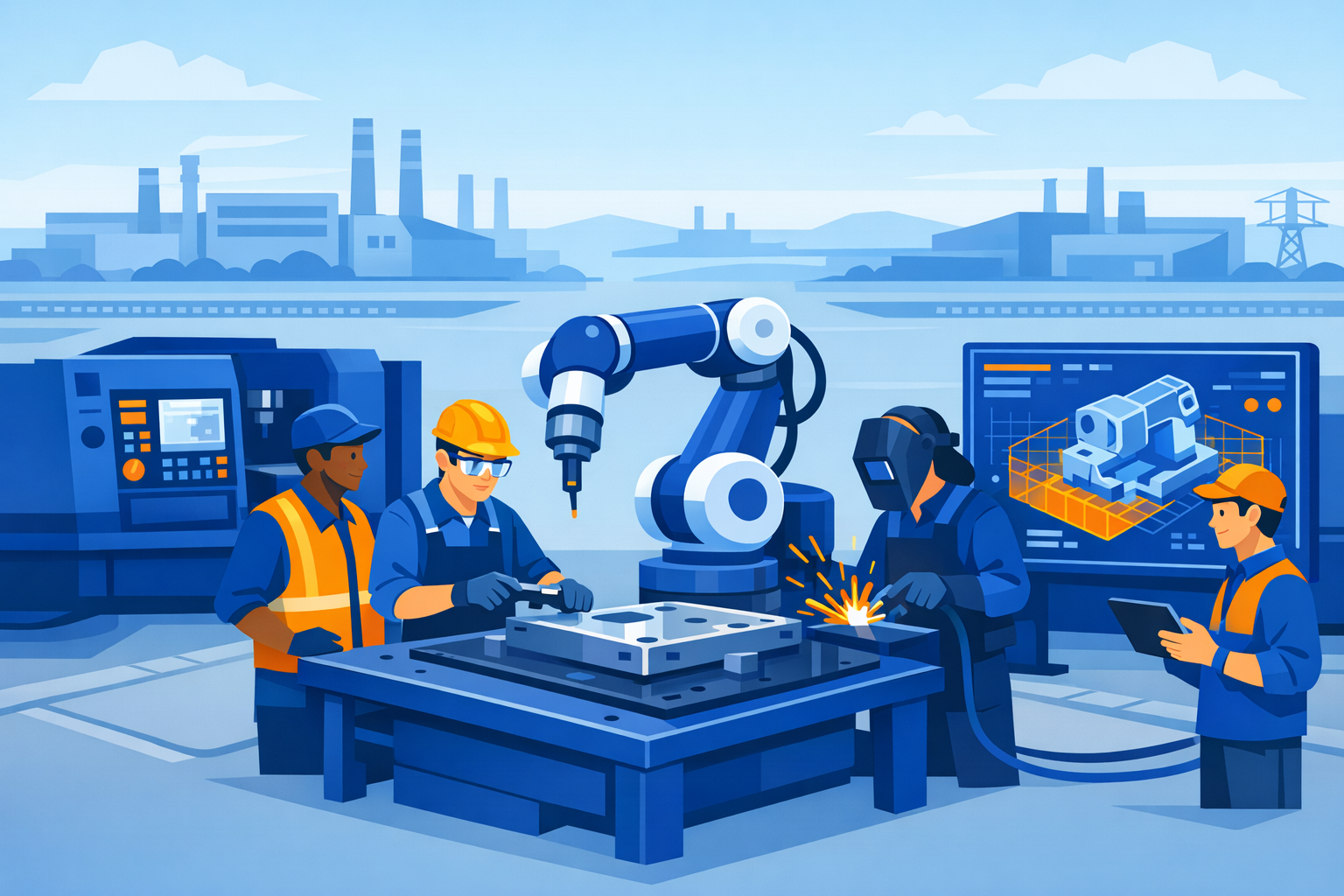
A growing number of contract manufacturers and SMEs in metal fabrication are adopting vision-guided robotics to streamline high-mix production, achieving return on investment (ROI) within 12 to 18 months. These systems, which integrate AI-powered part recognition and path planning with camera-based vision, have accelerated changeover times, decreased defects, and enabled real-time fixture adjustments. Continuous data capture supports predictive maintenance. Integrators and standards bodies are addressing interoperability between modern robotic cells and legacy CNC controllers, ERP/MES platforms, and PLCs. Workforce roles are shifting toward system tuning, AI validation, and analytics.
Background
Vision-guided robotics (VGR) has become essential for high-mix, low-volume metalworking, enabling shops to handle diverse SKUs without extensive fixturing. Industry forecasts indicate applications such as welding and machine tending-common in metal fabrication-typically achieve ROI within 12-18 months, with moderate integration effort[1]. Vision-guided inspection and automated vision systems, while more complex to integrate, deliver defect detection rates above 90 percent and payback periods of 18-30 months[1].
Details
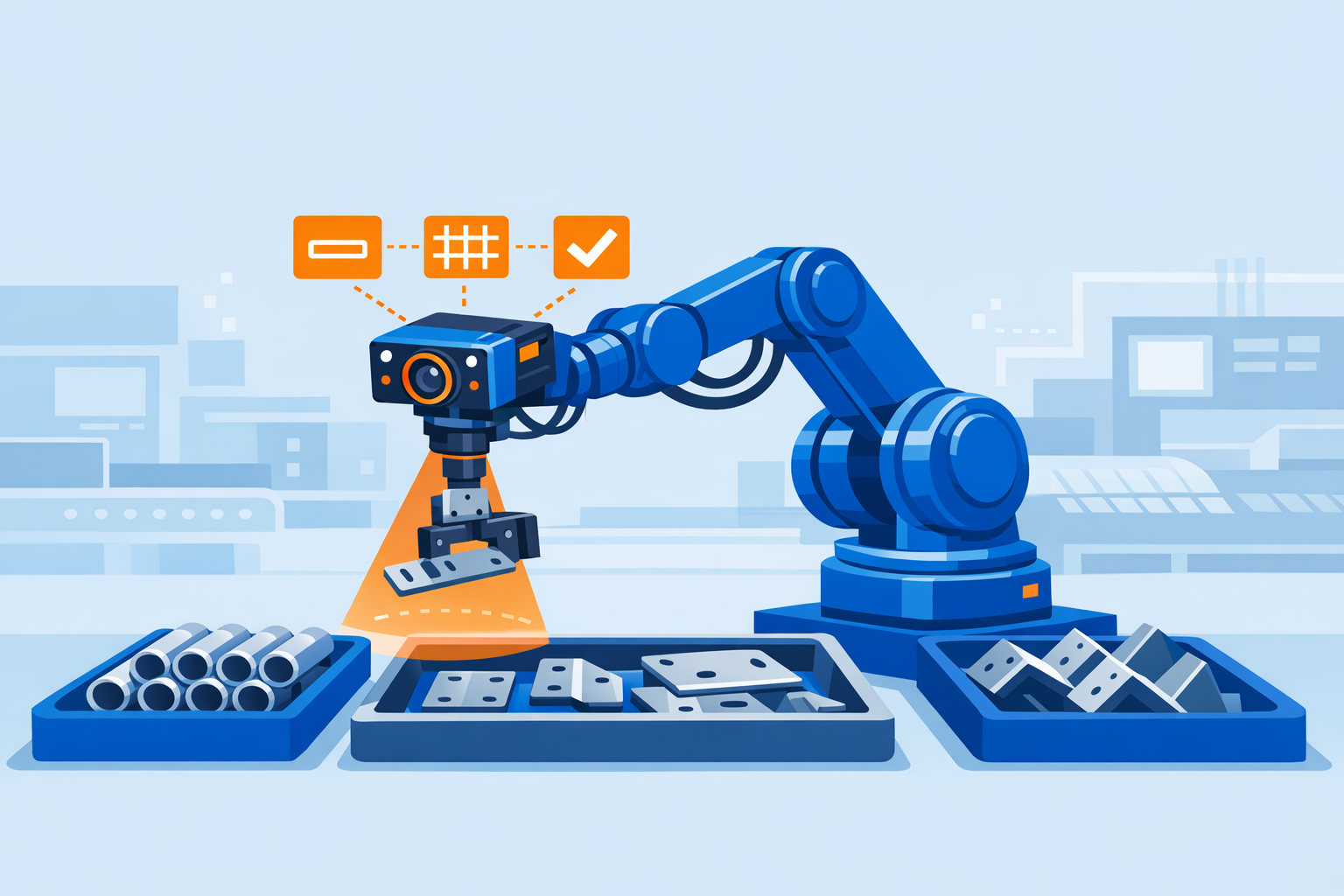
Deployments are producing measurable gains in operational efficiency. High-mix metal fabricators are reporting shorter changeover times, reduced scrap rates, and fewer defects due to AI-enabled part recognition and rapid fixture adaptation. For example, Mech-Mind's 3D vision-guided systems enable robots to pick, sort, qualify, and palletize varying cutting pieces with high accuracy across different part geometries[2].
Interoperability remains a significant challenge. Integrators are connecting robots with PLCs and vision systems using Profinet and Ethernet connections, as seen in multicompartment feeding systems with Siemens S7-1500 PLCs and I/O-Link hubs[3]. Another integrator outlined typical automation steps: vision system installation, robot-PLC integration, ERP/MES synchronization, and iterative testing and training[4].
Standards groups and integrators are advocating open interfaces and standardized data schemas to minimize vendor lock-in and accelerate deployment. On the workforce side, technicians are increasingly focused on model validation, data analysis, and AI system tuning, while operators leverage decision-support tools for faster changeovers-trends observed across the industry[5].
Larger original equipment manufacturers (OEMs) now provide turnkey, vision-guided robotic lines, while smaller integrators supply modular retrofit kits for existing fabrication cells. Successful projects often follow a lifecycle approach, from feasibility and pilot testing to full-scale rollout and continuous optimization, incorporating cybersecurity for networked automation assets.
Outlook
As adoption rises, manufacturers are seeking clear ROI metrics, including improvements in energy efficiency, cycle time, and yield. Regulatory factors-such as collaborative robot safety and traceability in high-mix operations-are impacting vendor selection and deployment schedules. The shift positions vision-guided robotics as foundational to agile, data-driven metal fabrication, not as niche add-ons.