Executive summary. AI-enabled automation is rapidly progressing from pilot stages to plant-wide deployment in U.S. glass fabrication, delivering measurable reductions in scrap, improved furnace efficiency, and fewer incidents. For leaders in metalworking and fabrication, glass represents a clear demonstration of how machine vision, predictive maintenance, and smart process control generate ROI amid tightening decarbonization and safety standards.
Glass Manufacturing as a Testbed for Industrial AI
Glass production integrates continuous high-temperature operations, strict surface quality standards, and narrow operating margins-conditions well-suited for AI-driven optimization.
Roughly 65% of glass manufacturers are currently exploring AI-driven automation to boost efficiency. Industry surveys indicate early AI adoptions in glass have led to about a 25% reduction in production errors and an 18% decrease in waste. These advancements address industry-wide pressures to lower energy consumption and emissions.
The U.S. Department of Energy (DOE) designates glass as an energy- and emissions-intensive sector in its Industrial Efficiency & Decarbonization Office (IEDO) programs, prioritizing it alongside cement, food, and metals for research investment. DOE materials highlight glass as a challenging, growing industry sector in need of targeted decarbonization support.
For metalworking professionals, the evolution of glass manufacturing with AI presents a roadmap for evaluating automation: focusing not just on throughput and yield, but on energy savings, enhanced safety, and compliance with decarbonization goals.
Where AI Is Delivering Measurable Gains on the Line
Machine vision and real-time quality control
Glass fabrication adopted AI-based machine vision early, due to manual inspection challenges with fast-moving lines, reflections, and minute surface flaws.
Key performance highlights:
- AI-powered quality control systems in glass manufacturing now achieve defect detection rates between 92-96%, surpassing traditional systems and human inspection.
- Industry analysis shows AI inspection reduces production errors by about 25% and cuts defect rates on glass sheets by up to 28% in some installations.
- Case studies report deep-learning vision systems trained on extensive image datasets:
- Detect micro-cracks and inclusions below 0.2-0.3 mm at full line speeds.
- Correlate defects with upstream variables (furnace temperature, batch mix, mold wear), enabling process adjustments that cut repeat defects by 10-20% at specific plants.
- Deliver significant reductions in scrap and rework costs once optimized.
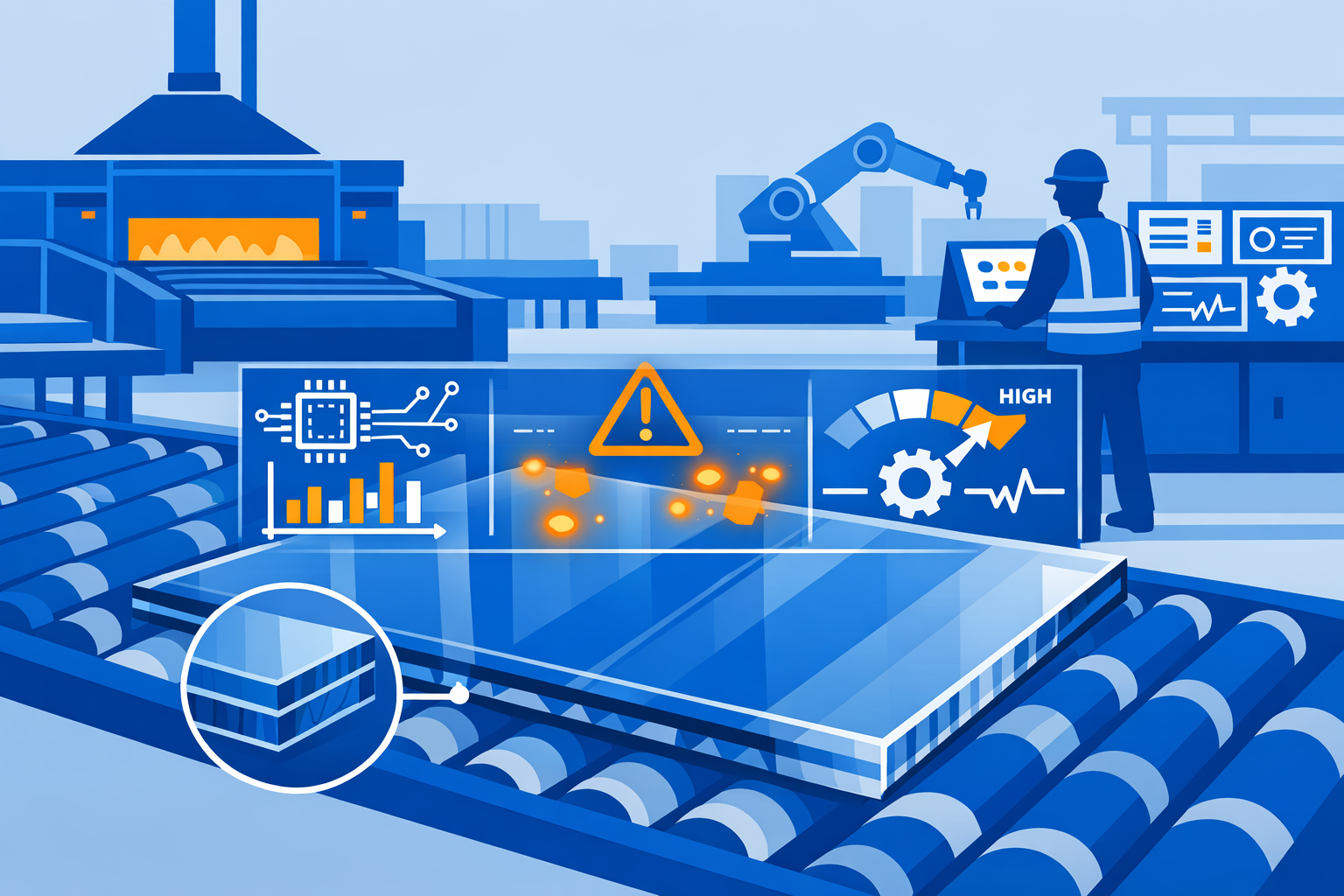
Modern AI inspection typically involves:
- High-resolution line-scan or area cameras positioned on float lines or conveyors.
- Deep-learning models classifying defect types and severity in milliseconds.
- Logic linking defect maps to specific molds, production zones, or process windows.
Similar machine vision frameworks are increasingly used in metalworking for inspecting steel strips, welded seams, and machined surfaces, with >95% accuracy on representative datasets. Once data and imaging challenges are addressed, these inspection strategies adapt across glass, metals, and composites.
Furnace and process optimization: energy and yield
Glass melting furnaces operate continuously at 1,400-1,600 °C, accounting for most plant energy consumption. Incremental improvements in combustion or loading lead directly to energy, emission, and maintenance savings.
Industry findings show:
- AI solutions optimizing furnace temperatures and setpoints have achieved about 20% energy savings in glass plants, along with a 15% overall reduction in factory energy use when integrated with energy management systems.
- AI-driven process controls have brought approximately 21% cuts in energy usage in specific furnace applications, as reported by glass manufacturers.
Recent cases illustrate these mechanisms:
Furnace digital twins and combustion optimization. Vendors and large producers are applying model-predictive controllers and AI-based digital twins to:
- Analyze fuel flow, air-fuel ratios, electric boosting, cullet amounts, and pull rates.
- Forecast furnace temperatures, oxygen levels, and energy requirements.
- Recommend setpoints to optimize quality and output while minimizing fuel.
- In one 60 TPD container-glass plant, such systems drove fuel savings and increased output, contributing USD 1-3 million in additional annual revenue at steady quality.
Kiln loading optimization. A European quartz glass facility used AI to optimize mold placement in kilns, shifting from manual to AI-optimized packing. Volume utilization rose by about 50%, increasing output by roughly €1.3 million annually and cutting energy use by 120 MWh, with a 114-ton CO₂ emissions reduction.
These approaches directly mirror strategies underway in metalworking for reheating furnaces, heat-treating ovens, and kilns: leveraging AI to fine-tune process variables, improve yield, and lower fuel usage.
Predictive maintenance on continuous lines
Unplanned furnace or line outages in glass are costly: cooling and reheating require days, and line interruptions generate significant scrap.
AI-based predictive maintenance is offering results:
- Industry data indicate AI-driven predictive maintenance reduces unplanned downtime in glass by up to 30%.
- Comparable programs in related sectors achieve 20-30% maintenance cost reductions, 30-50% drops in downtime, and annual ROIs of 20-30%.
Typical deployment includes:
- Sensor networks monitoring vibration, temperature, and motor currents on critical assets.
- Machine-learning models recognizing normal behaviors and flagging early signs of failure.
- Dashboards that prioritize maintenance and coordinate repairs with outages or mold changes.
Float glass case studies show unplanned downtime drops of 15-20% and OEE improvements surpassing 90% after predictive models are integrated. Metalworking operations, especially where bearing and drive failures dominate, are building on these practices for casting lines, presses, and critical machinery.
Safety, autonomous handling, and human-in-the-loop operations
Glass fabrication presents hazards: high heat, sharp edges, heavy handling, and rapid automation. Increasingly, AI is utilized for productivity and safety.
Reported improvements include:
- AI-enhanced safety systems-using cameras, wearables, and zone monitoring-correlate with roughly 15% fewer workplace accidents in certain datasets.
- Smart robots guided by AI vision and scheduling have improved handling efficiency by about 18%, reducing direct manual interactions with hot or heavy products.
From a regulatory perspective, U.S. plants integrating AI-driven robotics must follow OSHA's machine-guarding and robotics guidance, referencing standards like ANSI/RIA R15.06 and ANSI B11.20 for risk assessments and safeguarding.
AI-enabled robots and AGVs in both glass and metals require:
- Task-based risk assessments for all collaborative and non-collaborative operations.
- Interlocked guarding, safety scanners, and well-defined safe zones.
- Emergency stop functions, monitoring for safe speeds, and explicit protocols for exceptional operations (programming, jam-clearance, mold changes), where incident rates are highest.
Policy, Funding, and Regulatory Signals Shaping Adoption
U.S. decarbonization and smart manufacturing programs
Policy and funding are accelerating AI adoption in energy-intensive manufacturing, including glass.
- In July 2024, DOE's Advanced Materials and Manufacturing Technologies Office announced $33 million in funding for smart manufacturing, explicitly including digital and AI-based productivity, quality, and security improvements.
- DOE's Industrial Demonstrations Program dedicates about $6 billion to industrial decarbonization, naming glass as a target industry.
- The Industrial Efficiency & Decarbonization Office highlights glass as a key area for emissions reduction due to its growth and process challenges.
These initiatives reside within DOE's TIEReD program and complementary efforts funding smart manufacturing, electrification, and low-carbon thermal solutions for heavy industry.
For plant leaders planning investments, this creates several imperatives:
- Projects coupling AI automation with quantifiable energy or emissions savings are more likely to receive federal funding or assistance.
- Secure, governed digital infrastructure for AI and operational technology is aligned with DOE and NIST requirements for trustworthy system deployment.
AI risk and cybersecurity frameworks
AI integration into production- and safety-critical operations brings increased governance expectations.
- NIST's AI Risk Management Framework (AI RMF 1.0) helps organizations design and operate reliable, secure, and unbiased AI systems.
- NIST's Cybersecurity Framework-including sector-specific guidance for industrial control systems-now extends to AI-driven controls and inspections.
For glass and metals facilities, key considerations include:
- Ensuring training data and models are validated, versioned, and access-controlled.
- Establishing protocol for handling AI failures, compromises, or performance drift.
- Logging and auditing AI decisions for regulatory and quality control review.
ROI Drivers: Quantifying Value in AI-Driven Glass Plants
A consistent pattern is emerging in areas where AI delivers the strongest returns in glass manufacturing.
Typical impact ranges
| Lever | Typical AI-enabled impact in glass manufacturing* |
|---|---|
| Quality & scrap | 10-28% reduction in defect rates and waste; up to ~$1.5M/year QC cost savings industry-wide |
| Production errors | ~25% reduction in overall production errors |
| Throughput | 5-15% increase at line or furnace level; up to 50% in specific kiln-loading scenarios |
| Furnace/process energy use | 3-5% efficiency gain in pilots; 15-21% reductions where AI is fully embedded |
| Overall plant energy | Up to 15% reduction through AI-based energy management |
| Downtime & maintenance | Up to 30% drop in unplanned downtime; 20-30% maintenance savings (sector-wide) |
| Safety incidents | ~15% reduction in incident rates with AI-enabled safety systems |
*Ranges sourced from recent statistics and case studies in glass manufacturing and related industries.
Aggregated reports show about 85% of glass plants using AI report higher overall efficiency, with over half also citing increased profit margins.
Key ROI enablers
Three factors typically determine AI value realization:
- Data foundation. High-quality sensor, DCS/PLC, MES, and lab data is crucial. Incomplete tags or siloed data commonly delay deployment more than model development.
- Integration with control and MES/ERP. AI insights must directly inform:
- Setpoint or closed-loop adjustments in furnaces or lines.
- Automated maintenance planning and spare parts logistics.
- Quality routing and batch-specific grading.
- Operational alignment. Leading plants implement AI as a multi-disciplinary initiative between process engineering, maintenance, IT/OT security, and safety-not a standalone data project.
Implementation Challenges: Data, Cybersecurity, Skills
Despite significant returns, common challenges persist in glass and metals AI deployment.
Data and model robustness
- Labeling burden. Curating labeled defect datasets is demanding. Shifts in products, lighting, or coatings require ongoing relabeling and retraining.
- Edge cases and false positives. Plants need high accuracy and minimal false alarms. Coordinated efforts between quality engineers and data teams are essential.
- Model drift. Evolving materials, equipment, or conditions shift data profiles, necessitating structured monitoring and retraining cycles.
Cybersecurity and OT integration
Tying AI into controls amplifies risk:
- AI servers and data flows enlarge attack surfaces in complex OT networks.
- Integration with MES/ERP can unintentionally link IT and OT environments unless segmented.
- Access control, logging, and change management for models must fit with safety and controls systems.
Workforce and skills gap
Plants often lack personnel skilled in both high-temperature operations and digital data, machine learning, or cybersecurity.
Approaches include targeted training, academic partnerships, and national technical assistance for smart manufacturing and energy efficiency.
Cross-Industry Takeaways for Metalworking and Fabrication
For metals and fabrication professionals, glass offers a proven approach to scaling AI-enabled automation.
1. Machine vision: a mature entry point
Glass demonstrates that AI vision moves to plant scale once imaging and data challenges are addressed. Metalworking can extend this to:
- Hot and cold strip steel (surface defects).
- Weld beads and heat-affected zones.
- Machined and finished parts.
Challenges like reflections and variable surfaces are similar, and the solutions-custom optics, tailored models, and ongoing dataset management-are directly applicable.
2. Furnace and kiln optimization: transferable frameworks
Glass furnace optimization echoes heat treating, forging, and casting in metals:
- Metal furnaces and ovens benefit from AI combustion and loading controls using digital-twin and MPC methods proven in glass.
- Projects involving waste heat recovery, hybrid heating, or fuel switching can leverage AI to manage changing operating windows while maintaining product quality.
3. Predictive maintenance: process-agnostic principles
Predictive maintenance in glass-sensor analytics, anomaly detection, CMMS integration-translates directly to:
- Rolling mills, presses, and machining centers.
- Cranes and automated storage.
- Critical rotating assets.
Underlying analytics focus on vibration, temperature, and load data, independent of product material.
4. Safety and governance: converging requirements
Glass plants integrating AI robotics face safety and governance standards parallel to those in metals:
- Compliance with prevailing rules for machine guarding, robotics, and lockout/tagout.
- Adoption of NIST's AI RMF and related risk frameworks.
- Transparent monitoring, clear override protocols, and traceability for AI decisions.
Regulatory and customer expectations for documentation, change control, and system explainability are converging across sectors.
Actionable Conclusions and Next Steps for Manufacturers
For manufacturers considering AI-enabled automation in glass or metals, U.S. glass sector developments suggest clear steps:
- Prioritize clear data-rich, high-value applications. Start with vision-based inspection, furnace energy metering, and asset condition monitoring for faster ROI and easier buy-in.
- Develop a robust data and integration backbone. Invest early in unified tag structures, robust data infrastructure, and seamless connection to MES/ERP and CMMS. Many AI failures stem from weak data foundations, not model limits.
- Embed safety and governance. Treat AI as safety-related automation: conduct risk assessments, document failure modes, establish safe states, and align with recognized standards.
- Bring together process and data expertise. Success requires marrying process engineering, maintenance, and quality skills with data engineering and ML knowledge.
- Pilot before scaling. Use pilots to validate ROI and refine methods, then standardize successful practices for wide deployment across assets, sites, and materials.
The global AI-in-glass market is expected to grow at around 15% CAGR through 2028, with nearly half of new capital investment now allocated to AI technologies. For metalworking and fabrication, AI-driven glass operations foreshadow the trajectory for industrial automation.
Frequently Asked Questions
How should a glass or metal plant prioritize its first AI projects?
Begin with projects that have reliable data and clear impact, such as surface inspection (where scrap is costly), energy optimization for furnaces, and predictive maintenance for critical assets. These typically use existing sensor data and have well-defined KPIs, making ROI tracking straightforward.
How do AI vision systems integrate with quality workflows?
AI vision operates inline, inspecting all products at production speed. Output-including defect details-is integrated with PLCs and MES to automate rejection, re-routing, or rework. Human inspectors shift to exception handling and system auditing.
What are key safety considerations for AI-driven robots and AGVs?
Maintain compliance with machine-guarding and robotics standards. Assess risks for both physical and AI components. Use layered safeguards-physical barriers, scanners, and speed limits-so any AI error results in fail-safe behavior.
What skills are needed to operate and maintain AI systems?
Teams increasingly require both traditional process, maintenance, and controls skills, and digital capabilities for interpreting AI alerts and collaborating with data experts. Training focuses on dashboard interpretation, labeling workflows, and structured feedback.
How transferable are AI solutions between glass and metalworking?
Technologies like machine vision, predictive maintenance, digital twins, and AI-based optimization are largely material-independent. Differences are physical constraints and defect definitions, but core integration and data lessons from glass are directly translatable to metals.