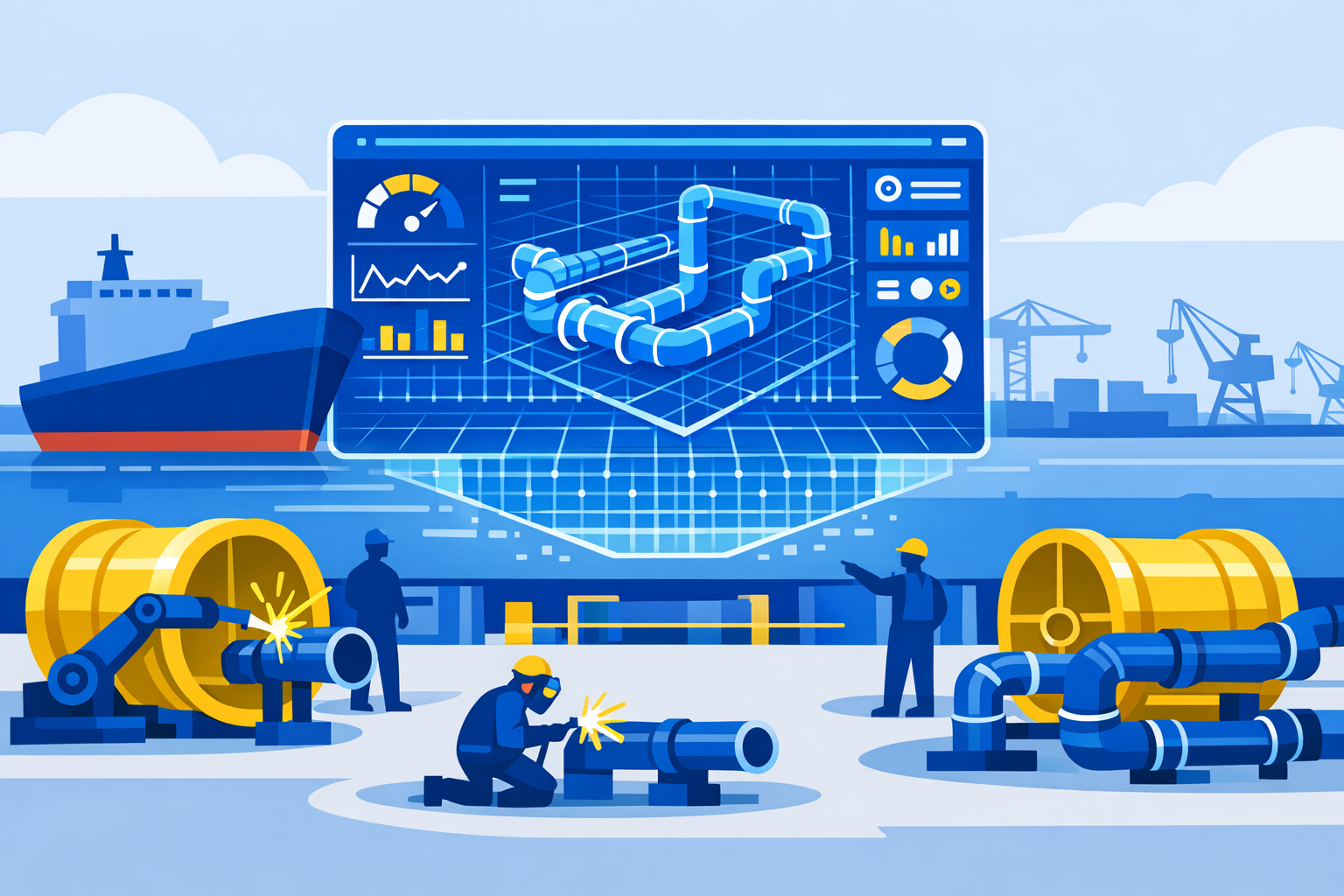
Shipyards and vessel owners are increasingly deploying digital twin technology throughout pipe spool fabrication to reduce emissions and shorten lead times. This trend emerged in mid-2025, as tightening regulations and advances in digital tools began to reshape maritime fabrication workflows.
Background
International and regional regulations have amplified scrutiny of ship emissions. The International Maritime Organization (IMO) targets a 40 percent reduction in shipping emissions by 2030 and net-zero by 2050. The European Union's FuelEU Maritime regulation, effective January 1, 2025, requires shipping operators within European waters to lower greenhouse gas intensity . These policies are driving implementation of digital solutions to improve operational efficiency and ensure compliance . Digital twin platforms create real-time, virtual representations of physical workflows-including fabrication and inspection-enabling precise management of material consumption, welding procedures, and quality assurance.
Details
The OECD reports that digital twins allow real-time monitoring of vessel systems, which supports predictive maintenance, reduces unplanned downtime, and can improve routing and operational fuel efficiency by up to 10 percent . In shipbuilding applications, virtual modeling has delivered a 90 percent reduction in assembly errors during pipe outfitting, with injury rates dropping by approximately 43 percent in these processes .
The EU's DT4GS initiative (2022-2025) is piloting an open digital twin framework to advance maritime decarbonization. The initiative aims to achieve CO₂ reductions of up to 20 percent by 2026 and targets more than 1,000 vessels-both new builds and retrofits-by 2030 .
Routine workflows using digital twins incorporate sensor data from fabrication and welding systems, enabling real-time process sequencing and automated quality control. This data-centric approach streamlines material management and reduces the need for rework, resulting in faster pipe spool delivery and enhanced regulatory traceability.
Industry analysts observe that partnerships are forming between original equipment manufacturers (OEMs) and contractors to develop integrated digital platforms. Shipyards are deploying spool fabrication lines that interface with vessel lifecycle management systems, improving transitions from production to maintenance planning and regulatory reporting.
Outlook
As the EU and IMO further tighten emission standards, digital twin-enabled spool fabrication is poised for broader adoption. Stakeholders are evaluating the scalability of these platforms across diverse shipyard operations and supply chains. Expected efficiency improvements and enhanced transparency could reshape productivity benchmarks throughout the maritime fabrication industry.