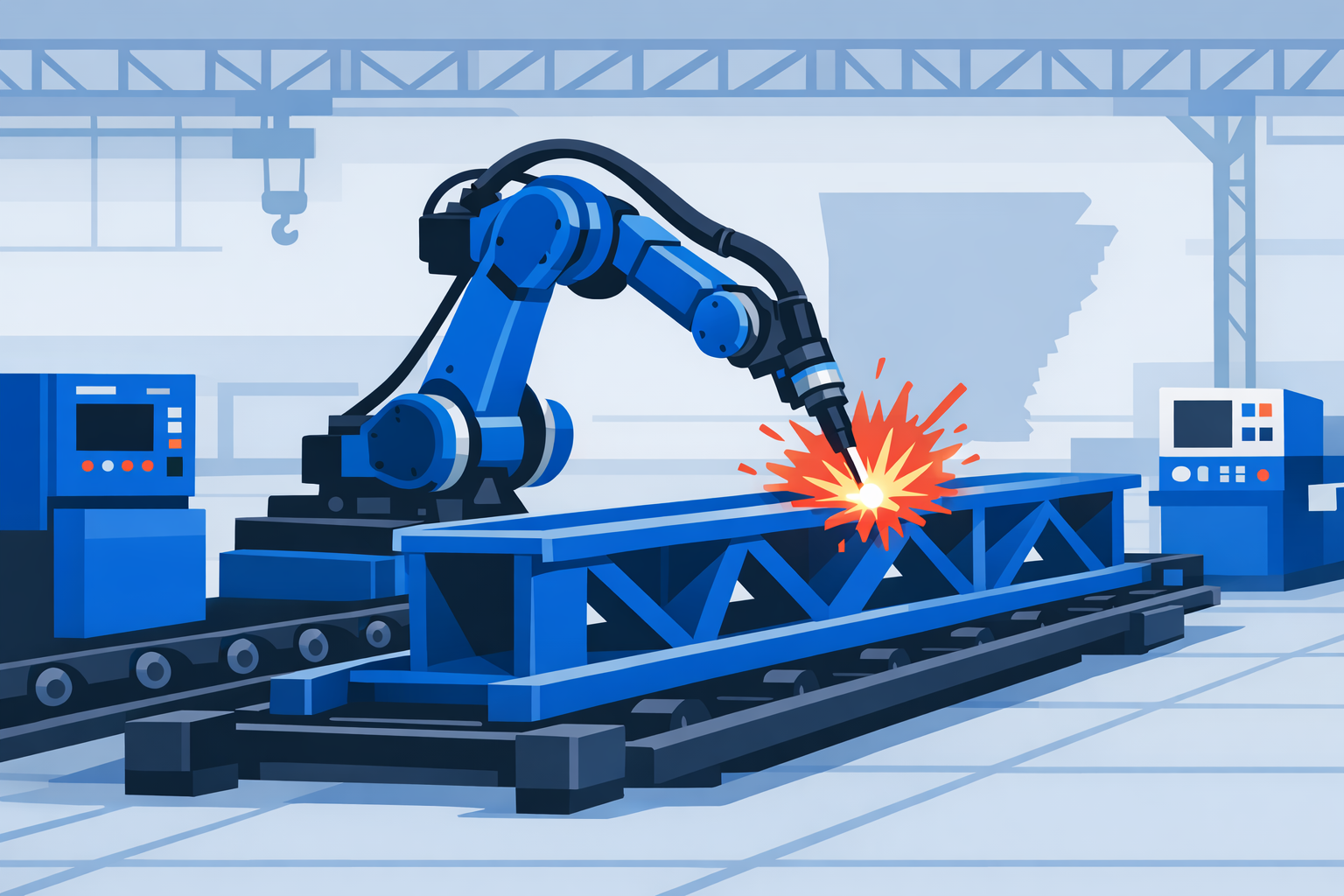
Lexicon, Inc. has installed an AGT Robotics BLOK 500 robotic welding system at its Prospect Steel division in Blytheville, Arkansas - making the facility the first in the United States, and the only in Arkansas, to operate the system for fabricating large trusses and other complex structural assemblies. The line was officially unveiled during a May 12 ceremony attended by company leadership and state officials, marking the latest capital investment in Lexicon's strategy to modernize production across its fabrication group.
Background
The deployment builds on Prospect Steel's longstanding automation program. The Blytheville plant already operates a Zeman SBA2 conti+ and a Lincoln Electric Zeman Enspector, and the BLOK 500 represents the first phase of a broader plan to advance capabilities across Lexicon's fabrication facilities, according to Arkansas Business. Lexicon's fabrication group generated $600 million in revenue last year, according to a company presentation cited by the Arkansas Democrat-Gazette.
The investment comes amid acute skilled-labor scarcity. The American Welding Society projects a shortage of approximately 330,000 to 360,000 welding professionals in the United States by 2027-2028, according to multiple industry sources, with roughly 82,500 welding positions needing to be filled annually through 2028. The average age of a U.S. welder currently stands at 55, accelerating retirement attrition and intensifying pressure on fabricators to automate repetitive weld sequences. The structural steel segment faces particular challenges: unlike automotive body-in-white production, a structural steel fabricator may produce dozens of different assemblies in a single week, with weld joint configurations that change for every connection plate or stiffener location.
System Details and Cell Configuration
The BLOK 500, manufactured by AGT Robotics of Trois-Rivières, Quebec, is a 9-axis modular robotic welding platform offering full three-axis motion - X, Y, and a plunging Z - along with part-rotation capabilities that provide vertical torch access into deep or complex weld zones. The system is purpose-built for oversized structural components that fall outside the reach of conventional single-arm automation.
Prospect Steel specified a dual-zone layout: one zone equipped with heavy-duty positioners rated to handle parts up to 25,000 pounds, and a second flexible "free zone" that accepts customer fixtures or variable assembly types. This arrangement allows operators to alternate between massive structural weldments and lighter, mixed-volume builds without retooling the entire cell - a critical capability for high-mix fabrication environments.
Weld-sequence programming is handled by AGT's Cortex software, which automatically generates robot programs for each unique assembly from design data, requiring no manual robot-programming expertise. Part positioning is verified by the SnapCam 3D vision system, which captures an image before each weld to analyze part location and optimize path planning with real-time adjustments.
"This system allows us to handle much larger, more intricate assemblies than ever before, with weld accuracy and repeatability that manual processes or basic robotics simply can't match," said Jimmy Stokley, vice president of production for Lexicon's Fabrication Group. Stokley added that the system "reduces the amount of manual heavy welding required, enhancing safety and creating opportunities for team members to grow into higher-skill automation and robotics roles."
Benoit Richard, CEO of AGT Robotics, confirmed the collaborative nature of the deployment: "We were proud to work closely with Prospect Steel to develop a tailored BLOK 500 solution that meets their specific production needs."
Labor Reskilling and Workforce Impact
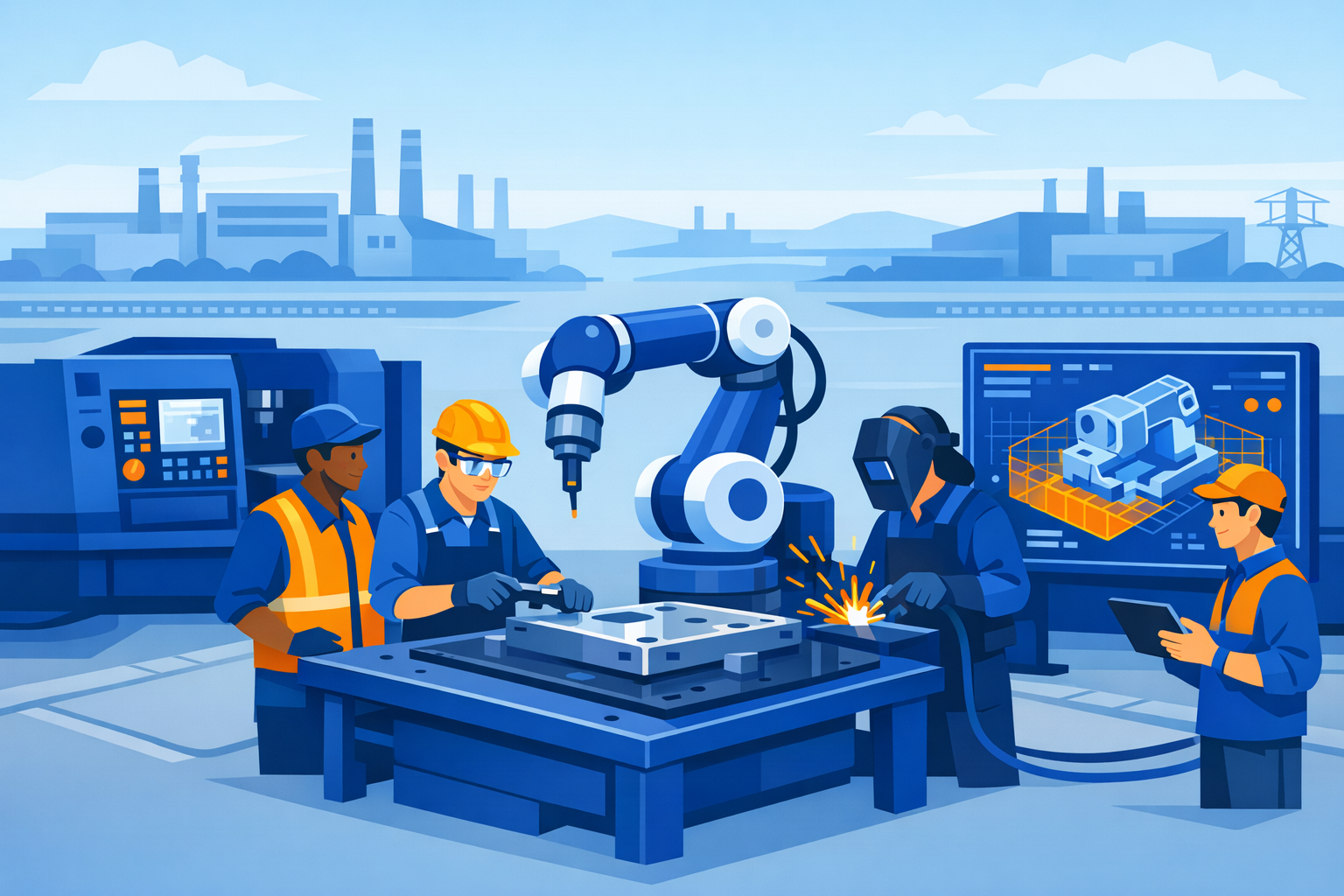
The integration directly addresses the workforce transition that accompanies heavy-automation deployments. Rather than displacing welders, Prospect Steel redirects existing personnel toward cell supervision, Cortex program review, fixture management, and quality inspection - roles that require familiarity with structural welding but not continuous manual arc time. AGT Robotics provides proactive post-installation support for both welding-quality assurance and ongoing operator training as Cortex features evolve, according to the company.
Industry research indicates that nearly 40% of robotic welding installations in 2025 were completed by small and medium-sized manufacturers, reflecting broader sector adoption beyond large-volume producers. Fabricators evaluating similar deployments commonly benchmark system performance against manual-cell baselines using Overall Equipment Effectiveness (OEE), Mean Time Between Failures (MTBF), and part changeover time.
Outlook
The global robotic welding market was valued at approximately $7.2 billion in 2025 and is projected to reach $11.8 billion by 2030, growing at a compound annual growth rate of over 10%, according to data from the International Federation of Robotics and MarketsandMarkets. Lexicon COO Steve Grandfield stated the technology "strengthens our ability to deliver high-precision, high-volume structural work for customers nationwide." Additional automation phases across other Lexicon fabrication sites have not been announced, but the company has indicated the Blytheville installation is the first step in a broader modernization strategy.