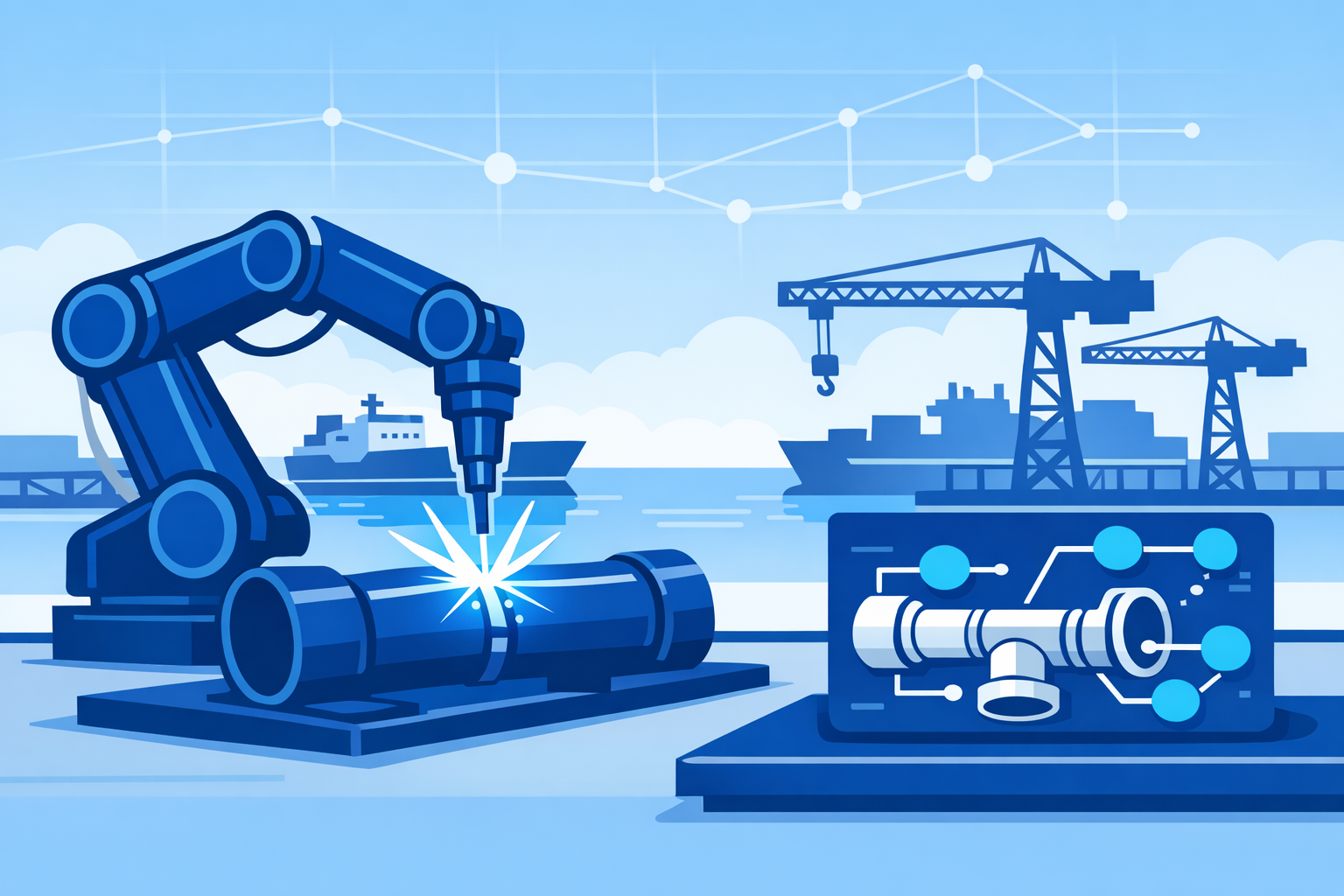
Samsung Heavy Industries (SHI) has advanced automated pipe spool fabrication at its Geoje shipyard, increasing supply chain agility, safety, and lifecycle efficiency. By implementing laser high-speed welding robots, SHI improved work efficiency by approximately 30% and reduced manual intervention, according to its 2024 sustainability data. Digital traceability systems now link welds and inspection logs directly to specific spools, reinforcing quality control and auditability.
Background
SHI, one of South Korea's leading shipbuilders, is pursuing a "future shipyard" strategy centered on smart manufacturing and automation. In 2024, SHI's robotics division introduced laser welding robots for LNG cargo hold panels, achieving roughly 30% efficiency gains through enhanced precision and speed. This initiative also supports the shift to 24-hour unmanned operations and elevated safety protocols from 2026. As part of its digital transformation, SHI is transitioning to paperless 3D digital drawings, aiming to eliminate approximately 600,000 sheets annually and reduce design labor costs by 45%. The company's adoption of Dassault Systèmes' virtual twin platform enables streamlined construction workflows from design to supply chain execution.
Details
SHI's laser welding robots operate about five times faster than conventional plasma arc welding, delivering precise assembly of LNG cargo hold membrane panels while reducing production time and staff workload. Integrated sensors and AI diagnostics monitor welding parameters and verify weld quality. Digital workflow platforms now automatically record data on material sourcing, welding conditions, and inspection times, tying each record to the corresponding spool for complete traceability and audit documentation. This automation minimizes human error and ensures compliance with marine quality standards. SHI expects that its unmanned safety system-with robotic patrols-will be a core component of smart shipyard operations starting in 2026.
Outlook
SHI intends to expand robotics and AI-driven automation to additional fabrication processes, including painting, fit-up, and non-destructive testing (NDT) inspection. The company targets fully autonomous pipe spool fabrication by the end of the decade. Integrating digital twins and real-time tracking is projected to further improve lifecycle cost management and enhance supply chain resilience throughout the global shipbuilding sector.