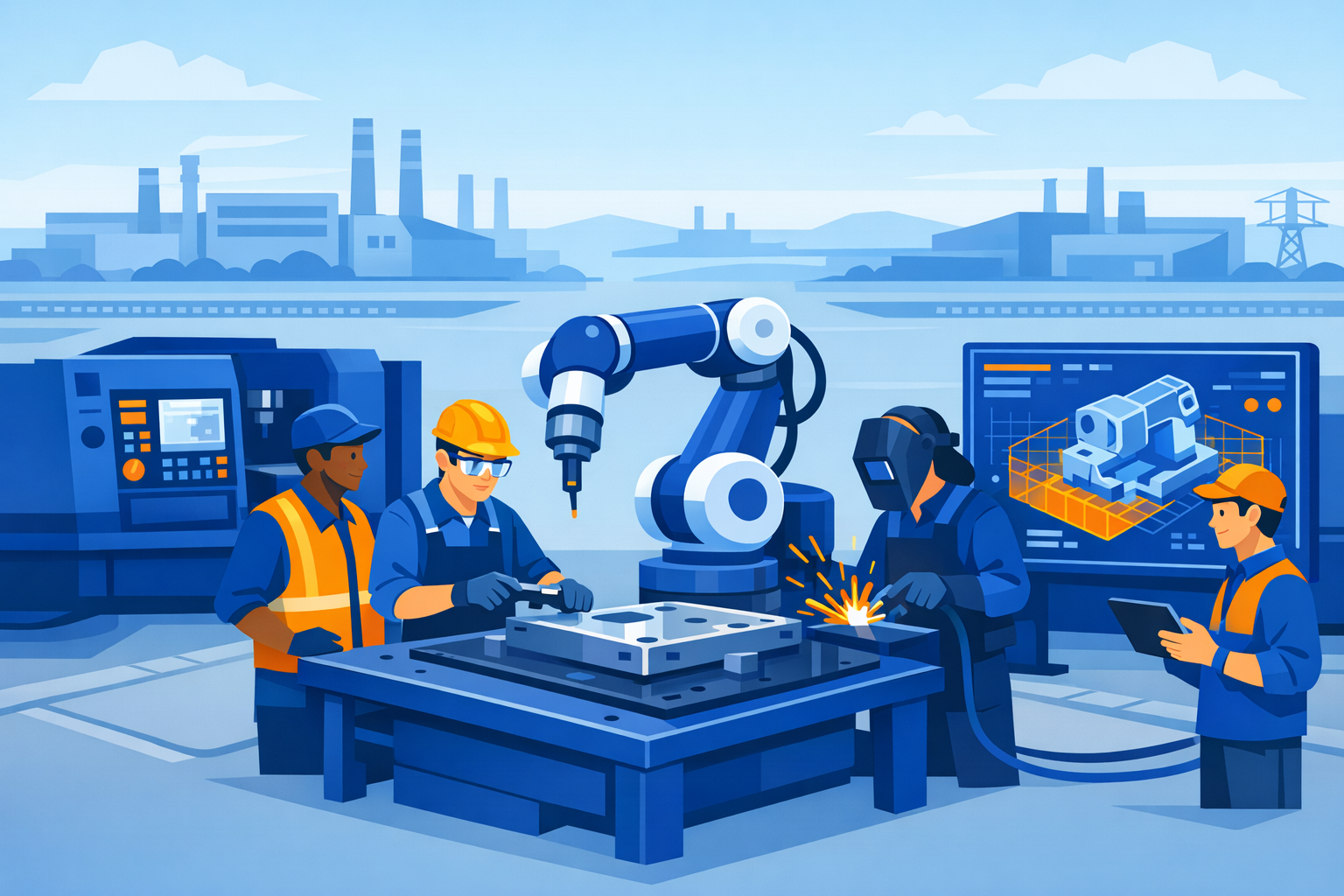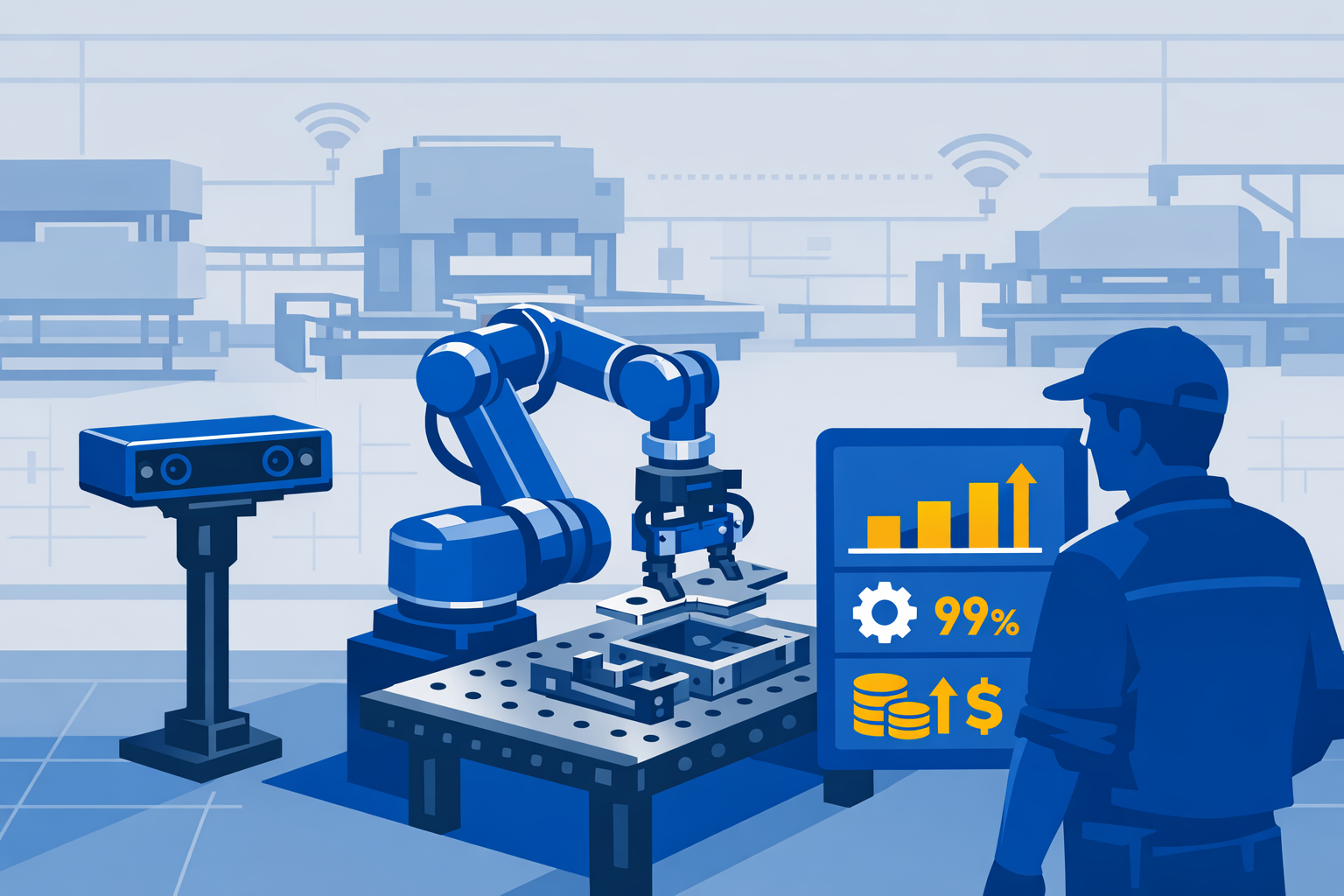
Small and medium-sized metal fabrication shops adopting vision-guided robotic systems are reporting measurable returns on investment within 6 to 24 months. These systems, primarily deployed in high-mix, low-volume settings, deliver faster changeovers, improved part accuracy, stronger quality control, and closer integration with MES and ERP platforms.
Background
Vision-guided robotics pair machine vision with robotic motion control, allowing real-time adjustment to varying part types and configurations. This adaptability is especially valuable in high-mix environments, where traditional fixed tooling increases changeover times and setup errors. The rise of shop floor digitization and the adoption of IIoT, along with modular MES, ERP, and quality systems, support broader implementation of adaptive automation.
Details
Industry benchmarks show significant performance gains for SMEs deploying these technologies. A recent study found well-utilized collaborative robot deployments, especially those with integrated 3D vision for flexible machine tending, achieved payback periods of 10 to 14 months, largely through continuous operation and reduced staffing Typical SME payback ranged from 12 to 18 months for machine tending applications[1].
Across manufacturing sectors, pilots using industrial robotics with vision inspection reported typical paybacks of 12 to 24 months. SMEs often reached a three-fold ROI within 18 to 24 months, gaining capacity increases of 30-60% and quality improvements of 25-50%[2].
In high-volume, low-complexity applications-such as pick-and-place and palletizing with vision guidance-paybacks ranged from 6 to 12 months, accompanied by throughput gains of 30-50%. More complex tasks such as vision-based inspection or adaptive assembly saw longer payback periods of 18-30 months, reflecting increased integration requirements[3].
One documented case involved a small fabrication cell with two vision-guided collaborative robots, where staffing was reduced from seven to three operators per shift. This enabled nearly 21 hours of unmanned operation per day. Time savings translated to about 34 days' worth of productivity, resulting in ROI after just over a month of operation One example reported the cell paid for itself in about 34 production days, saving seven hours per shift per operator[4].
SMEs are responding with new roles and training pathways. The adoption of automated vision systems prompts technician positions focusing on vision calibration, system oversight, and MES/ERP integration. Cross-training machinists to support both robotic and software interfaces is increasingly standard. Analyses of AI-based robotics in German SME metalworking-including small heat-treatment operations using AI robots to handle varied workpieces-show that robotics can deliver value even in low-volume contexts, especially where labor shortages drive demand for flexible handling SMEs in German metal-working are already adopting AI-based robotics for handling variable workpieces to address labor shortages[5].
Outlook
As SMEs expand vision-guided robotics, mature integration with MES and ERP systems will be essential. Adoption of standardized IIoT platforms and modular architectures could streamline data synchronization and enable real-time quality feedback. Workforce upskilling and shared training resources, particularly through industry networks, will be key to further adoption and sustained ROI.