Executive summary:
Vision-guided robotics (VGR) has expanded from large automotive plants to small and medium-sized metal shops, driven by the need to automate high-mix, short-run production without losing flexibility. For SMEs, the question is not if VGR works, but where it delivers swift returns-shorter changeovers, higher first-pass yield, and improved data use across the shop floor.
This article examines the operational and financial impact of VGR in high-mix metal fabrication, emphasizing SME-scale deployments. It outlines ROI drivers, changeover benchmarks, integration methods, and the safety and regulatory framework for robot installations in metalworking environments.
High-Mix Metal Fabrication: Why Flexibility Beats Raw Speed
High-mix, low-volume (HMLV) fabrication involves frequent part changes, small batches, and varied geometries and materials. HMLV manufacturing is generally defined as producing many different product variants in relatively small quantities, rather than running a few part numbers at very high volume.
In metalworking, this often includes:
- Short-run sheet metal components with frequent drawing revisions
- Fabricated frames and weldments for machinery, HVAC, or data center infrastructure
- Custom brackets, fixtures, and enclosures for OEMs and contract customers
This environment highlights the drawbacks of traditional, hard-tooled automation:
- Lengthy, engineering-intensive changeovers with any change in part geometry or presentation
- Reliance on skilled operators for setup, orientation, and inspection
- Cumulative variability (fit-up, tolerance stack-up, manual loading) that impacts repeatability
Vision-guided robotics addresses these limitations by giving robots the ability to adjust to varying part positions, orientations, and features, reducing dependence on rigid fixturing.
What Vision-Guided Robotics Delivers on the Shop Floor
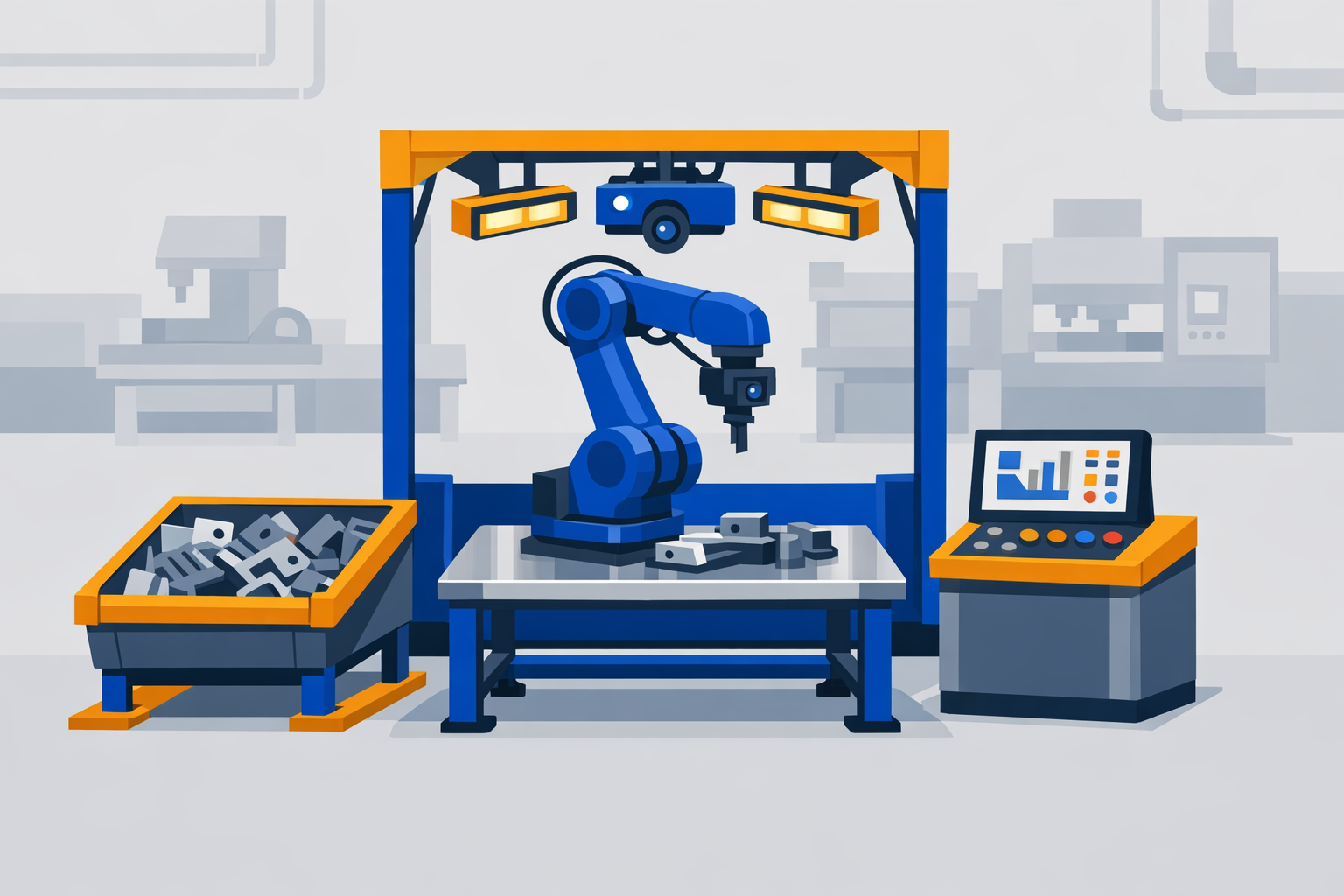
Vision-guided robotic systems combine robots with cameras, lighting, and image-processing software to locate and classify parts in 2D or 3D space. In a vision-guided system, the machine-vision stack (cameras, lenses, lighting, and image-processing software) provides position and orientation data to the robot controller, effectively turning a conventional robot into a vision-guided robotics (VGR) cell.
Changeover Speed and High-Mix Flexibility
For HMLV metal shops, the main advantage is reduced changeover time and mechanical adjustments.
- Vision enables processing of parts in random orientation on conveyors or in bins, removing the need for dedicated nests.Modern VGR systems can pick parts with varying geometry and orientation without mechanical changes to the machine, enabling quick changeovers compared with fixed tooling.
- Recipe changes become software updates-new vision models or weld paths-rather than full mechanical retooling.
A collaborative-robot case study using a vision-guided system reported changeover downtime dropping from 35 minutes to 20 minutes-a 41% reduction. This is significant for metal fabrication cells changing parts several times per shift.
First-Pass Yield and Quality Stability
Machine vision boosts cutting, welding, and assembly consistency:
- Feature location (holes, edges, seams) is detected before operations, allowing offsets to match actual part positions.
- Misaligned or out-of-tolerance parts are flagged or rejected before moving downstream.
Deployments of vision-guided inspection and guidance systems report throughput gains of about 27% and a 34% reduction in waste from false positives. These improvements lead to less scrap, reduced rework, and more reliable delivery-key metrics for contract fabricators.
Labor, Ergonomics, and Safety
SMEs typically reassign rather than eliminate staff with VGR:
- Robots handle repetitive loading, unloading, and tacking tasks.
- Skilled workers focus on complex, low-run, or rework tasks with higher value-add.
Collaborative robots with integrated vision help:
- Reduce manual lifting and awkward assembly postures
- Enhance safety due to force/torque limits and area scanners
These ergonomic gains are notable in shops handling heavy plate and awkward assemblies.
Quantifying the Business Case: ROI Drivers for SMEs
Adoption and Payback Benchmarks
While adoption rates vary by region and sector, cobots and VGR have become mainstream among SMEs. Recent industry research indicates more than 41% of SMEs in North America use collaborative robots to address labor shortages and improve assembly and fabrication.
Payback expectations have evolved:
- Cobot payback periods for SME manufacturers typically range from 12-18 months, with some high-utilization cases achieving ROI in under six months.
- Broader SME studies report robotic payback periods between 1.5 and 3.5 years, based on utilization, labor savings, and scrap reduction.
For VGR, three main payback drivers are:
- Changeover reduction (increased productive time per shift)
- Scrap and rework reduction (improved first-pass yield)
- Labor and overtime savings (unattended or extended-hours operation)
Typical KPI Shifts: Before vs. After VGR
The table below summarizes metrics from case studies of vision-guided cobot and machine-vision deployments in discrete manufacturing and metalworking environments.
| Metric | Pre-VGR Baseline | Post-VGR with Vision | Source Type |
|---|---|---|---|
| Changeover downtime per event | 35 min | 20 min (41% reduction) | Lab/case study in vision-guided cobot cell |
| Production throughput | 100% baseline | ~127% (27% increase) | Machine-vision manufacturing case study |
| Waste from false positives / mis-detections | 100% baseline | ~66% (34% reduction) | Machine-vision manufacturing case study |
| Payback period on cobot cell | N/A | 12-18 months typical; <6 months in high-utilization scenarios | SME-focused ROI analyses |
These figures serve as order-of-magnitude indicators for SME ROI modeling.
Where the Numbers Usually Add Up in Metal Shops
In high-mix metal fabrication (e.g., laser cutting, forming, welding), the primary ROI contributors are:
- Labor reallocation
- Shift one operator from manual loading or repetitive welding to supervising multiple cells
- Reduced overtime during peak periods
- Changeover efficiency
- Saving 10-15 minutes per changeover across 4-6 changeovers per shift quickly compounds into hours of productive time weekly
- Scrap and rework
- Eliminate defects from mislocated welds or incorrect part orientation
- Improved first-pass yield supports tighter delivery timelines
- Extended hours
- Vision-guided cobot cells are suitable for unattended shifts handling repeatable high-mix operations
Building the business case is best achieved by modeling a pilot cell in detail rather than a broad, plant-wide rollout.
Data-Driven Integration: From Robot Cell to MES and ERP
High-mix environments benefit when robot data is accessible beyond the cell.
OPC UA and Interoperability
OPC Unified Architecture (OPC UA) is an IEC 62541 standard for secure cross-platform data exchange from industrial sensors and controllers to MES and cloud platforms, serving as a key Industry 4.0 technology.
For SMEs, this enables:
- New robot and vision cells exposed as standard OPC UA servers, sharing:
- Part counts and cycle times
- Machine states and alarms
- Quality metrics (vision pass/fail data)
- Easy integration of this data into MES/OEE systems, historians, or dashboards without custom interfaces
This approach supports:
- Centralized performance monitoring across cells
- Traceability linking robot operations to work orders and part IDs
- Continuous improvement through downtime and variant analysis
Practical Integration Patterns for SMEs
Common, straightforward integration methods include:
- Starting with a standalone VGR cell using local HMI and basic data logging
- Adding an OPC UA or MQTT gateway to feed key data (counts, status, quality) into existing SCADA or OEE systems
- Implementing lightweight MES functions (digital work orders, routing) after achieving cell-level stability
This staged process matches SME resource constraints and supports data-driven operations.
Safety, Standards, and Regulatory Considerations
Metal fabrication introduces hazards such as heavy workpieces, hot surfaces, welding arcs, sharp edges, and human-robot interaction. Any VGR deployment must follow applicable standards and the EU regulatory framework, especially for shops governed by the Machinery Directive.
Core Robot and Machinery Safety Standards
Key standards for industrial and collaborative robots include:
- ISO 10218-1 and ISO 10218-2 define safety for industrial robots, systems, and integration.
- ISO/TS 15066 covers collaborative robot applications, including force and contact limits.
- ISO 12100 details general principles for machinery design, risk assessment, and is harmonized under the EU Machinery Directive.
- ISO 13849 covers safety functions such as emergency stops and protective stops.
Compliance for European SMEs involves:
- Carrying out documented risk assessments covering:
- Robot motion and reach
- Part handling and sharp edges
- Worker interaction zones
- Implementing safeguards:
- Guarding or fencing as required
- Safety-rated stops, scanners, or curtains
- Verified emergency-stop and enabling devices
Interoperability with Legacy Equipment
Integrating VGR with older machines requires attention to safety and control compatibility:
- Ensuring legacy equipment has safety-rated interfaces compatible with modern safety PLCs
- Avoiding scenarios where robots are in collaborative mode but associated equipment lacks equivalent safety measures
- Documenting safety function integration for both new and old equipment, which is vital for CE and insurance purposes
Implementation Roadmap: From Pilot to Scaled VGR in SMEs
1. Use-Case Selection in High-Mix Fabrication
Not all cells are ideal initial candidates. Prioritize:
- Stable but repetitive sub-operations in high-mix workflows:
- Loading/unloading laser blanks into a press brake
- Tack welding of repeatable joints across part numbers
- Vision-based picking for kitting
- Tasks with visible pain points:
- Frequent overtime
- High ergonomic risks
- Recurring quality escapes linked to manual steps
2. Vendor and Integrator Selection Criteria
For SMEs, integrator expertise is critical. Evaluate:
- Experience with metalworking applications (cutting, forming, welding)
- Proven success in high-mix environments, beyond automotive high volume
- Ability to deliver:
- User-friendly vision tools
- Standard industrial connectivity (OPC UA, fieldbus)
- Complete safety documentation
Contracts should specify:
- Ownership and maintenance responsibility for vision models and robot programs
- Support response times
- Training deliverables for in-house staff
3. Workforce Training and Change Management
Success relies on growing internal skills:
- Train operators to:
- Operate cells safely
- Resolve common faults
- Make basic recipe changes
- Train technicians/engineers to:
- Tune vision parameters
- Maintain calibration
- Add new part numbers within set limits
Present VGR as a means to reduce repetitive strain and improve job quality, rather than a threat to jobs.
4. Phased Rollout Strategy
A practical rollout for SMEs typically involves:
- Pilot cell targeting a clear use case with defined metrics (OEE, scrap, overtime).
- Stabilization phase (3-6 months) to refine vision, establish maintenance, and validate safety under production conditions.
- Replication using standard templates to similar cells (e.g., multiple weld stations).
- Integration of VGR cell data into dashboards, using measured results to drive further improvement.
Actionable Conclusions and Next Steps for Metal-Fab SMEs
For high-mix metal fabricators, vision-guided robotics is now accessible for addressing labor constraints, changeover losses, and quality issues-if implemented with a solid ROI case, adherence to safety standards, and targeted workforce development.
Key points:
- Start with high-impact, focused use cases where vision adds obvious value.
- Base business cases on realistic benchmarks-30-40% changeover reduction, double-digit throughput gains, and 12-36 month payback periods.
- Treat safety and standards as enablers: engage with ISO 10218, ISO/TS 15066, ISO 12100, and ISO 13849 from the outset.
- Develop internal expertise so your team can manage recipes, vision models, and ongoing improvements.
Immediate steps for decision-makers:
- Identify candidate cells with clear pain points and reusable solutions.
- Request concept studies from multiple integrators, focusing on how vision reduces changeovers and scrap for specific part families.
- Define success metrics and agree on measurement methods before, during, and after deployment.
- Plan for at least one post-commissioning optimization phase to fully realize system benefits.
Frequently Asked Questions
How does vision-guided robotics differ from traditional robot automation in a metal shop?
Traditional robot cells rely on fixed, precision fixturing and repeatable part presentation. Any change in geometry or orientation requires reprogramming and new fixtures.
Vision-guided robotics equips the robot with cameras and image processing to detect position, orientation, and sometimes type, enabling flexible presentation-such as loosely fixtured blanks or mixed bins-while maintaining accuracy. For high-mix operations, this reduces changeovers and mechanical retooling.
Do SMEs really see fast ROI from vision-guided cobots?
Yes, when applications are chosen with care. Industry data shows typical cobot payback between 12 and 18 months, with some high-utilization deployments under six months. ROI is strongest where VGR addresses:
- A bottleneck operation (e.g., welding)
- Significant changeover or setup losses
- High scrap or rework from manual variability
Labor reallocation, overtime reduction, and scrap savings combine to shorten payback periods.
When is it worth adding vision, rather than using a simpler robot cell?
Vision is warranted when:
- Parts have variable orientation or position (bins, mixed trays, stacked blanks)
- Operations rely on locating features (holes, edges, seams) that vary due to upstream processes
- The mix includes frequent engineering changes or new SKUs, making hard tooling impractical
A stable, single-part operation with consistent fixturing may benefit more from basic robotic automation without vision.
What safety standards should a metal shop follow for VGR and cobot deployments?
Relevant standards include:
- ISO 10218-1 and ISO 10218-2 for industrial robot safety
- ISO/TS 15066 for collaborative robots
- ISO 12100 for machinery risk assessment
- ISO 13849 for safety-related controls
Compliance requires documented risk assessments, proper safeguarding, and validation of safety functions.
How can an SME prepare its workforce for vision-guided automation?
Preparation involves technical training and clear messaging:
- Train operators on safe use, fault handling, and recipe selection
- Train technicians and engineers on programming, vision calibration, and model management
- Explain VGR's purpose: to reduce strain, stabilize quality, and support growth-not a headcount reduction
Engaging shop-floor personnel in pilot projects often increases acceptance and yields practical improvements.