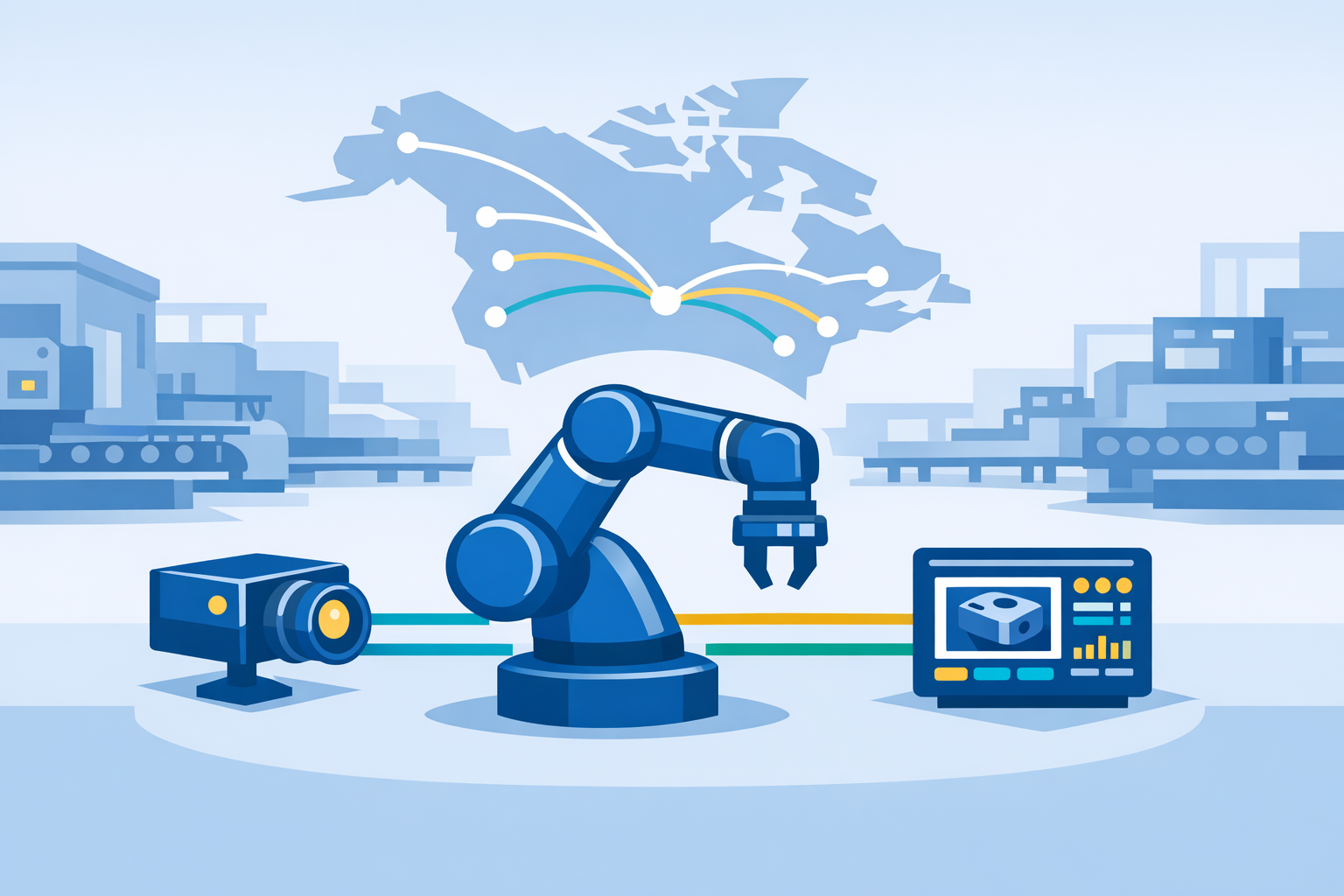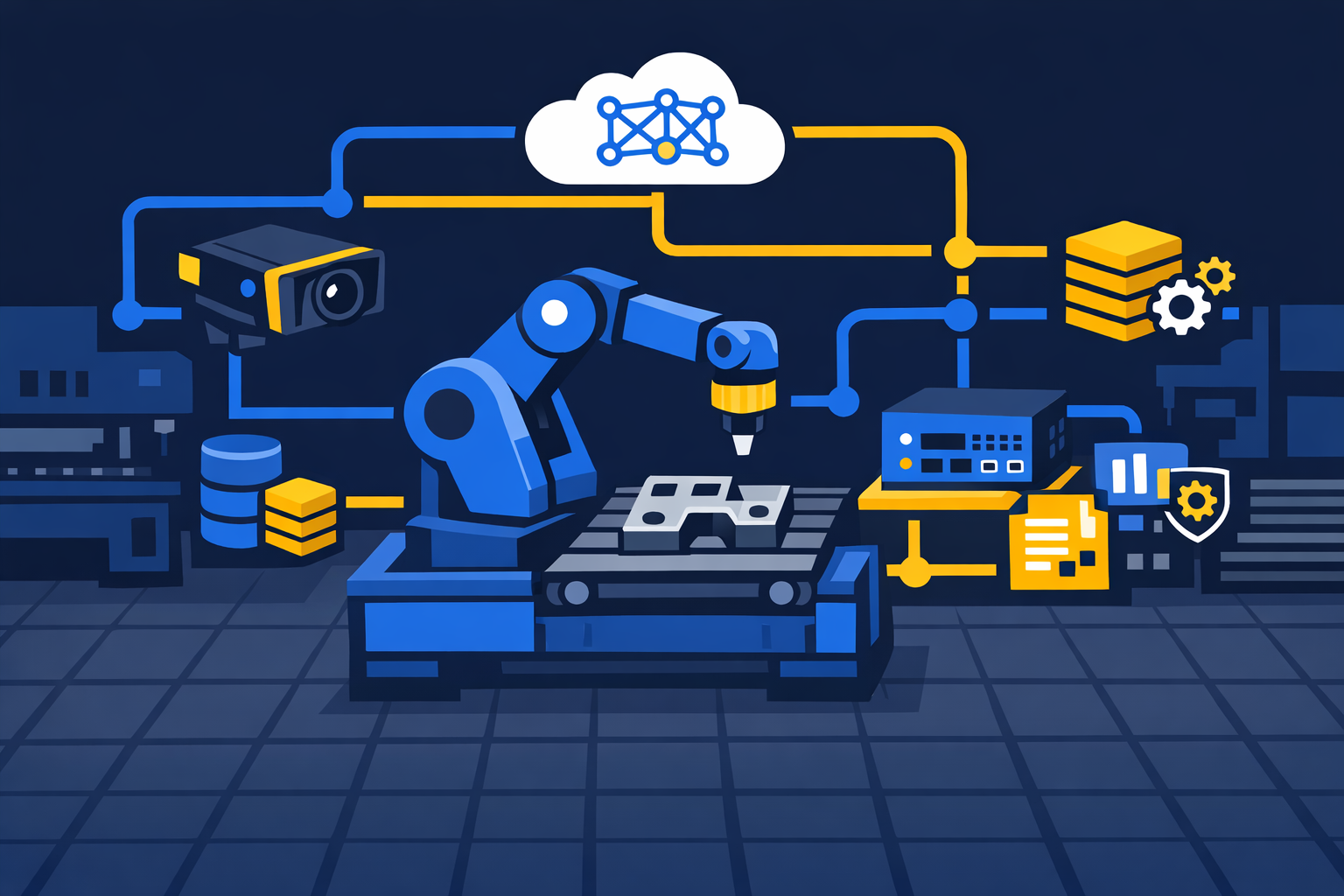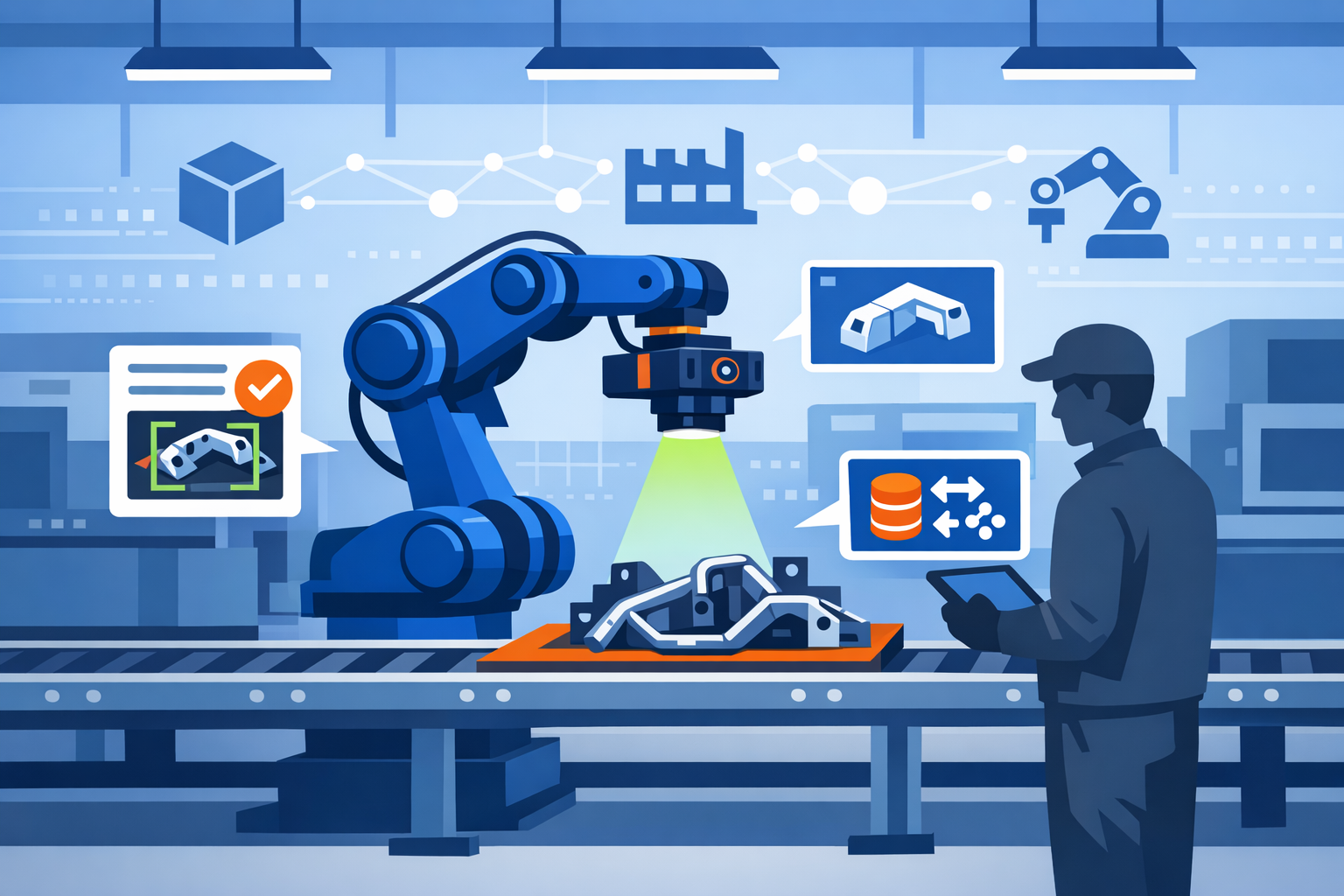
Fabricators are increasingly implementing vision-guided robotics to coordinate workflows in high-mix metalworking environments, enabling faster changeovers and reduced scrap. Integrators and manufacturers combine camera-based perception, AI-driven part verification, and interoperable interfaces to maintain digital thread continuity across CAD, MES, and robotic platforms in mixed-setup production lines.
Background
High-mix manufacturing requires frequent part changes and setup flexibility-capabilities that traditional fixed-program robot cells often lack. Vision-guided systems with real-time perception and AI allow robots to adapt to varying part geometries without extensive reprogramming, increasing flexibility in mixed-task lines. Recent market analysis indicates ROI can be achieved within 6 to 24 months for collaborative robot deployments, with some payback in under six months for high-volume or standardized tasks. Universal Robots reports average payback periods of 195 days for cobots, and robotic deployments in vaccine manufacturing achieved ROI in as little as two months, according to Robotiq and Deloitte data. Average cost reductions of 32% within two years have been reported[1]. Vision-guided systems deliver up to 85% defect reduction, 30% throughput gains, and 20-40% reduction in unplanned downtime through AI vision implementations. Case studies report quality improvements up to 85%, throughput gains of 30%, and unplanned downtime reduction of up to 40%[2]
Details
High initial investment and integration complexity remain significant barriers for small and medium enterprises (SMEs). Vision-guided robotics require precise calibration, lighting optimization, and alignment with existing equipment, while in-house expertise is often limited. Market reports note that high capital outlay and technical resource demands make ROI challenging for small-scale companies[3]. Interoperability also remains a challenge: diverse data formats and non-standard interfaces hinder seamless integration among CAD, MES, and robot control systems.
Standardization efforts are addressing these issues. The German industry association VDMA has published OPC UA Companion Specifications to support vertical integration across machinery and plant engineering, streamlining data exchange between devices. VDMA released an "Industrie 4.0 Interoperability through OPC UA with Companion Specifications" guide in late 2025[4]. In steel prefabrication, the DSTV-NC standard has been expanded with an ontology-based semantic digital twin, enabling robots to adjust plasma-cutting paths based on measured tolerances-demonstrating improved interoperability across CAD, process feedback, and robotic control. A case study showed DSTV-NC ontology enabled semantic digital twin control and feedback in robotic plasma cutting[5]
Pilot deployments show early ROI in high-mix applications. Vision-guided systems enable adaptive task switching, reducing changeover times and scrap. Establishing clear baseline metrics-such as first-pass yield, error rates, and OEE-is essential for assessing pilot outcomes and guiding phased rollouts. Best practices advise defining metrics, involving operations and quality engineering, and planning deployment before pilot launch[6]. Some manufacturers simulate scenarios that account for labor savings and quality gains to project multi-year ROI, with cumulative annual savings exceeding €500,000 in mid-sized operations after two years. Typical lines adopting robotics report labor cost reductions of 20-40%, defect reductions of 30-60%, throughput increases of 10-25%, and cumulative annual savings over €500,000 by year two[7]
Outlook
As standards such as OPC UA Companion Specifications and DSTV-NC semantic models gain traction, integration across CAD, MES, and robotics platforms is expected to improve. Manufacturers piloting vision-guided robotics should form cross-functional ROI teams, define measurable metrics, and plan phased deployments aligned with digital thread continuity to accelerate adoption in high-mix production.