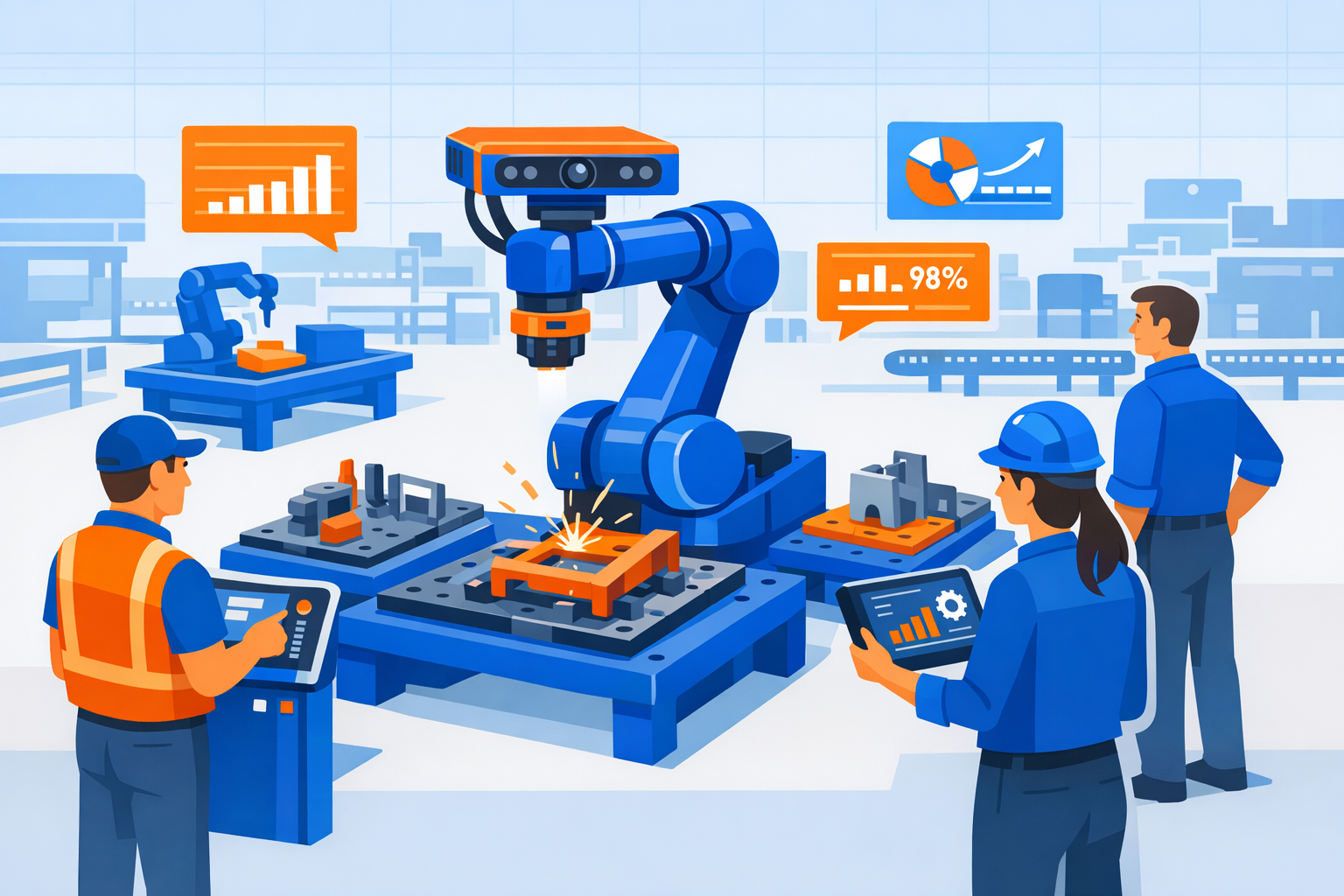
Most North American fabrication shops that deployed their first vision-guided robot cell in 2023 or 2024 now face a harder question than "does it work?" - they're asking "how do we scale it without breaking everything else?"
The global machine vision market is projected to grow from USD 15.83 billion in 2025 to USD 23.63 billion by 2030, at a compound annual growth rate of 8.3%, according to MarketsandMarkets[1]. The fastest-growing segment is AI-based software - the intelligence layer that makes variant-flexible inspection and robotic guidance practical without hard-coded programming. That growth is not concentrated in controlled Tier 1 plants. It is happening in job shops, contract fabricators, and mid-market OEM suppliers running dozens of SKUs per shift.
The transition from a successful proof-of-concept to factory-wide deployment is where automation initiatives stall, overshoot budgets, or produce islands of automation that don't communicate. Understanding the structural differences between pilot and scale - and planning for them - separates shops that realize compounding returns from those that accumulate underutilized capital equipment.
Why High-Mix Fabrication Is the Right Environment - and the Hardest One
High-mix, low-volume manufacturing has historically resisted automation because traditional industrial robots require specialist engineers, complex code, and lengthy integration cycles, making them impractical for operations running dozens or hundreds of part geometries. A single weld fixture optimized for one part number becomes a liability the moment the job mix changes.
Vision-guided systems address this constraint directly. By combining structured-light or time-of-flight 3D cameras with AI-based recognition, robots can locate parts in unstructured layouts, adapt torch orientation on the fly, and switch between part programs without manual re-referencing. Earlier coverage on this site documented how inline vision inspection enables near-instant defect detection across part families, trimming downstream quality escapes.
The result: automation that competes on flexibility, not just throughput. Cobots equipped with force-sensing and intuitive programming are now widely used in welding, assembly, and quality inspection, with their flexibility making them particularly suited to small-batch production and fast retooling, according to robotics integration analysts[2].
The ROI Case: What the Numbers Actually Show
The business case for scaling is strong but requires disciplined measurement from the pilot stage forward.
Most machine vision deployments achieve ROI within 6 to 18 months through reduced labor costs, improved quality, and decreased scrap rates, with documented figures[1] showing that AI-powered vision systems now detect defects at 97% accuracy compared to 85-90% from traditional inspection methods. For fabricators running high-value alloys, that accuracy gap translates directly into material cost avoidance.
The primary ROI levers in high-mix environments break down as follows:
- Setup time reduction: AI-driven vision eliminates manual re-referencing between part families. Providers have reported setup time reductions of up to 70% compared to conventional programming approaches.
- Scrap and rework: Machine vision systems running 24/7 reduce rework by 30 to 50%[1], with first-pass yield improvements directly lowering material consumption and cycle time.
- Labor redeployment: ROI estimates range from two to ten months when cobots replace or redeploy manual labor valued at approximately USD 60,000 per year, with complete cobot and vision system setups typically costing USD 75,000 or more[3] depending on sensor and tooling requirements.
- Short-run reconfiguration: Reusable vision libraries and pre-trained recognition models allow rapid cell reconfiguration for new jobs, directly reducing changeover-related downtime across the production schedule.
Capturing these gains at scale requires that KPIs - throughput, first-pass yield, OEE, scrap rate - be instrumented at the cell level and connected to MES/ERP for system-wide visibility. Pilots that operate without structured data capture cannot generate the evidence base needed to justify capital expansion.
The Pilot-to-Scale Gap: Where Deployments Stall
The mechanics of scaling differ fundamentally from pilot deployment. The table below maps critical differences across seven operational dimensions.
| Dimension | Pilot Phase | Full-Scale Deployment |
|---|---|---|
| Scope | 1-2 cells, single part family | Multi-cell, multi-part families across the shop floor |
| Programming approach | Manual / semi-manual, engineer-dependent | Reusable vision libraries; AI-driven auto-programming |
| Data governance | Ad hoc or vendor-managed | Structured OT data policies, ERP/MES integration |
| Cybersecurity posture | Minimal - isolated network segment | OT/IT segmentation, SBOM documentation, patch management |
| Operator role | Heavy reliance on specialist engineers | Trained operators manage cell reconfiguration independently |
| ROI visibility | Qualitative / proof-of-concept metrics | Quantified throughput, FPY, scrap, and uptime KPIs |
| Vendor landscape | Single integrator or OEM | Multi-vendor ecosystem with standardized interfaces |
Three friction points account for the majority of scale-up failures.
1. Cross-Vendor Interoperability
Most fabrication shops do not operate a single-vendor automation stack. Welding robots, vision platforms, press brake controls, laser heads, and MES systems may come from four or five different manufacturers. Standardization bodies are expected to address cross-vendor telemetry and data-format compatibility over the next 18 to 24 months, a gap that currently complicates factory-wide rollouts involving multiple vision platform suppliers, according to industry reporting[1]. Until that standardization matures, shops must specify open protocols - OPC-UA and MQTT are the dominant choices - in vendor RFQs and validate interoperability before purchase orders are issued.
2. OT Cybersecurity and SBOM Compliance
As vision cameras and inspection nodes become networked operational technology (OT) assets, they enter the attack surface. OT-targeted cyberattacks became a persistent trend in 2025, with attackers exploiting unpatched vulnerabilities in exposed industrial devices, per industry security research[1]. Procurement teams at larger manufacturers now routinely require Software Bills of Materials (SBOMs) from vision platform vendors as a condition of qualification.
This requirement carries regulatory momentum. CISA, NSA, and 19 international partners published joint guidance[4] in September 2025 establishing a shared framework for SBOM adoption to strengthen software supply chain transparency and security. Shops supplying automotive, defense, or aerospace customers should anticipate SBOM requirements flowing down through procurement contracts.
Practically, this means:
- Isolating vision and inspection nodes in a segmented OT network before connecting to MES/ERP
- Requiring SBOM documentation from all vision platform suppliers
- Including patch management and SBOM maintenance obligations in vendor service-level agreements
3. Data Governance and Integration Depth
Vision systems generate substantial data volumes. Without defined data ownership policies, retention schedules, and integration architecture, shops risk creating data silos that cannot support predictive scheduling or cross-cell quality correlation. Manufacturers that resolve ERP integration and OT network segmentation early in deployment can compress subsequent site rollouts from weeks to days, according to industry analysis[1].
A Phased Rollout Framework
Shops consistently report better outcomes when scale-up follows a structured sequence rather than opportunistic cell-by-cell expansion.
Phase 1 - Constrain and Validate: Select one high-frequency part family. Establish baseline KPIs before go-live. Validate the business case with quantified data, not subjective assessment.
Phase 2 - Standardize and Secure: Mandate open interfaces from all vendors. Segment the OT network. Require SBOM documentation before any vision node connects to plant infrastructure.
Phase 3 - Build the Library: Develop and document reusable vision recipes, robot path templates, and part-recognition configurations during the pilot. These assets become the scaling accelerant - each subsequent cell draws on proven, tested logic rather than starting from scratch.
Phase 4 - Train and Instrument: Operator training for vision-guided systems typically ranges from two to five days per person, while integration expenses often comprise 20 to 50% of the robot's base cost. Deploy structured training before cell handover. Connect the cell to MES/ERP dashboards measuring throughput, FPY, and OEE.
Phase 5 - Replicate with Rigor: Apply the validated architecture - network segmentation, SBOM documentation, reusable libraries, training protocols - to each subsequent cell. Resist the temptation to customize cell architecture for each deployment; standardization is what makes scaling economical.
What to Demand from the Ecosystem
The vendor ecosystem for vision-guided fabrication automation - systems integrators, tooling vendors, and machine builders - has matured significantly, but quality varies. Manufacturers scaling beyond a single cell should hold suppliers to specific standards:
- Systems integrators must demonstrate documented experience with high-mix environments, not solely high-volume lines. Request references from fabricators with comparable SKU counts and part geometries.
- Vision platform vendors must provide SBOMs, commit to patch cadences, and support open protocol integration. Proprietary data formats that cannot connect to standard MES/ERP interfaces are a scaling liability, not a feature.
- Machine builders integrating vision from the factory floor up should offer pre-validated vision-robot combinations with documented API specifications. Cobots with IP67-rated hardware, intuitive hand-guidance, and drag-and-drop programming are specifically engineered for high-mix, low-volume environments where fast redeployment is operationally essential, as demonstrated by leading robot builders at FABTECH 2025[5].
- Tooling vendors supplying end effectors for vision-guided cells must support adaptive gripping geometries compatible with the full part range, not merely the anchor part used during pilot validation.
The broader point: a vision-guided automation initiative is a system-of-systems investment, not a product purchase. Supplier qualification standards should reflect that scope.
Workforce Development: The Scaling Multiplier
Automation at scale does not eliminate the need for skilled personnel - it reshapes the skill profile. Operators who previously performed manual re-referencing and inspection become cell supervisors, vision calibration technicians, and data analysts. The World Economic Forum has reported that manufacturing industries worldwide face difficulty filling 87% of skilled positions, with quality control and precision assembly roles most affected - a dynamic accelerating machine vision adoption as a structural response to labor market conditions[1], not merely a productivity play.
Shops that invest in structured training programs and identify internal vision champions - operators who can support peer training and first-line troubleshooting - scale faster and with fewer rollback events than those relying exclusively on integrator support after go-live.
The Bottom Line
Vision-guided automation has cleared the proof-of-concept threshold in North American high-mix fabrication. The competitive question is no longer whether the technology works - it is whether a given shop's operational infrastructure, vendor relationships, and workforce capabilities can support scaling without compressing the margins the technology is meant to protect.
Shops that treat the pilot as a data-gathering and infrastructure-building exercise - not merely a technology demonstration - are the ones converting six-figure pilot investments into plant-wide productivity gains. Those that skip the governance and interoperability groundwork will find the second cell harder to deploy than the first, and the fifth cell nearly impossible.
The path from pilot to scale is as much a process discipline problem as a technology problem. Fabricators that recognize that distinction early will be the ones setting throughput benchmarks by the end of the decade.