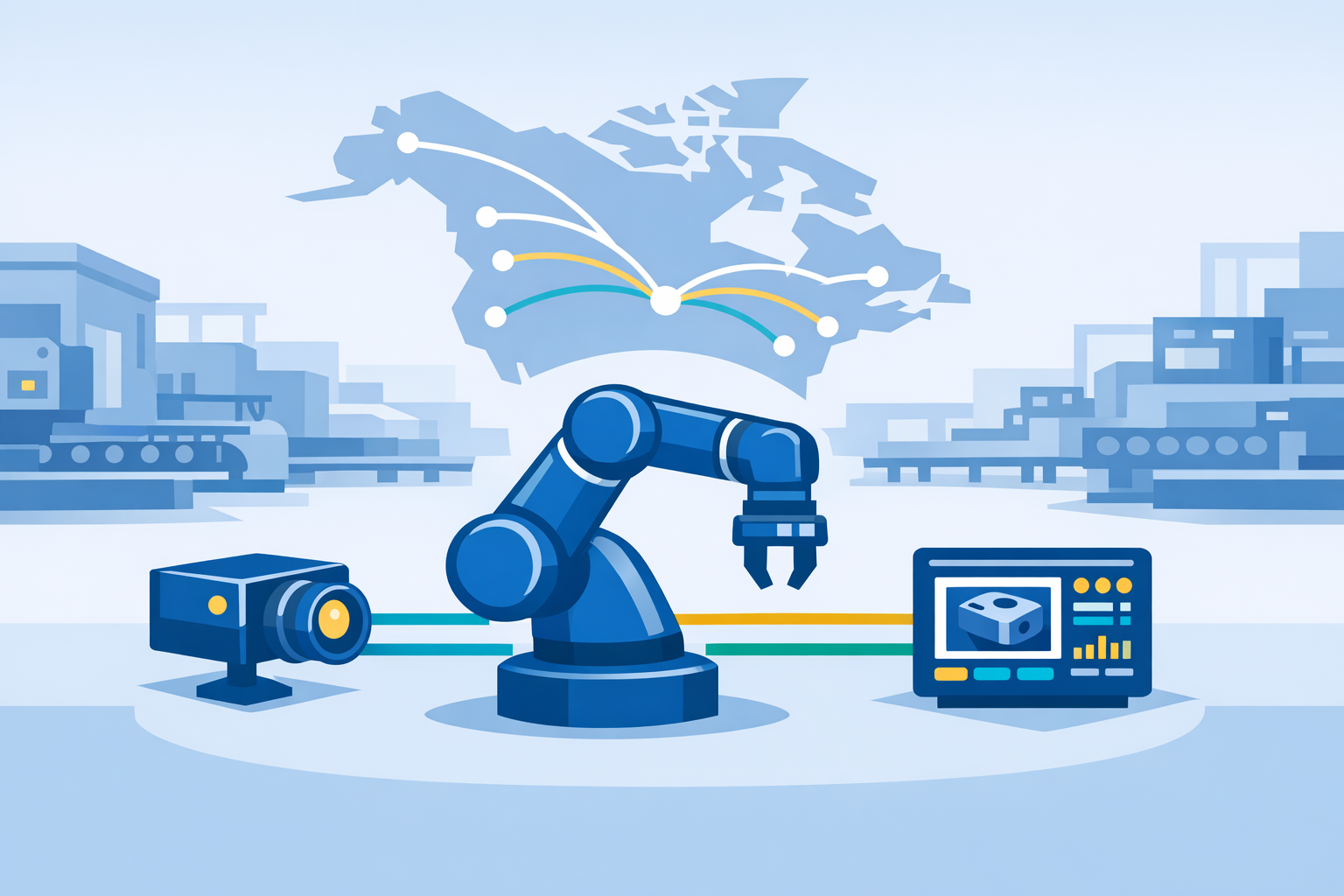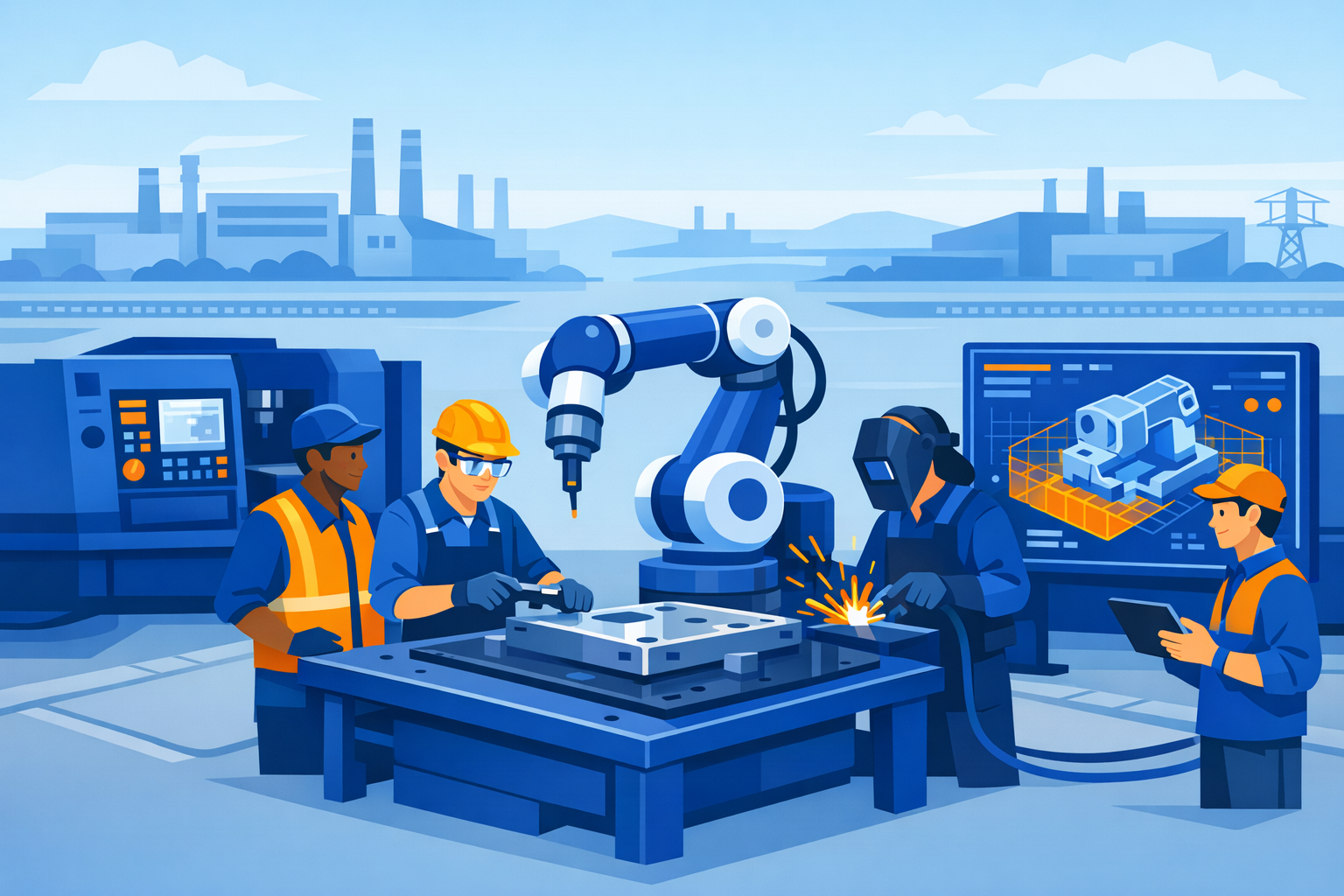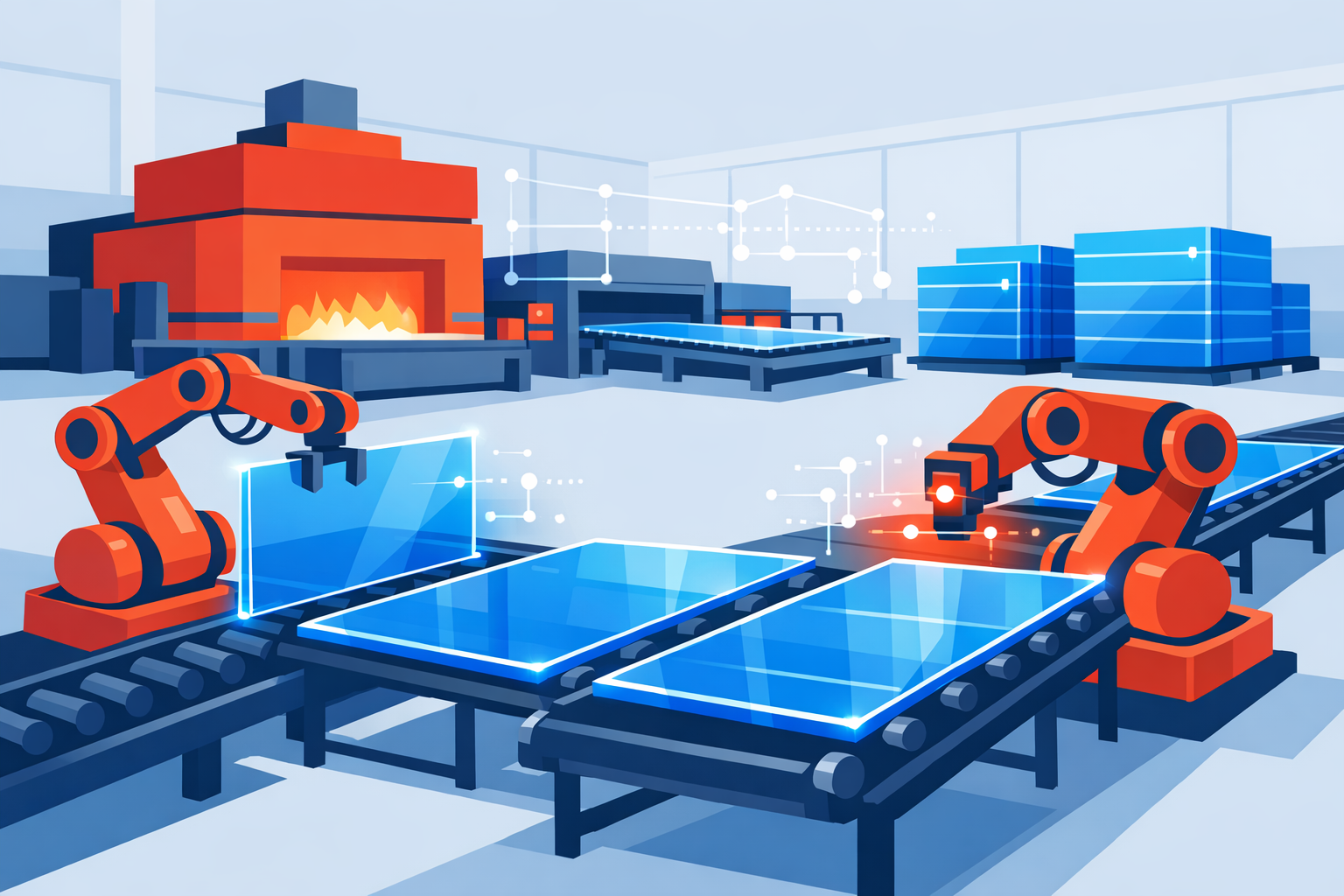
Executive summary. Glass fabrication has become a leading testbed for AI-driven process control and real-time vision inspection. By shifting from batch-based checks to continuous monitoring and adaptive feedback, plants are reducing scrap, stabilizing furnace conditions, and moving workers away from hazardous manual inspection and handling.
For metalworking professionals increasingly involved with architectural, display, and specialty glass, these advancements in AI-enabled glass lines offer a preview of future control strategies for brittle-material workflows, hybrid assemblies, and hot processes.
Why Glass Fabrication Is a Prime Candidate for AI-Driven Control
A narrow process window with high energy stakes
Glass fabrication is both thermally intensive and sensitive to mechanical stress. Melting, forming, tempering, and bending require strict control of temperature, stress, and cooling profiles.
Industry data indicate that glass production uses about 4 GJ of energy per tonne of container glass, with furnaces running at up to approximately 1,600°C; melting accounts for approximately 75% of plant energy use. While energy efficiency has improved, further optimization is possible: European glass manufacturing raised efficiency by about 30% between 1990 and 2015.
Implications for plant managers include:
- Minor deviations can drive up fuel usage.
- Each rejected product represents significant embodied energy and CO₂.
- Dynamic control is required to maintain optimal furnace conditions as cullet ratios, ambient factors, and product mix shift.
Waste and rework are structurally embedded
Even advanced glass plants generate notable in-process scrap through breakage, shape defects, inclusions, scratches, and anisotropy issues.
Sustainability reports show about 100-200 kg of waste per tonne of glass produced, with 95% internally recycled as cullet. Although this recycles material, energy lost during melting and processing is not recovered.
Traditional inspection typically:
- Finds systemic issues only after multiple batches are processed.
- Misses defects that are low-contrast or appear under specific conditions.
- Provides limited quantitative data for process engineers seeking root causes.
Safety pressures around hot and heavy operations
Glass production involves hot ends at furnace and forming stations and cold ends with large, fragile panels. Manual inspection and handling expose operators to cuts, burns, musculoskeletal injury, and crush hazards.
US data shows a nonfatal injury and illness rate of 3.3 cases per 100 full-time flat glass workers in 2019, above many other manufacturing sectors. Regulatory focus remains on manual handling and hot equipment as key risk areas.
Narrow process windows, high energy demands, embedded waste, and safety challenges make a strong case for real-time, AI-enabled automation.
How Real-Time AI Process Control Works on Glass Lines
Vision-based inspection at the hot and cold end
Glass lines now use high-resolution cameras and sensors at key points:
- Hot end: Thermal and visible cameras detect gob shape, mold filling, striations, surface defects, and glow patterns indicating thermal anomalies.
- Cold end: Line-scan and area-scan cameras recognize scratches, inclusions, chips, bow, roller waves, anisotropy, coating issues, and alignment errors.
Deep learning models, trained with labeled defect images, analyze each frame in milliseconds, identifying:
- Defect type (bubble, stone, scratch, crack, chip, inclusion, warp, roller mark, coating spot).
- Location (surface X-Y, edge, center, or interface regions).
- Severity (correlated to specification thresholds or EN/ASTM standards).
Unlike conventional rule-based systems, these models distinguish true defects from acceptable cosmetic variations-a crucial capability given glass's complex reflection and interference properties.
Closed-loop control in forming, tempering, and bending
AI inspection feeds directly into feedback loops, enabling automatic process parameter adjustments.
Recent research in glass bottle forming demonstrates deep-learning controls that use gob characteristics and production data to regulate machine settings, stabilizing wall thickness and reducing defects in live environments.
Typical control loops:
- Adjust furnace and forehearth temperatures based on defect trends.
- Modify forming machine timings and pressures in response to thickness or shape deviations.
- Tune tempering profiles (soak time, quench rates) when output exceeds anisotropy or roller wave limits.
- Update bending programs for curved glass when springback or deviation surpasses tolerances.
The objective is to stabilize production and minimize defect occurrence, not just sort out nonconforming pieces.
Integration with MES, ERP, and plant safety systems
AI vision data links into the plant's digital infrastructure:
- MES integration: Defect rates tie into OEE dashboards and SPC charts, triggering line adjustments or preventative maintenance.
- ERP/planning: Real-time yield forecasts inform schedules and raw material orders, critical for high-value glass with tight delivery windows.
- CMMS/SCADA: Defect patterns initiate maintenance orders and adjust alarm thresholds.
- Safety systems: Abnormal conditions detected by vision or thermal analytics can trigger equipment slowdowns or targeted alerts, reducing reliance on human observation.
For facilities using MES/ERP on metal lines, this integration is readily applicable to glass or hybrid cells.
Quantified Impacts: Waste, Energy, and Safety
Inspection accuracy and quality outcomes
Industrial AI vision achieves accuracy levels that surpass manual inspection.
Large-scale deployments report defect detection accuracy of 97-99.5% at full speed, versus 60-80% for manual inspectors. In consumer-goods applications, AI robotic vision is linked to 30-45% fewer defects reaching customers.
For glass, modern vision systems enable:
- 100% output inspection versus sampling.
- Early culling of nonconforming pieces before value-added processing.
- Structured defect data for process control and improvement.
Waste and energy savings
AI process control reduces waste and energy use via:
- Early detection of drifts. AI flags defect clusters within minutes, curtailing out-of-spec production runs.
- Adaptive correction. Feedback loops auto-adjust temperatures, speeds, and pressures to restore stability.
- Predictive maintenance. Analytics link defects to equipment wear, enabling scheduled interventions.
One AI-enabled project reduced mold-cleaning time from 5 hours to 2 seconds, resulting in major material and energy savings.
With more stable operation, higher cullet use, and reduced downtime, incremental yield and efficiency gains make measurable impact. Global glass industry energy use is estimated at 500-800 PJ per year, with melting as the primary source of emissions. Small improvements, therefore, are significant at scale.
Safety and ergonomics improvements
Technology-driven quality gains also reduce risk:
- Less manual inspection. Cameras and sensors eliminate close operator presence near hot or moving glass.
- Less manual lifting. Automated handling, guided by vision, moves heavy panes, directly addressing main injury causes.
- Earlier abnormal event detection. AI monitoring flags anomalies for proactive interventions.
Published safety data specific to AI in glass are still emerging, but trends indicate less worker exposure and a shift toward supervisory roles.
Data, Calibration, and Change Management: The Hard Parts
Building robust image-data pipelines
For transparent, brittle materials, data quality often presents bigger challenges than model design.
Critical issues include:
- Lighting control. Controlling reflections and interference needs multi-channel lighting for surface and subsurface flaw detection.
- High-throughput capture. Inline processing requires line-scan cameras and edge computing for real-time analysis.
- Annotation at scale. Millions of labeled images are needed for all defect types and severities, requiring structured methods and clear taxonomies.
To address class imbalance-where true defects are rare-synthetic data plays a role. Diffusion-based synthetic data in glass boosted classifier accuracy from 78% to 93% by filling minority classes. Such techniques are entering industrial use to reduce annotation overhead and improve robustness.
Calibration for brittle, transparent materials
Glass calibration is more challenging than with opaque metals:
- Shop lighting and environment reflections can cause false positives.
- Minor changes in color or coating shift the visual profile even if geometry is correct.
- Thermal gradients create image distortions that require adjustment.
Effective programs employ:
- Calibration artifacts for regular performance checks.
- Domain adaptation and retraining for new recipes or product types.
- Ongoing monitoring of reject/accept rates as core quality indicators.
Organizational change and workforce skills
Implementing AI-driven control is as much about organization as technology.
Key issues include:
- Trust and interpretability: Staff require clear rationale for defect identification and recommended changes.
- New roles: Plants need personnel versed in both process engineering and data science to manage AI systems.
- Standard operating procedures (SOPs): Integration of AI outputs into workflows is critical; unclear SOPs lead to underuse or parallel systems.
Weak change management risks poor adoption and limits ROI.
Lessons for Other Brittle-Material Workflows
While focused on glass, these patterns generalize to other brittle and surface-critical materials intersecting with metal fabrication:
- Ceramics and tiles: Real-time vision identifies glaze defects and warpage; predictive models adjust kiln settings.
- Optical/Coated lenses: High-magnification vision and AI detect micro-defects affecting performance.
- Coated metal panels/composites: Anomaly detection exposes coating issues or delamination before assembly.
Shops fabricating assemblies combining glass and metals can benefit from unified AI vision and process control approaches for streamlined quality and data management.
Manual vs AI-Driven Control: A Comparative View
| Aspect | Manual / Legacy Inspection & Control | AI-Driven Real-Time Inspection & Control |
|---|---|---|
| Inspection coverage | Sampling (2-10% of output) | 100% of units at line speed |
| Detection accuracy | ~60-80%; drops with fatigue | Typically 97-99.5% in industrial use |
| Feedback latency to process | Minutes to hours; end-of-batch | Milliseconds to seconds; directly linked to causes |
| Data for root-cause analysis | Manual logs and spot checks | Structured defect databases-type, location, trends |
| Impact on operators | Work near hot, heavy glass; repetitive tasks | Supervisory roles from protected locations |
| Typical quality outcome | Recurring escapes, later drift detection | Fewer escapes; earlier process control adjustments |
This pattern matches other manufacturing sectors, where AI robotic vision cut customer-facing defects by 30-45% post-implementation, suggesting similar gains for glass producers.
Actionable Conclusions and Next Steps for Producers
A staged approach can manage risk and speed payoff for AI-assisted glass process control:
1. Quantify the baseline
- Map current scrap and rework by product, line, and defect category.
- Calculate energy and cost per rejected output using plant-specific data.
- Review injury incidents tied to inspection and handling.
2. Prioritize high-impact use cases
Target initial projects where waste, energy, and safety impacts are largest:
- Tempering lines with chronic quality complaints.
- IG or laminated lines with high breakage downstream.
- Container lines with frequent mold issues.
3. Design data and integration architecture first
- Define data flow and synchronization with MES/ERP.
- Assign decision levels between PLC, MES, and optimization systems.
- Set KPIs (scrap, energy per good unit, false reject rate, incident rate).
4. Start with closed-loop recommendations, then automation
- Launch with AI suggesting setpoint changes for review.
- Gradually transition to auto-adjustment within approved ranges after validation.
5. Invest in calibration and workforce skills
- Set up regular calibration for each product family.
- Train teams on system use and interpretation.
- Enable feedback loops between operators and data specialists.
6. Plan for broader rollout
- Document lessons for use on additional lines.
- Standardize data and integration models.
- Explore application across materials, such as coated metals.
Frequently Asked Questions
How much data is needed to train an AI inspection system for glass?
Thousands of labeled examples per defect category are typically required for robust performance. Synthetic data and focused campaigns augment real-world data for rare defects. Recent work found synthetic diffusion images raised model accuracy from about 78% to 93%.
Does AI replace human inspectors and operators in glass plants?
AI systems take over repetitive inspection and parameter recommendations. Human staff manage exceptions, maintenance, and optimization. Experienced inspectors often transition to calibration and system oversight roles.
What are realistic payback periods for AI-driven inspection and control?
Payback varies, but industry studies cite ROI within one year based on scrap, warranty, and labor savings. Yield gains and reduced downtime often justify investment without placing value on improved safety.
How does AI contribute specifically to safety improvements?
AI reduces close-proximity work at hot ends, supports automated handling, and detects process issues early. This enables equipment to slow or stop before incidents, and shifts labor toward analytical roles.
Are lessons from glass applicable to metalworking and fabrication shops?
Yes. The same principles-advanced sensing, AI-based anomaly detection, and automated feedback-are relevant to hot rolling, heat treatment, welding, and surface finishing. Existing automation and MES/ERP infrastructure in metalworking can extend these controls to glass and other brittle materials for integrated quality and safety monitoring.