AI-driven, vision-guided automation is moving beyond limited pilot programs to full-scale shop floor deployment across high-mix metal fabrication operations. Early adopters report measurable gains in throughput, changeover speed, and defect detection. The shift stems from converging pressures: a deepening skilled labor shortage, tightening quality standards, and the commercial maturation of machine vision platforms that no longer require manual programming or dedicated robot specialists.
Background
The global robotic welding market stood at USD 5.42 billion in 2020 and is projected to reach USD 16.87 billion by 2030, growing at a compound annual growth rate of 10.2%, driven by Industry 4.0 adoption and increasing automation across manufacturing sectors. Machine vision, a core enabling technology within this growth, tracks a parallel trajectory: the machine vision systems market is projected to grow from USD 20.4 billion in 2024 to USD 41.7 billion by 2030, at a CAGR of 13%.
Historically, robotic grinding, deburring, and weld-seam finishing cells have been poorly suited to job shops handling diverse part geometries. The barrier was programming: each new part type required hours or days of manual teach-pendant work, negating throughput gains in low-batch environments. According to Teqram co-CEO Frans Tollenaar, robotic grinding cells existed for years but were not widely adopted by high-mix job shops because the programming phase made rapid changeover impractical. That calculus is shifting as AI-based vision models eliminate part-specific programming entirely.
Workforce pressure adds further urgency. According to the American Welding Society, the United States could face a shortage of 360,000 welders by 2027. Meanwhile, only 10% of machine-tending operations are currently automated, according to MIT, indicating substantial productivity headroom in most fabrication facilities.
Details
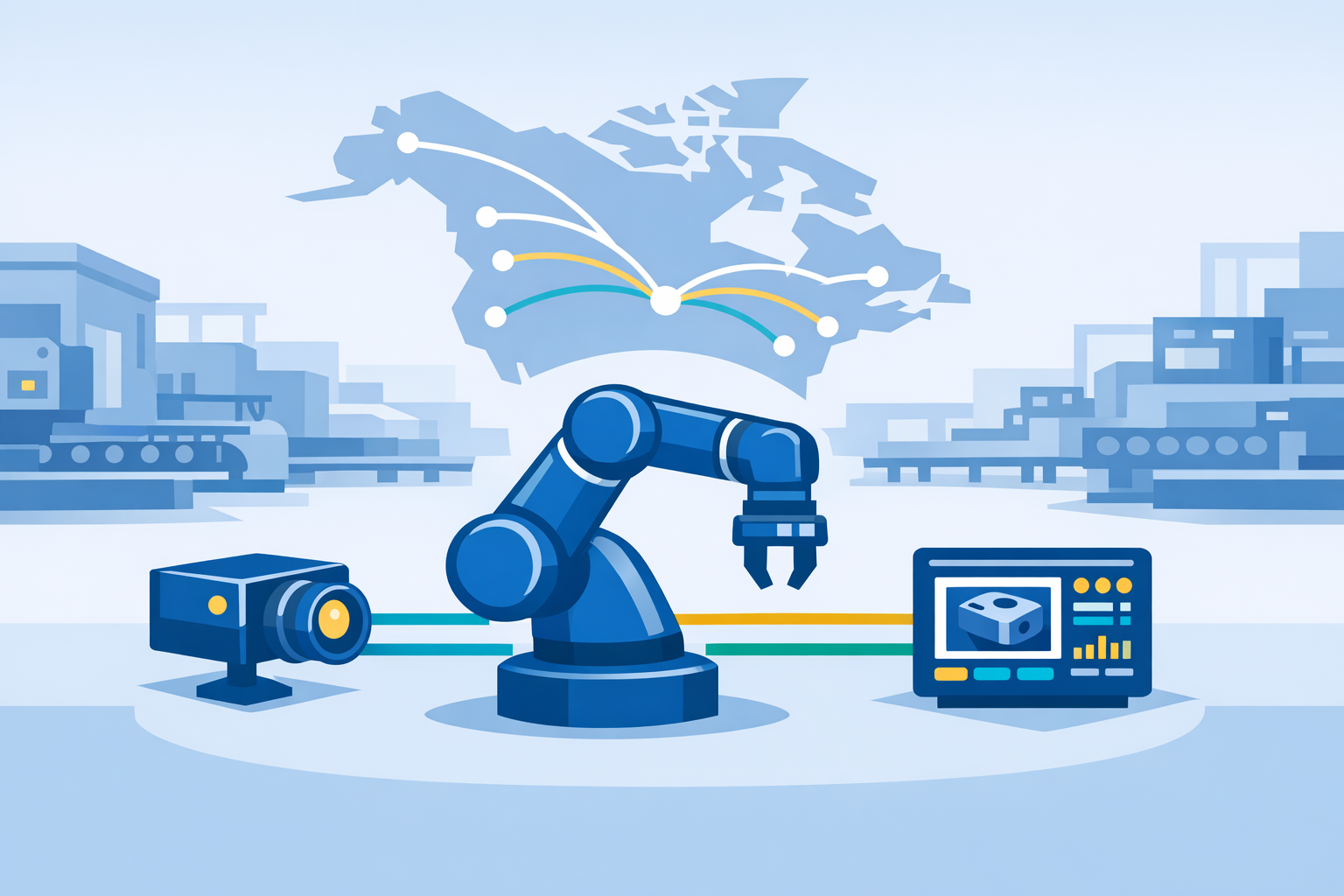
Real-world deployments illustrate the scale of change. Teqram's AI vision-guided EasyGrinder system, which requires no manual programming or teach-pendant operation, is now operating at O'Brien Steel Services in Peoria, Illinois; Minerd & Sons in Lawrence, Pennsylvania; Canam Bridges in Québec City, Canada; and at two Accurate Metal facilities in Milwaukee, Wisconsin, and Rockford, Illinois. According to Tollenaar, these companies use automation not only to offset labor gaps but to gain competitive advantages in processing speed and surface finish consistency-particularly as quality standards such as DIN EN ISO 8501-3 (preparation grade P3) impose stricter requirements on the edge condition of flame-cut and plasma-cut parts.
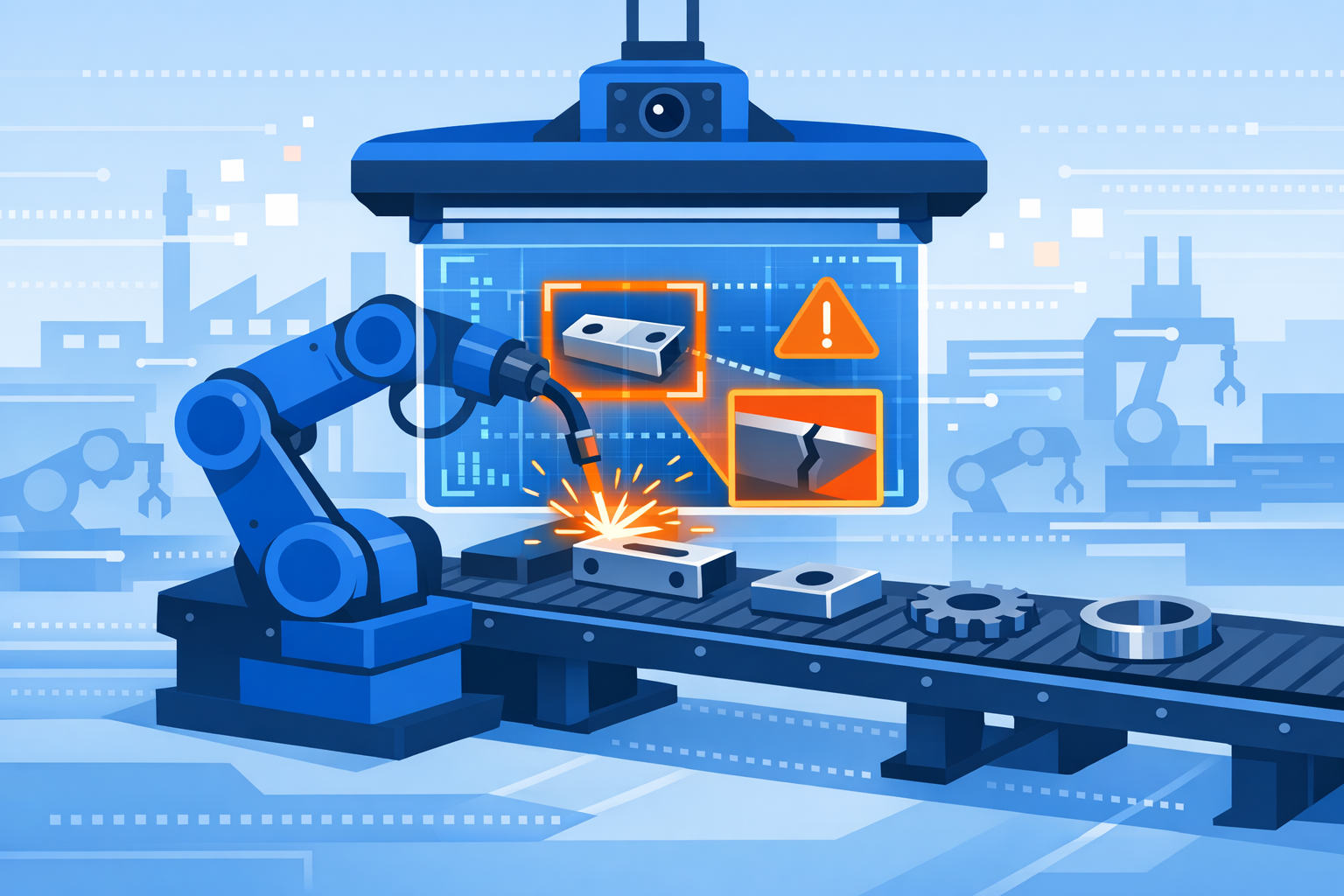
Throughput data from other deployments is concrete. One welding operation reported completing six parts in 20 minutes using a cobot, compared to one part manually in the same period. Separately, one heavy fabricator implementing a full robotic welding cell reported a 40% increase in production output alongside a 25% reduction in labor costs. On the inspection side, AI visual inspection systems are capable of detecting assembly and weld defects in under 200 milliseconds, enabling in-process correction rather than downstream rework.
System integration is a critical dimension of current deployments. Modern AI vision platforms connect directly with existing production infrastructure. According to Wevolver, platforms such as Matroid deliver real-time inspection alerts directly to PLCs, SCADA, MES, and ERP systems, maintaining digital traceability across a part's full production journey. This connectivity allows quality event data generated on the shop floor to feed immediately into scheduling and procurement decisions at the ERP level-closing a loop that previously required manual data entry or end-of-shift reconciliation.
Traditional PLC control systems have struggled to keep pace with the data throughput demands of AI-vision-integrated cells, according to automation integrators at FABTECH 2025. Vendors are responding with purpose-built controllers: Vention, for instance, demonstrated a MachineMotion AI controller powered by the NVIDIA Jetson GPU at FABTECH 2025, designed to run multiple AI-vision processes across an entire shop floor from a single control architecture.
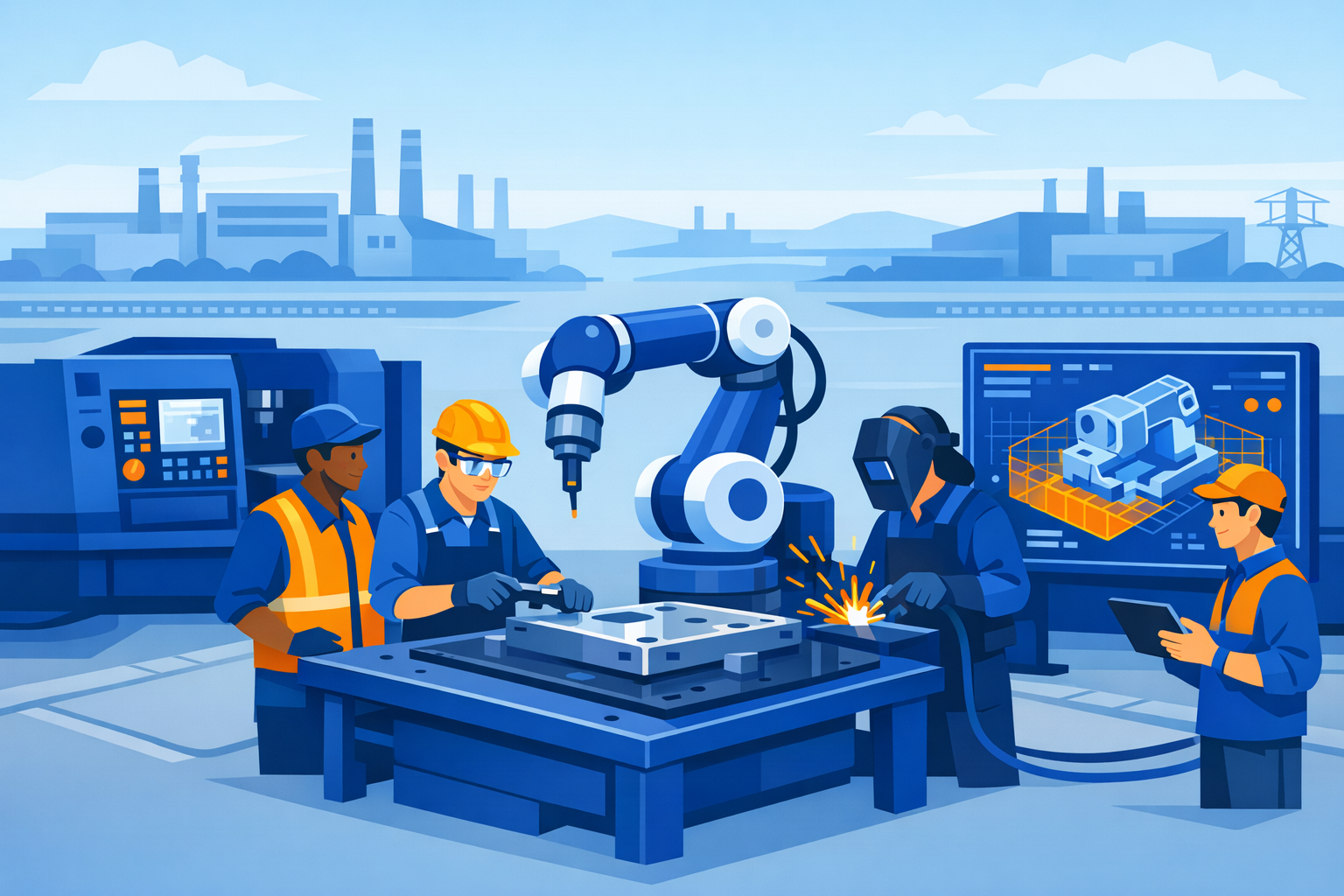
Workforce transformation presents an equally significant operational variable. As AI copilots and digital twins are introduced to the shop floor, technicians are shifting from manual operation roles toward supervision, model validation, and process engineering functions. Industry consultants advise that change management-specifically involving shop-floor teams early and demonstrating how vision-guided cells remove physically demanding and hazardous tasks-is essential for sustained adoption. On the safety front, visual AI systems in manufacturing are increasingly used for real-time PPE compliance monitoring, proximity alerts, and hazard detection, with academic research indicating AI can reduce workplace accidents by up to 30%.
Outlook
Integration complexity-particularly connecting multi-vendor vision systems with legacy ERP and MES platforms-remains the primary friction point for shops scaling beyond a single pilot cell. Key integration challenges cited by engineers include environmental variability such as dust and variable lighting on the shop floor, the need for ongoing model retraining as new part geometries are introduced, and managing false-positive rates during initial deployment. Vendors and integrators are expected to address these gaps through standardized middleware and open-protocol architectures over the next 12 to 24 months. For fabricators evaluating entry points, the integrator consensus is to start with a single, high-repetition application-such as post-laser-cut deburring or weld seam inspection-establish measurable baselines, and expand from demonstrated ROI.