The global digital twin market is projected to grow from roughly $36 billion in 2025 to $180 billion by 2030, reflecting a CAGR near 38%[1]. For plant managers at glass and metal facilities - where furnaces and kilns account for the majority of energy spend - that growth signals an urgent question: how fast can a digital twin or energy-efficiency retrofit pay for itself, and what does the path to deployment actually look like?
The answer is becoming clearer. Steel manufacturers implementing digital twins have reported 12% reductions in energy consumption, 8% throughput gains, and 30% cuts in unplanned downtime, with full technology payback achieved within 14 months in documented deployments[2]. Meanwhile, energy costs can represent up to 14% of total glass production expenses, as noted by the Glass Manufacturing Industry Council[3], making every incremental efficiency gain material to the bottom line.
The Regulatory Catalyst: Why the Investment Window Is Narrowing
The policy landscape is pressuring glass and metal plants from multiple directions. EPA NESHAP standards continue to apply to glass manufacturing plants operating continuous furnaces producing at least 50 tons per year, with ongoing compliance requirements[4] for hazardous air pollutants. In steel, EPA finalized interim rules extending compliance deadlines for integrated iron and steel manufacturing facilities in November 2025, but the updated air toxics standards[5] remain stringent.
Perhaps more consequential for capital planning: the Clean Competition Act (CCA), introduced in Congress in late 2025, would impose a carbon performance fee starting at $60 per ton of CO₂e on sectors including iron and steel, aluminum, and glass, according to CSIS analysis[6]. Even if the CCA's timeline remains uncertain, the directional signal is clear - plants that benchmark and reduce emissions intensity now will be better positioned regardless of which regulations materialize.
Digital Twins in Furnace and Kiln Operations: From Pilot to Production
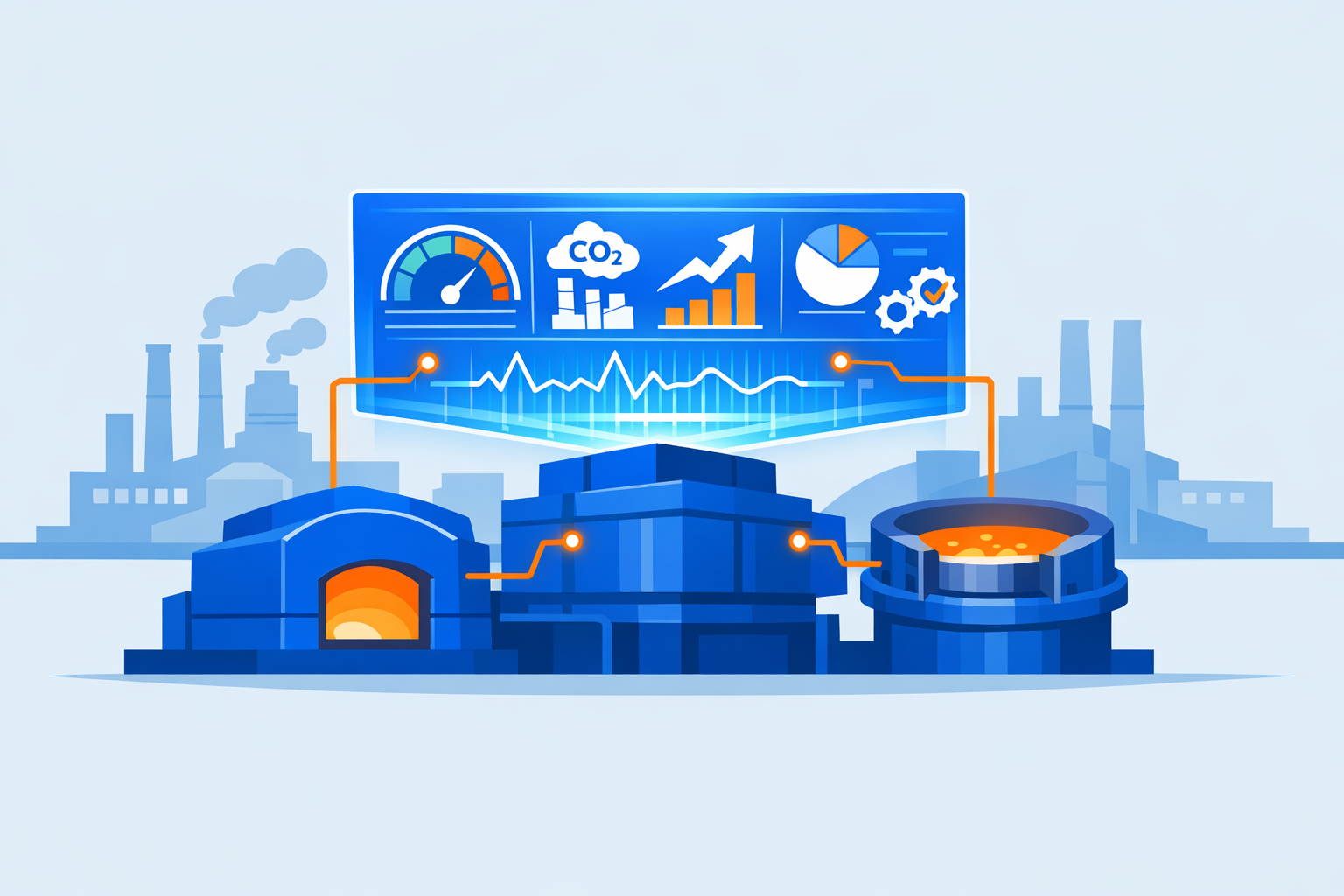
A digital twin in a glass or metal plant is not a static 3D model. It is a continuously updated virtual replica of a physical asset - a furnace, kiln, or entire production line - that ingests real-time sensor data and uses physics-based and data-driven hybrid models to predict behavior and test changes in silico.
In practical terms, operators can simulate adjustments to temperature profiles, airflow ratios, batch composition, and pull rates before executing them on the shop floor. The result: optimized combustion, reduced fuel consumption, and maintained product quality without the production risk of trial-and-error adjustments.
Recent pilot programs illustrate the impact. One mid-sized glass facility deployed a reduced-order model digital twin to monitor forehearth temperatures above 1,400°C, detecting deviations and alerting operators within seconds. Another pilot linked Python-based control logic via OPC UA to a heating tunnel, achieving energy savings of up to 40% during heating cycles.
Five Steps to a Successful Digital Twin Deployment
- Establish energy baselines. Instrument furnaces, kilns, and auxiliary systems with IoT sensors. Collect at least 90 days of granular energy, temperature, and throughput data before modeling.
- Deploy a pilot digital twin. Start with a single high-energy asset. Use hybrid physics-based plus data-driven models to simulate temperature profiles, airflow, and fuel consumption.
- Run what-if scenarios. Simulate process changes - adjusted batch composition, modified pull rates, altered combustion air ratios - to identify the top 3-5 energy-saving interventions without disrupting production.
- Implement and validate gains. Execute the highest-impact changes on the physical line. Compare digital twin predictions against actual KPIs to calibrate the model.
- Scale and integrate. Expand across additional lines. Connect to predictive maintenance, automated controls, and ERP systems.
Waste Heat Recovery: The Complementary Investment
The global metal manufacturing waste heat recovery system market reached $13.42 billion in 2025 and is projected to hit $27.22 billion by 2035, per Precedence Research[7]. Furnaces dominate as the primary heat source, accounting for 33.8% of the waste heat recovery market in 2025.
Payback timelines vary significantly by technology:
| Upgrade Category | Typical Payback | Energy/Emissions Impact |
|---|---|---|
| Recuperators (combustion air preheat) | 6-24 months | 15-30% energy reduction |
| Scrap/Cullet preheating | 2-3 years | ~3% energy cut per 10% cullet increase |
| ORC systems (low-grade heat to power) | 3-7 years | CO₂ offset via self-generated electricity |
| Digital twin (furnace/kiln pilot) | 12-18 months | 10-15% energy reduction |
| AI-enhanced controls & sensors | 6-12 months | 5-10% fuel waste reduction |
In glass manufacturing specifically, CelSian's GTM-X furnace modeling platform and DOE-supported training programs are helping operators identify combustion inefficiencies and reduce fuel consumption through the ISEED program[3]. On the metals side, thermal recovery heat exchangers in energy-intensive applications such as metal processing typically deliver payback periods of 6-24 months with energy recovery efficiencies of 60-85%, according to equipment manufacturers[8].
Where Digital Twins Meet Predictive Maintenance and AI
The compounding value of a digital twin investment emerges when it connects to broader automation and quality systems. Digital twins enable up to 20% reduction in unexpected work stoppages while optimizing maintenance schedules, based on industry data[9]. Paired with AI-enhanced defect detection - such as machine-vision tools that inspect glass for bubbles or scratches and adjust production conditions to minimize scrap - the combined efficiency and yield gains accelerate payback.
The operational logic is straightforward: a digital twin that models furnace thermal dynamics can also predict refractory wear, burner degradation, and sensor drift. That predictive capability shifts maintenance from calendar-based schedules to condition-based interventions, reducing both downtime and spare-parts inventory costs.
For a deeper look at how glass plants are integrating AI-driven defect detection with digital twin systems, see the earlier coverage of pilot programs in U.S. glass facilities.
Data Governance: The Make-or-Break Factor
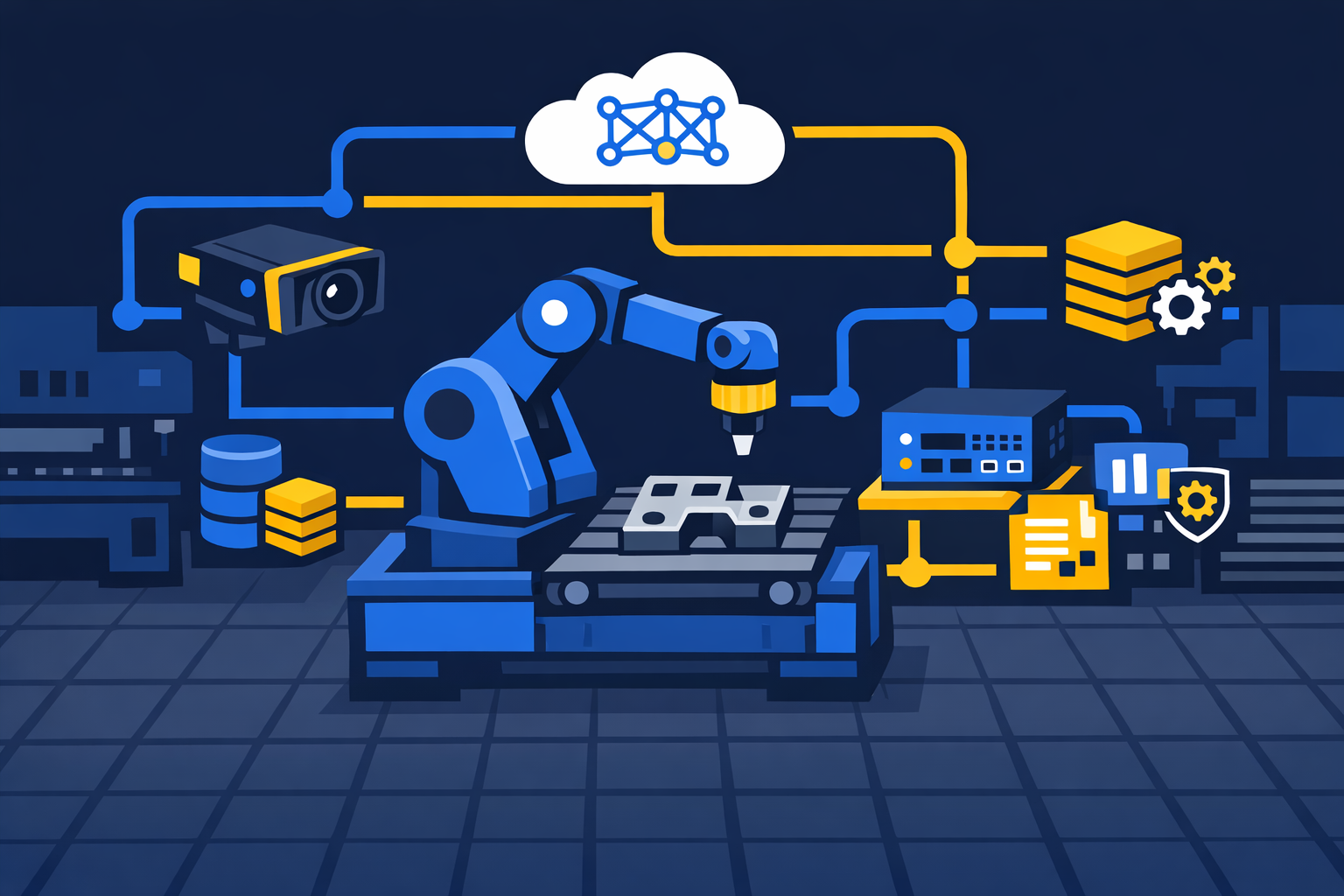
Critical consideration: Data fragmentation across siloed MES, SCADA, and ERP systems is the most commonly cited barrier to successful digital twin deployments. Unify protocols (e.g., OPC UA) and designate a single source of truth before deployment.
A digital twin is only as good as its data pipeline. Before selecting a vendor, plant teams should address several governance fundamentals:
- Data ownership: Clarify whether sensor data, model outputs, and derived insights belong to the plant, the vendor, or a shared arrangement.
- Sensor calibration schedules: Drift in temperature, flow, or pressure sensors directly corrupts twin accuracy. Automate calibration alerts.
- Access-control tiers: Production operators, engineers, and leadership each need different levels of access to twin outputs. Define role-based permissions early.
- Cybersecurity: Real-time connectivity between OT and IT networks introduces attack surface. Segment networks and audit regularly.
Building the Business Case: KPIs That Justify Investment in 6-12 Months
Plant managers presenting digital twin and efficiency projects to leadership should anchor the case on KPIs that map directly to financial and regulatory outcomes:
- Energy intensity (BTU or kWh per ton of output) - the primary efficiency metric
- Unplanned downtime reduction (hours/month) - directly linked to throughput and revenue
- First-pass yield (%) - captures quality improvements from optimized thermal profiles
- Emissions per unit produced (kg CO₂e/ton) - essential for current and anticipated regulatory compliance
- Maintenance cost as % of replacement asset value (RAV) - demonstrates predictive maintenance ROI
Many manufacturers report ROI figures of 15-30% within the first few years, with payback periods often under 24 months for targeted pilot projects, according to 2026 implementation guides[10]. Starting with a focused pilot on the highest-energy asset remains the most reliable strategy for demonstrating value quickly and securing budget for broader rollout.
Evaluating Vendors and Setting Realistic Timelines
When evaluating digital twin platforms and energy-efficiency retrofit suppliers, consider these differentiators:
- Hybrid modeling capability: Vendors offering physics-based models augmented with machine-learning layers will outperform pure data-driven approaches in environments with limited historical data.
- Integration breadth: Can the platform connect to existing SCADA, MES, and historian systems via open protocols? Avoid proprietary lock-in.
- Scalability path: A pilot twin for one furnace should be architecturally extensible to plant-wide deployment without re-platforming.
- Reference installations: Request documented case studies in glass or metals - not generic manufacturing references.
Realistic timelines for a pilot deployment: 3-4 months for sensor instrumentation and baseline data collection, 2-3 months for model development and validation, and 1-2 months for initial optimization runs. Total time to measurable results: approximately 6-9 months.
Key Takeaways
The convergence of tightening emissions rules, volatile energy costs, and maturing digital twin technology is creating a window where energy-efficiency investments are increasingly compelling for glass and metal plants. The playbook is well established: baseline rigorously, pilot on a high-impact asset, validate with real KPIs, and scale systematically. Plants that move decisively now stand to capture both near-term operational savings and long-term regulatory resilience.