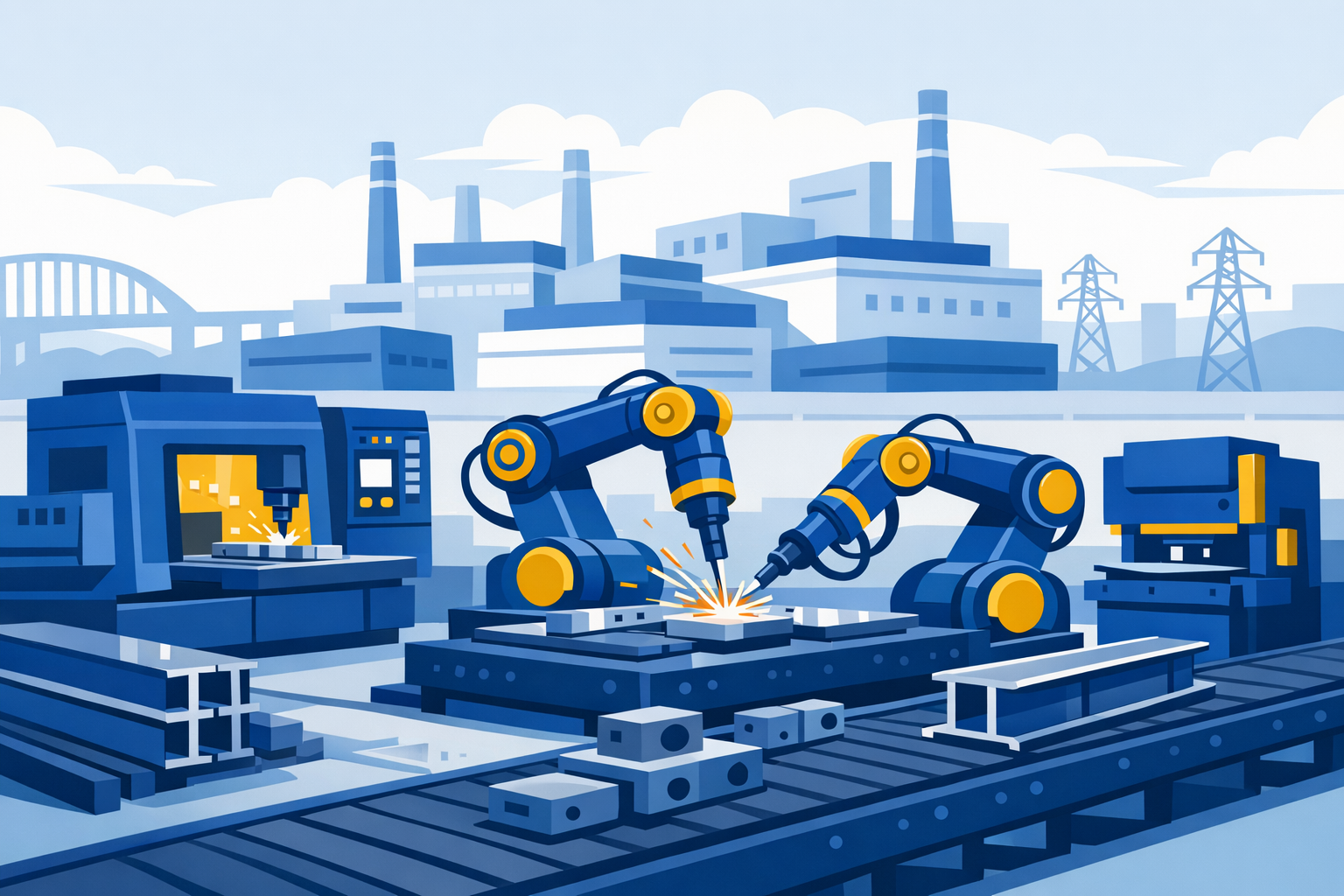
India's metal fabrication sector is scaling rapidly under a confluence of public infrastructure mandates, foreign direct investment, and accelerating automation adoption, positioning the country as a credible alternative production base for global component buyers.
According to Mordor Intelligence, the India metal fabrication market is valued at USD 8.03 billion in 2025 and is projected to reach USD 11.56 billion by 2031, growing at a CAGR of 6.32% over the 2026-2031 period. The expansion rests on large public capital programs in rail, energy, and defence, alongside a structural shift toward automated, precision-driven production across the country's western and southern industrial corridors.
Background
India's fabrication sector has historically been characterized by labor-intensive processes and fragmented supply chains. That profile is changing materially under sustained government policy. The Production Linked Incentive (PLI) scheme, launched in 2020 with a $24 billion budget, targets 14 critical manufacturing sectors, according to the U.S. Trade and Investment Mission. Combined with the Digital India program, these initiatives contributed $165.1 billion of investment into India's manufacturing sector in 2024.
The government's Samarth Udyog 4.0 (SAMARTH) program targets Industry 4.0 adoption in capital goods manufacturing. As part of the initiative, five Centres of Excellence dedicated to smart manufacturing have been established, according to Invest India, demonstrating real-world applications of automation, robotics, and data-driven production. The PM GatiShakti Mission, a digital platform integrating planning across 16 key ministries, covers 293 infrastructure projects valued at approximately $163 billion, strengthening connectivity between manufacturing zones, logistics hubs, and industrial clusters.
Details
The automation transition is measurable. According to the World Robotics 2024 report by the International Federation of Robotics, India ranks seventh worldwide in annual robot installations - a significant marker for an economy until recently dominated by manual fabrication labor. The country's industrial robotics market is projected to reach approximately $264 million by 2028, according to Invest India.
Machining services dominate the revenue mix: machining held 34.28% of 2025 service-type revenue in India's metal fabrication sector, according to Mordor Intelligence, anchoring high-precision workloads in power generation, oil and gas, and defence applications where tight dimensional tolerances and formal process control documentation are procurement prerequisites. Southern India is expected to advance at a 7.33% CAGR through 2031, outpacing the national rate, driven by aerospace cluster development and EV manufacturing investment.
Defence and aerospace fabrication is attracting structured, high-value orders. Dassault Aviation and Tata Advanced Systems signed production-transfer agreements for Rafale fuselage assemblies in 2025, with a greenfield site targeted to deliver 24 fuselages per year from FY 2028, according to Mordor Intelligence. In November 2024, the Raghu Vamsi Group committed INR 300 crore to construct a precision manufacturing facility in Hyderabad, incorporating advanced CNC machining and sheet metal fabrication capabilities to serve the aerospace and defence supply chain.
Renewable energy is generating large structural steel orders. India's solar module manufacturing capacity nearly doubled from 38 GW in March 2024 to 74 GW by March 2025, creating sustained procurement demand for mounting structures, modular racks, and galvanized steelwork. Domestic crude steel output reached 235 million tonnes by November 2025, against a policy target of 300 million tonnes by 2030.
The shift is also attracting global automation suppliers. ABB confirmed in early 2026 a $75 million investment in India to expand manufacturing and R&D capacity, building on more than $35 million invested in the country in 2025.
For international procurement managers and supply chain engineers, the implications extend to sourcing strategy. Global manufacturing companies are increasingly focusing on diversifying their production by setting up low-cost plants in countries such as India, according to Research and Markets. As suppliers align operations around long-cycle capital orders requiring ISO 3834-2 welding quality compliance and formal Procedure Qualification Records (PQR), component pricing and lead-time dynamics are shifting in favor of buyers who establish qualified vendor relationships early.
Outlook
As India's fabrication base scales into higher-certification tiers - AS9100, NADCAP, and EN 1090 - it stands to compete not only on unit cost but on process traceability and quality documentation, areas that have historically differentiated European and North American suppliers. Data center infrastructure is set to add another demand layer: India's data center power capacity is charted to grow from a 1.4-1.8 GW range in late 2024 to 3.5-4.5 GW by 2030, absorbing USD 20-25 billion in investment, generating orders for modular steel superstructures and equipment skids. Procurement teams evaluating India-based fabricators should assess supplier certification pipelines and automation investment levels as leading indicators of delivery reliability through 2034.