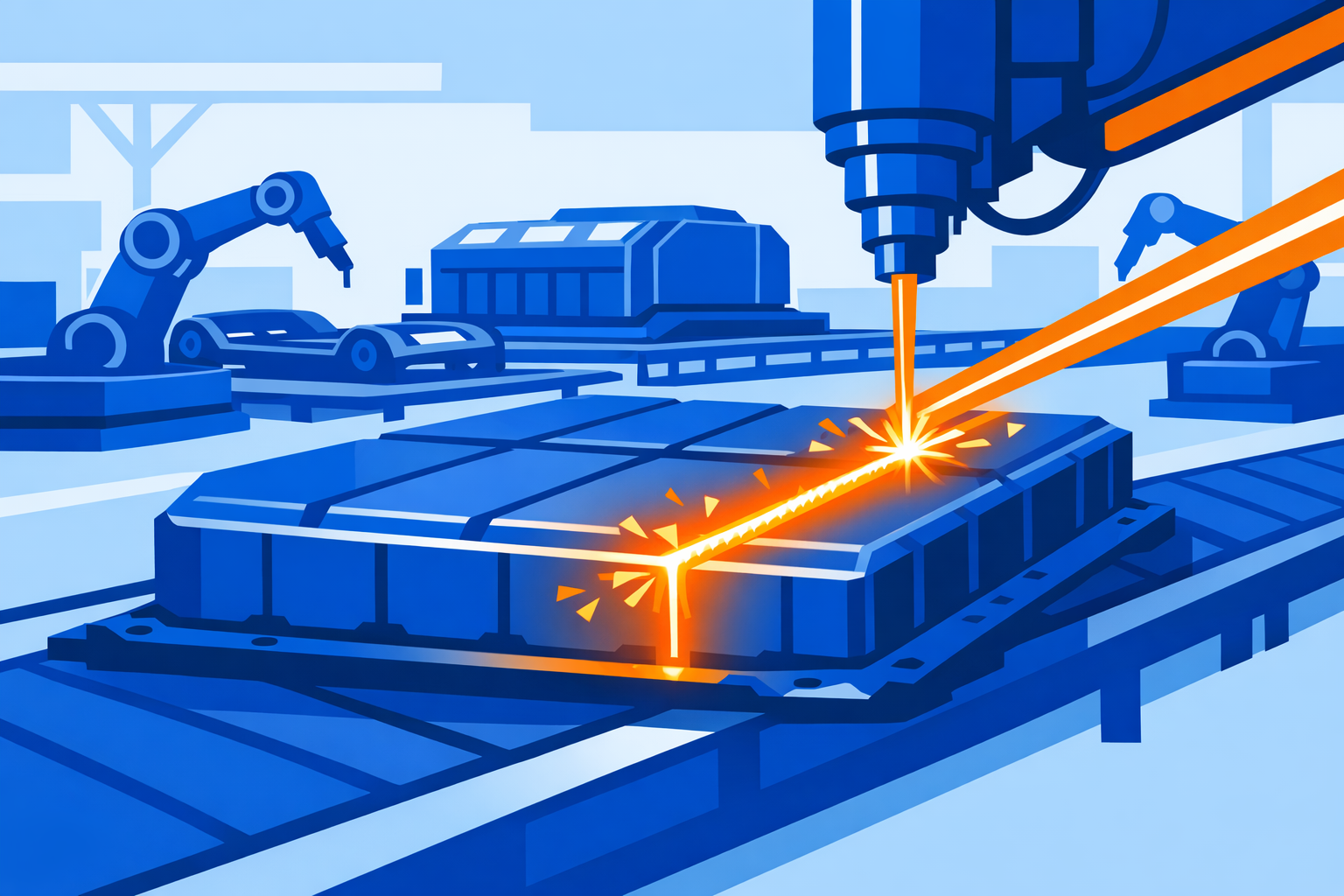
Advanced laser welding technologies are delivering measurable gains in throughput and joint quality across electric-vehicle battery and chassis manufacturing, as new equipment releases, process innovations, and cross-platform data standards converge to accelerate adoption among automakers and tier suppliers. The shift is driven by the structural demands of lithium-ion battery enclosures, where hermetic seal integrity and dimensional precision are non-negotiable at production scale.
Background
The automotive laser welding system market was valued at USD 1.25 billion in 2024 and is projected to grow at a compound annual growth rate of over 4.8% through 2034, according to market research firm GM Insights, with electric-vehicle assembly representing the primary growth vector. The broader industrial laser welding market reached USD 2.9 billion in 2025, with automotive applications accounting for 38% of that total, driven by demand for precision joining of aluminum and copper in battery packs and body-in-white structures.
The technical case for laser welding in EV production rests on physics. Lithium-ion batteries' mechanical sensitivity and enclosure assemblies' structural complexity require welding technologies that deliver high repeatability, precision, and strength while maintaining short cycle times and consistent quality under mass production conditions.[1] A battery enclosure must form a hermetic seal: any porosity, crack, or incomplete fusion in the weld seam creates a pathway for electrolyte leakage, moisture ingress, or structural failure-consequences ranging from capacity degradation to thermal runaway.
Unlike structural welds in chassis or bodywork, battery enclosure welds cannot be visually inspected after assembly without destructive testing. The weld is typically the last manufacturing step before a cell is sealed and electrolyte-filled, meaning any latent defect propagates through the entire downstream value chain before detection in the field.
Equipment Innovations Drive Process Capability
Several equipment developments are expanding what laser welding can achieve inside complex battery geometries. Researchers at the Fraunhofer Institute for Material and Beam Technology (IWS) in Dresden recently unveiled a process that uses dynamic beam shaping to eliminate filler wire while producing crack-free, low-porosity seams. The technique controls the melt pool, reduces pores, and stabilizes welds. According to Axel Jahn, head of the joining department, even the most challenging welding tasks-such as joining hard-to-weld alloys or thick sections-can now be carried out robustly and efficiently, with reduced energy consumption, material use, and post-processing.
The team validated the approach at full component scale under the EU-funded ALBATROSS initiative, welding aluminum enclosures combining 6000-series extrusion profiles with die-cast elements at wall thicknesses up to five millimeters-a material pairing long considered problematic because "die casting often causes pores, and 6000-series extrusions are susceptible to hot cracking."
For enclosures with complex internal geometry, Scansonic's ALO4 optics family addresses weld-position accessibility. For vertical seams in enclosure corners, the ALO4-F version employs an additional 115° deflection mirror, allowing the laser beam to reach otherwise inaccessible weld seams.[2] All optics within the ALO4 family use a shared control architecture that detects which variant is connected and automatically loads the appropriate parameters, simplifying changeovers and ensuring process consistency. The standardized design also reduces maintenance requirements and streamlines spare parts management.[3]
On the systems side, Coherent launched its WELD1D+ processing head in September 2025, compatible with lasers up to 10 kW and incorporating API control for enhanced flexibility and automation in EV battery and large automotive assembly applications. IPG Photonics has deployed its Adjustable Mode Beam (AMB) dual-beam technology, which virtually eliminates weld defects such as spatter without compromising welding speed. IPG's On-The-Fly welding technology creates precise weld seams while the process head is in motion, enabling speeds that often exceed 10 cells per second.
In-Process Monitoring and Data Integration Gain Traction
Quality assurance has emerged as a parallel focus. Manufacturers pursuing high-throughput, defect-free battery assembly must simultaneously address process parameter stability, material variability, joint geometry tolerance, and in-process quality verification-often at cycle times measured in seconds per enclosure. IPG's systems include optional real-time weld measurement that directly measures every weld as it is made, enabling 100% quality assurance. The patented in-process monitoring technology eliminates the need for time-consuming destructive post-weld testing and tracks weld dimension data to flag process drift.
Standardized communication protocols are becoming central to integration strategies. Manz AG's BLS 500 laser welding platform leverages OPC UA for machine-to-machine data exchange across production lines. OPC UA offers the advantage that security mechanisms are already integrated into the communication stacks, providing built-in security capabilities. The company's CAD-driven Smart Laser Assistant tool automatically determines optimal path planning and laser power for each weld point. Manz's Stephan Lausterer noted that "our programming tool makes it much easier to adapt the BLS 500 to diverse applications, for example, to different cell types and module formats," adding that "commissioning is accelerated and simplified by the fact that using the model, the control program can be tested in detail and realistically in advance, before the machine has actually been mechanically assembled."
Outlook
Fiber laser systems hold a dominant position in automotive adoption and are projected to grow at a CAGR of 6.1% through 2034, driven by superior beam quality, efficiency, and compatibility with lightweight dissimilar-material joining in EV battery enclosures, according to GM Insights. Blue and green laser wavelengths are forecast to capture 45% of EV battery applications by 2030, despite carrying 30% higher equipment costs, due to superior performance when welding copper. For procurement and engineering teams, the near-term pressure points are system integration-aligning new laser cells with existing MES and quality management infrastructure-and workforce upskilling to operate increasingly software-defined welding processes.