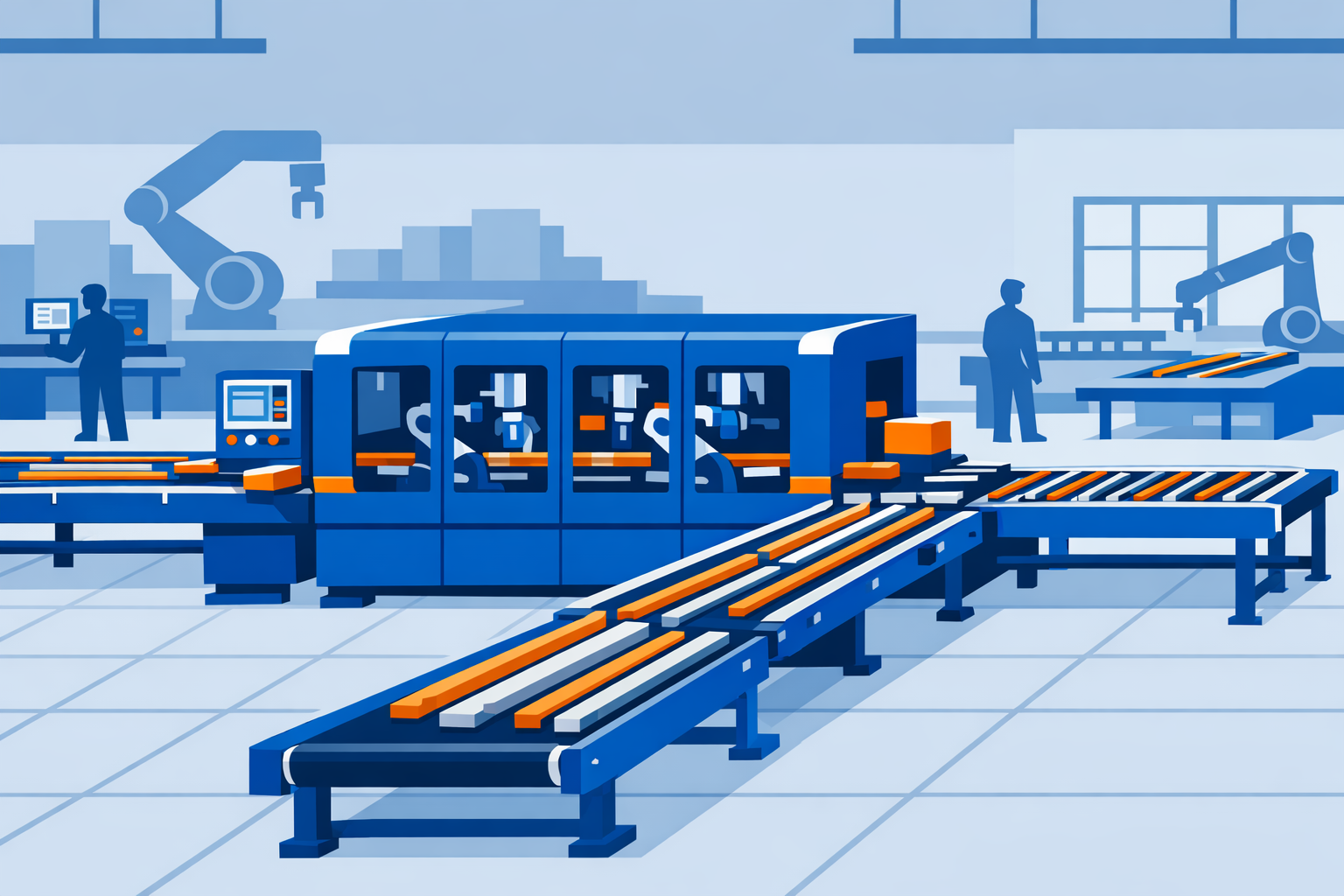
Custom die sets have long been the silent tax on insulating glass fabrication-capital-intensive, wear-prone, and a persistent source of unplanned downtime. PDS IG, LLC's newly launched fully automated Muntin Machining Center directly challenges that model, offering a case study in what end-to-end automation looks like when designed from the ground up to eliminate legacy cost centers rather than simply replicate them with robotics.
The launch arrives as the broader fenestration and glazing sector navigates an inflection point: ERP and MES platforms have matured to the point where machine-level data can be consumed and acted upon in near-real-time, yet fabrication equipment has often lagged behind. PDS IG's system narrows that gap for one of the most labor-intensive sub-processes in IG unit production.
What the System Does
PDS IG, LLC announced its fully automated muntin fabrication system, a complete solution for processing both contour and flat bars-including two-tone materials-while removing the financial burden of traditional punches and dies.
The Muntin Machining Center is a three-axis CNC that cuts and punches muntin bars, eliminating the need to change expensive dies that wear out on conventional machines.
The tooling philosophy marks a notable departure from conventional practice. By utilizing off-the-shelf precision endmill routing technology, the system lowers operational overhead and simplifies routine maintenance. Manufacturers no longer need to invest in or maintain custom tooling; a single standard endmill bit performs miter fish mouth cuts, lap joints, and end cuts.
The machine includes an automated muntin feed for 152-inch bars, handling both rectangles and contours with two-tone capabilities. The line also includes an explosion-proof vacuum system.
"We wanted to design a machine that eliminates the high costs and headaches associated with traditional custom dies," said Dave Rapp, CEO at PDS IG, LLC, according to Window + Door magazine[1].
PDS IG's broader product portfolio spans the full IG assembly sequence-from spacer application and glass flipping stations through secondary sealing robots-meaning the Muntin Machining Center is intended to slot into an already-integrated line architecture rather than operate as a standalone island.
The ERP/MES Integration Imperative
The hardware specification is only part of the story. For fabricators running high-mix production lines, the real value of automation lies in how cleanly systems communicate with upstream scheduling and downstream quality data.
The fenestration industry faces persistent challenges-functional inefficiencies and project delays-that often stem from fragmented processes, lack of data access, and communication gaps across departments. A CNC muntin center operating as a data island compounds rather than resolves this problem.
Comprehensive ERP and MES platforms for fenestration manufacturers now manage glass fabrication, assembly, quoting, and production scheduling, with advanced machine integration and real-time production traceability enabling fully automated operations. The critical question for any new equipment investment: can the machine controller consume work-order data directly from the MES-eliminating manual data re-entry-and push production counts and fault codes back into the ERP without custom middleware?
Integrated software systems that precisely match muntins with cut glass and spacer sizes reduce work in process. Combined with one-touch remakes and rush units for quick turnaround, these capabilities represent the operational benchmark fabricators should hold new equipment against. Systems achieving this tight sequencing can meaningfully compress cycle time across the full IG unit, not just at the muntin station.
As artificial intelligence and IoT technologies evolve, ERP solutions are expected to offer predictive analytics and more intelligent automation capabilities, further optimizing manufacturing processes and supporting sustainable practices while positioning the industry for long-term growth.
Scrap, Rework, and Consistency Gains
The shift from die-based punching to CNC endmill routing carries direct implications for dimensional consistency-and by extension, downstream rework rates.
Traditional custom die sets degrade over production cycles, introducing progressive dimensional drift in notch geometry that may go undetected until units reach assembly or, worse, field inspection. Without automation, switching between different muntin bar assembly sizes may require operators to obtain different stock, manually swap jigs and tooling, and absorb extended downtime-downtime that increases as manufacturers and consumers demand more customized products.
A standardized endmill approach, by contrast, defines geometry in software-meaning a profile change is a parameter update, not a tooling changeover. Defective components sorted out before processing into insulating glass units save material, reduce scrap, and prevent costly rework on finished IGUs. This principle applies equally to muntin bars entering the assembly station. When dimensional accuracy is guaranteed upstream, downstream inspection becomes confirmatory rather than corrective.
Factory-based fabrication methods are generally faster, more cost-effective, and benefit from controlled conditions and rigorous quality control-advantages amplified when automation removes operator-dependent variability from the equation entirely.
Strategic Implications for High-Mix Fabricators
PDS IG's launch is most instructive when read as a template for how architectural component fabricators should approach automation investment decisions in high-mix environments.
Several principles emerge:
Eliminate tooling categories, not just operators. The most durable cost reduction in the PDS IG system is not headcount-it is the removal of the die procurement, storage, and maintenance burden from the operating model entirely. Fabricators evaluating competing systems should ask what categories of recurring cost disappear, not just what tasks are automated.
Standardize on off-the-shelf consumables. Using a standard endmill rather than proprietary dies means replacement parts are available from multiple suppliers, lead times are short, and there is no single-source risk on a critical consumable. This principle applies broadly to robotics and automation selection.
Scope integration before specifying hardware. Glazing software bridges design, production, and supply chain management to enhance efficiency and precision-from comprehensive ERP systems to modular optimization tools, solution alignment is critical. Equipment that cannot exchange data with existing MES/ERP infrastructure requires compensating manual workflows that erode much of the efficiency gain.
Model scrap reduction as a primary ROI driver. Labor savings are visible and easy to quantify, but scrap and rework reduction frequently delivers comparable or greater financial impact-particularly on value-added architectural profiles and two-tone materials where raw material costs are elevated.
Evaluate the full line, not the station. Building high-speed, highly automated, and cost-effective solutions for the insulating glass and window fabrication industries requires assessing how a new station affects throughput and buffer inventory at every adjacent process step. A fast muntin center that outpaces a manual sealing operation creates a new bottleneck rather than eliminating one.
Takeaways for Manufacturers Considering Turnkey Automation
PDS IG's Muntin Machining Center illustrates a maturation in IG fabrication automation: the emphasis has shifted from automating individual motions to eliminating entire cost categories-custom tooling, die changeover downtime, and geometry drift-through software-driven process control.
For plant managers and process engineers assessing similar investments, the evaluation framework should extend well beyond cycle time comparisons:
- Map current tooling total cost of ownership, including procurement, storage, wear replacement, and changeover labor-this is the baseline the new system must beat.
- Audit MES/ERP data outputs to confirm the machine controller can ingest work-order data and return production telemetry without custom integration work.
- Quantify current rework rates at downstream stations attributable to muntin dimensional variability-this scrap reduction figure belongs in the business case.
- Assess profile range requirements over a three-to-five-year horizon, accounting for product line expansion, to ensure the system's parameter-based geometry capability covers anticipated SKU growth.
- Confirm consumable supply chain independence-systems dependent on proprietary tooling introduce procurement risk that partially offsets the die-elimination benefit.
End-to-end automation in architectural glazing supply chains is no longer a greenfield aspiration. Systems like PDS IG's Muntin Machining Center demonstrate that the technology is available, the tooling economics are favorable, and the integration pathways-via established fenestration ERP/MES platforms-are well-mapped. The remaining variable is execution discipline at the fabricator level.
For a broader look at how vision-guided robotics and MES integration are reshaping high-mix metal fabrication environments, see Vision-Guided Robotics, MES Integration Reshape High-Mix Metal Fabrication.