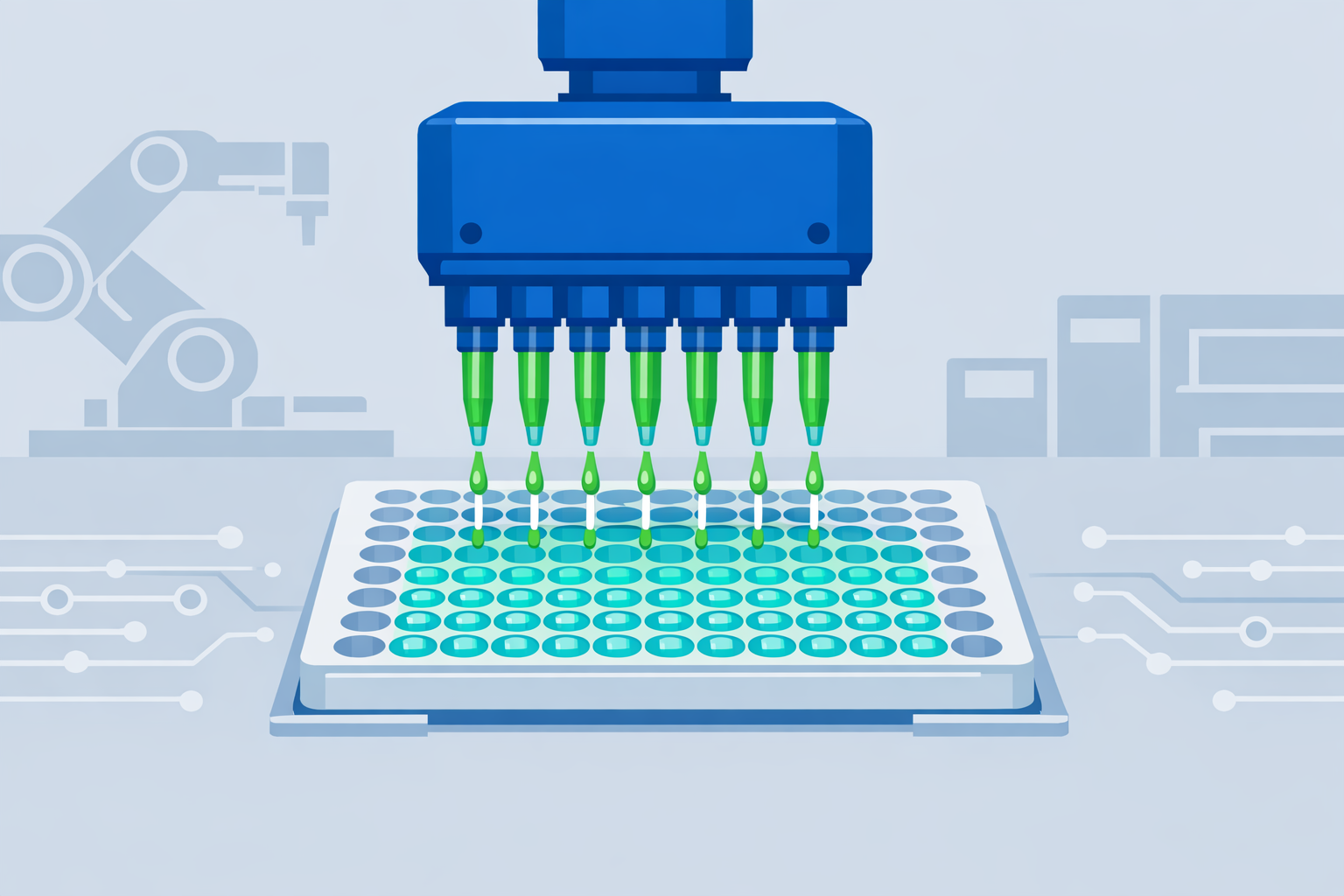
A new robotic liquid-handling method for hydrogel fabrication is advancing automation from laboratory research to manufacturing pipelines. Researchers have developed HYDRA (HYDrogels by Robotic liquid-handling Automation), a system that produces uniform, planar hydrogel films in standard microplate formats through automated dispensing and re-aspiration. Implemented in December 2025, HYDRA utilizes a commercial liquid-handling platform (Assist Plus, INTEGRA Biosciences) and automated protocols for 96- and 384-well plates. The HYDRA method achieved physiologically relevant shear moduli (500 Pa to ~3 kPa) and reproducibly formed thin hydrogel layers within minutes per plate; automated fabrication was completed in about 10 minutes, well under the ~40-minute gelation onset, according to Communications Engineering.[1]
Background
Hydrogel coatings in high-throughput screening (HTS) plates frequently create curved menisci, complicating cell seeding and imaging. HYDRA addresses these issues by dispensing a controlled sub-contact volume of gel precursor and re-aspirating it immediately to form a flat, uniform film. Researchers used cold-water fish gelatin, enzymatically crosslinked, selected for its low viscosity at room temperature and compatibility with robotic pipetting. This approach allows direct integration with existing HTS and imaging systems without requiring additional capital investment.[1]
The laboratory automation sector is increasingly adopting modular, AI-enhanced liquid-handling systems integrated with Laboratory Information Management Systems (LIMS) or Manufacturing Execution Systems (MES). Automated liquid handlers reduced turnaround times by approximately 35 percent across 2,300 European pathology laboratories in 2023, with LIMS integration rising 40 percent from 2022 to 2024. These solutions offer scalability, traceability, and reduced reagent usage.[2]
Details
HYDRA employed Integra's Assist Plus robotic system equipped with 8-channel pipettes to dispense and re-aspirate 12 µL of gelatin-TG precursor per well. Rheological testing confirmed that variations in gelatin concentration and crosslinker content produced stiffness levels meeting physiological standards: G' values rose from 500 Pa to ~2 kPa as TG concentration increased from 0.5 percent to 2 percent, aligning with skin tissue properties and cell-culture requirements.[1]
In 384-well formats, volumes were reduced to 1 µL per well, with automated quality control imaging to assess wall contact and homogeneity. Full plate analysis was completed in under two hours using fluorescence imaging and intensity metrics.[1]
Across the industry, automation trends include AI-driven workflows, cloud-based control, and modular platform architecture. These features support digital traceability, compliance, and robust data exchange with LIMS and MES, facilitating reproducible production beyond laboratory settings.[3]
Outlook
HYDRA supports HTS-compatible, scalable hydrogel manufacturing designed for GMP compliance and MES integration, suitable for pharmaceutical, cosmetic, and medical device production. Compatibility with standard automation platforms bridges laboratory workflows and pilot-scale reproducibility. Future developments are expected to extend HYDRA to 1,536-well formats and enhance alignment with regulatory traceability frameworks for broader cross-sector adoption.