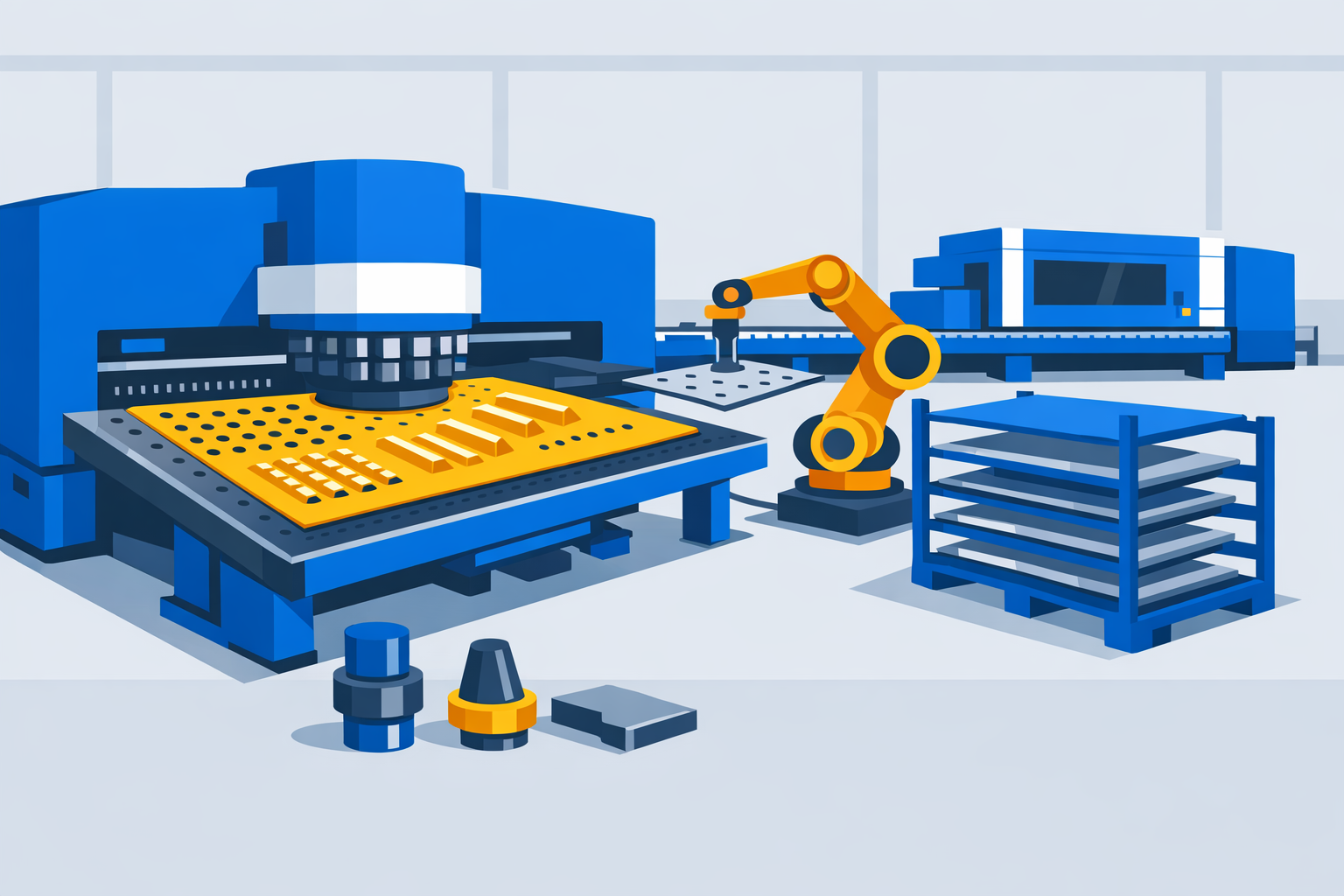
For years, the narrative in sheet metal fabrication has trended in one direction: laser dominance. Fiber laser technology drove down cutting cycle times, eliminated tooling lead times for new profiles, and offered the flexibility to switch from stainless to aluminum without a setup change. Yet a counternarrative is gaining traction on shop floors handling high-mix, low-to-mid-volume work - and it centers on a technology that predates modern laser cutting by decades.
CNC turret punching is reasserting itself. Not as a nostalgia play, but as a hard-nosed economic and operational choice for fabricators under margin pressure, managing volatile order books, and producing parts with perforations, formed features, or repetitive hole patterns that laser systems handle inefficiently.
The Market Conditions Driving a Reassessment
Several converging forces are pushing fabricators to revisit their process mix:
Automotive lightweighting continues to generate demand for brackets, enclosures, and structural panels in thinner aluminum and high-strength steel gauges - precisely the material thicknesses where turret punching operates most efficiently. Punching performs best on materials between 0.020" and 0.250" thick, a range that maps directly onto the sheet gauges most commonly specified in automotive sub-assembly and EV battery enclosure work.
Energy cost pressures are making the running-cost gap between the two technologies increasingly visible on the P&L. A turret punch press consumes roughly 3 kWh per hour, whereas a laser cutter can consume approximately 40 kWh per hour. For shops running double shifts or pursuing unattended night operations, that differential compounds rapidly.
Capital discipline is tightening as demand volatility discourages large machine investments. A punch press carries considerably lower upfront cost compared to a laser and can perform operations a laser cannot. Turret presses also routinely deliver 25-30 years of productive service life. That lifecycle argument grows increasingly persuasive when facilities teams must defend capex allocations.
Demand for formed features is rising in sectors like HVAC, server infrastructure, and industrial enclosures - products requiring louvers, knockouts, embossed stiffening ribs, and tapped extrusions that a laser simply cannot produce. Laser cutting excels at flat-profile work but lacks the forming versatility turret punching offers, such as creating louvers or countersinks. Shops without a punch press currently rely on secondary operations - press brakes, single-station stamping dies - to create these features, adding cost and floor time that a turret press consolidates into a single cycle.
Process Economics: Where Turret Punching Wins
The cost comparison between turret punching and laser cutting is highly part-geometry-dependent. The decision is rarely clear-cut, but the edges of the decision matrix are well defined.
On dense perforation patterns, the punch press holds a decisive throughput advantage. A 10-gauge mild steel part with a thousand 0.500 in. diameter round holes can be punched using a 12-hole cluster tool in less than a quarter of the time a laser requires. For round-hole perforations specifically, a punch press can operate at roughly 10× the speed of a laser.
On design-revision risk, the laser retains an advantage. If engineering requests a 0.125" shift in hole position after tooling is purchased, punching may require a $1,200 new tool, while laser cutting requires only a CAD file update at zero cost. This trade-off diminishes significantly for parts with stable, standardized geometries.
The following table summarizes key performance differentials across common evaluation criteria:
{{component:turret-vs-laser-table}}
Note on hybrid configurations: Some fabricators deploy punch-laser combination machines that handle both standard perforations and complex contours on a single platform without repositioning. These systems combine turret punching with high-speed fiber laser cutting, enabling punching, forming, tapping, and laser contouring on one machine - ideal for fabricators producing a mix of complex and standard parts while eliminating costly secondary processing.
{{component:when-punch-wins-callout}}
Automation Configurations: From Standalone to Flexible Cell
The punch press's competitive position improves substantially when automation is layered in. By integrating material handling systems, the press evolves from a standalone unit into a fully automated 24/7 production cell. Robotic arms or gantry loaders retrieve sheets from storage, feed the machine, and unload finished skeletons and panels - all without human intervention.
Advanced CNC turret punch presses now integrate with robotic arms, forming automated sheet metal fabrication cells that combine punching, bending, and stacking. This positions the turret press as the front-end anchor of a flexible manufacturing cell, with downstream press brakes, fastener insertion equipment, and robotic bending arms receiving parts in a coordinated flow.
For shops considering this cell architecture, the following implementation path reflects current best practice:
{{component:automation-steps}}
The servo-electric drive platform is central to these configurations. Servo systems offer substantial energy savings over older hydraulic models because the machine draws power only when the punch is actively cycling - idle time consumes no energy. The result is significantly lower overall energy consumption and a more cost-efficient operation.
Servo-driven machines also contain fewer wear-prone components than hydraulic systems, reducing maintenance costs and extending machine life. Eliminating hydraulic circuits removes oil maintenance requirements, coolant chiller costs, and the repeatability issues that arise from hydraulic fluid temperature variation.
Workforce and Maintenance Implications
Reintroducing or expanding turret punch capacity carries workforce implications that operators should plan for explicitly.
Tool management is the most critical skill gap in shops transitioning from laser-heavy environments. Unlike laser processing - where a CAD file change is the only required intervention - turret punching requires operators to maintain a physical tool library, understand punch-to-die clearances for different materials, monitor tool wear, and manage regrinding schedules. Intelligent tool management via the CNC system can automate much of this work, tracking each tool's lifespan and providing early warnings before wear leads to defects. Modern HMI interfaces simplify the process considerably, but a baseline of punching process knowledge remains essential.
Offline programming proficiency is non-negotiable for high-mix environments. Basic operation is straightforward; advanced programming requires geometry skills and machine-specific knowledge. Shops should invest in CAD/CAM operator training alongside the machine acquisition, not as an afterthought.
Predictive maintenance integration is an emerging differentiator. IoT sensors embedded throughout modern machines monitor condition, temperature, and energy consumption. AI algorithms analyze this data stream to anticipate potential faults and issue early warnings - transforming maintenance from reactive repair to proactive prevention and driving unplanned downtime toward zero.
This connects directly to broader Industry 4.0 strategies: integration with MES and IoT systems enables real-time performance tracking, allowing production managers to monitor punch counts, tool life consumption, and sheet utilization across multiple machines from a single dashboard.
The Automation Roadmap Argument
For fabricators building or rationalizing their automation roadmap, the turret punch press offers a capability profile that laser investment alone cannot replicate. Its forming functions, energy profile, capital cost, and service life create a compelling case for inclusion - not exclusion - on the modern fabrication floor.
The key insight driving shop-floor reassessments: laser and punch are not competing choices for the same work - they are complementary. The fabricators gaining throughput advantage are those routing parts intelligently between processes - laser for complex contour work, prototypes, and specialty materials; turret punch for dense hole patterns, formed features, and stable moderate-run part numbers.
The goal is manufacturing parts at the lowest cost by utilizing a mix of equipment to create the leanest possible downstream flow. Rising costs for electricity, consumables, maintenance, and floor time have made punch presses more attractive than they have been in years.
As demand patterns remain volatile and capital budgets tighten, the turret punch press's combination of low operating cost, multi-operation capability, and automation compatibility positions it not as legacy equipment to be retired, but as a strategic asset worth investing in - and integrating intelligently.
Process Selection Tool
Use the interactive tool below to evaluate whether turret punching or laser cutting is the stronger process fit for a given job specification.
{{widget:process-selector}}
Frequently Asked Questions
{{component:faq}}