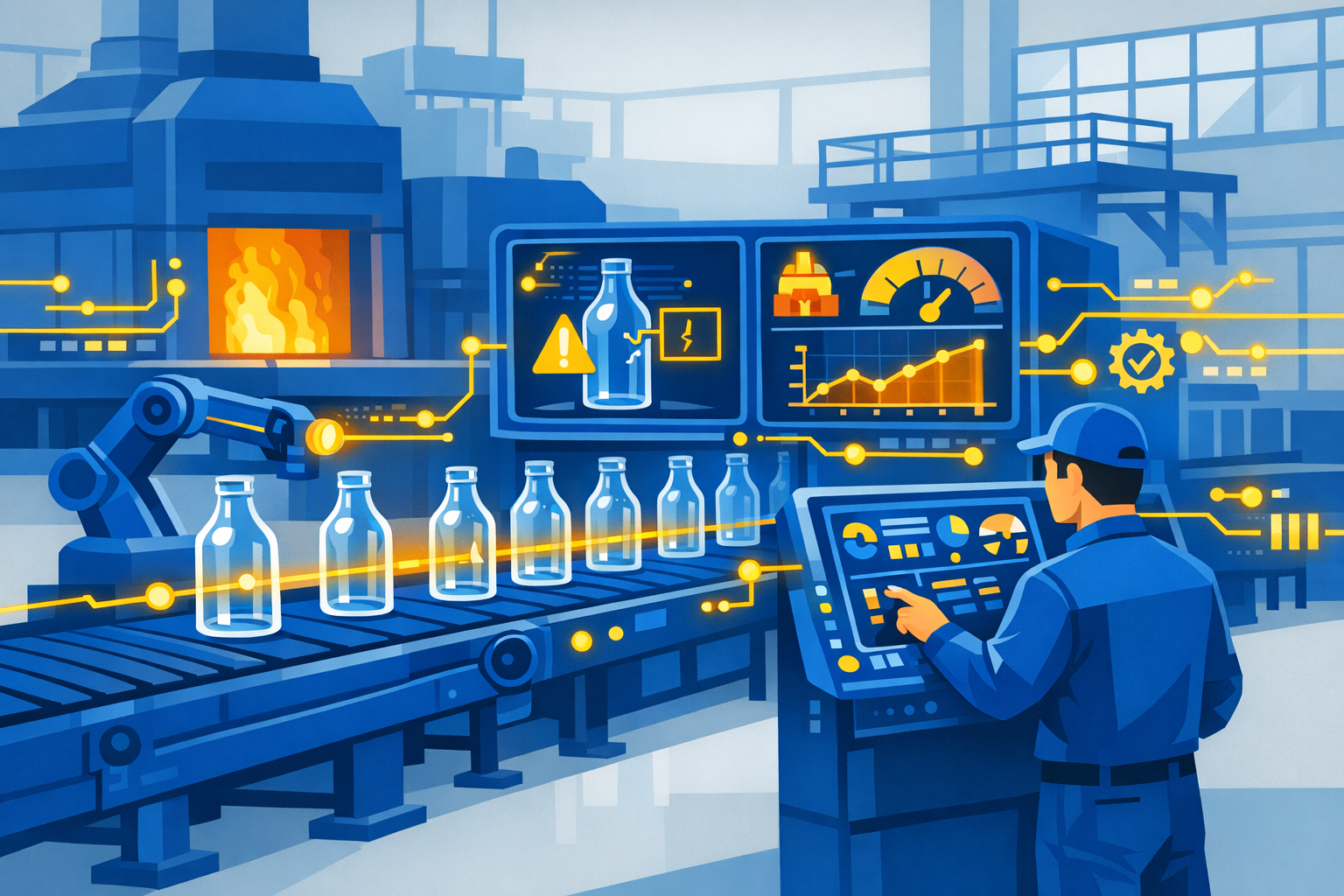
U.S. glass manufacturers are implementing AI-based defect detection and furnace control systems to reduce scrap and cut energy consumption. Recent pilot initiatives report successful integration with manufacturing execution systems (MES) and enterprise resource planning (ERP). Computer vision models provide real-time defect flagging, while AI-managed furnace cycles and airflow optimize energy use. These systems also support technician upskilling and address data governance issues, offering options for on-premises deployment and enhanced cyber-resilience. Reported return on investment ranges from 12 to 18 months, primarily driven by reductions in rework, scrap, and energy usage.
Background
Glass production is highly energy-intensive and susceptible to material waste from micro-defects, such as cracks, inclusions, and coating inconsistencies. Traditional inspection relies on manual methods or rule-based vision systems, both of which struggle to identify transparent and subtle flaws. This results in higher scrap rates, excess energy use, and increased rework. Rising demands for improved yield without increased energy use have accelerated the adoption of machine learning-based, real-time inspection and furnace optimization technologies.
Details
Industry data shows that AI algorithms in glass manufacturing can deliver energy savings up to 20% and waste reduction of about 18%, with annual quality control savings averaging $1.5 million AI algorithms optimize furnace temperatures, achieving energy savings of 20% in glass manufacturing plants; AI systems aid in reducing waste by 18% during the glass production process; AI-based defect prediction models saved an average of $1.5 million annually in quality control costs across the industry[1]. Case studies support these outcomes: AGC's AI-based inspection system achieved more than 95% defect detection accuracy and reduced scrap by over 10%, improving efficiency in precision-focused glass lines AGC's AI-driven quality control system reduced scrap by more than 10% and achieved over 95% defect detection accuracy[2]. Saint-Gobain's AI-assisted furnace management system lowered fuel consumption by high single-digit percentages and improved glass homogeneity through tighter thermal control Saint-Gobain's AI-driven furnace optimization reduced fuel consumption by high single-digit percentages and improved glass homogeneity[2].
Data governance remains a focus area. Solutions offer privacy-preserving models, on-premises hosting options, and upgraded cyber-resilience to protect process data.
Workforce strategies are evolving as technicians adopt AI-enabled quality assurance tools. Operator roles are shifting toward data interpretation, system calibration, and oversight.
Return on investment varies by facility and glass type, but multiple pilots report payback periods of 12 to 18 months, driven by savings in scrap, energy, and rework.
Outlook
Future developments will emphasize improved interoperability with MES and ERP systems and the creation of standardized defect taxonomies to facilitate broader adoption. As AI models are trained on larger, glass-specific datasets, defect detection accuracy is projected to increase, enabling tighter downstream process control for tempering and coating.
Category: Industry